

“Governments will respond with their own countermeasures, creating a spiral of trade conflict,” said Guardian’s financial author, Heather Stewart.
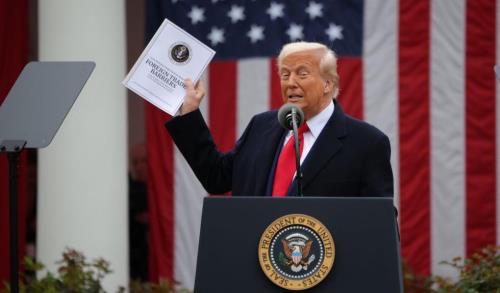
In one of his most prolonged and aggressive speeches, Donald Trump announced from the White House Rhodes Garden the “big return” of protectionism, launching a new “wall” – this time not on the border with Mexico, but on the world trade map.
Its plan provides horizontally imposing import duties from 10% to 40% on products from countries importing to the United States. Its implementation will begin immediately, with the aim – as he said – “the economic liberation of America”.
According to the Guardian’s financial author, Heather Stewart, the president promises prosperity, but the immediate consequences are expected to be high prices for US consumers and enormous uncertainty for businesses. Economic analysts estimate that this decision may trigger a recession in both the US and worldwide as it disrupts the supply chain and opens a new cycle of trade wars.
“People are not going to stay idle,” commented Stewart. “Governments will respond with their own countermeasures, creating a commercial spiral.”
Among the most directly affected countries are Cambodia (49%), Vietnam (46%) and Pakistan (29%), while the European Union is subject to 20%and the United Kingdom at 10%, following a backstage diplomatic approach of Kir Starmer, according to the British.
Trump duties: A plan without predictability
Despite the announcements of creating new jobs and boosting industry, the factor of uncertainty remains dominant. Businesses are reluctant to invest, as no one knows how long the duties will last or whether there will be exceptions.
According to Stewart, Trump’s strategy appears to be based on the challenge of political concessions from third countries through commercial blackmail, and it is not excluded that he will use uncertainty as a pressure tool.
“He has spoken openly about a” transition period “, implying that even the upheaval of markets can be part of the plan,” says the Guardian’s author.
The Trump government hopes to raise up to $ 600 billion a year from the new duties, which it plans to use for tax relief. However, this ambitious plan contradicts the possibility of exceptions or privileged treatment of partners, which intensifies the internal contradictions of the White House strategy.
The Guardian’s analysis concludes with an ominous conclusion: the possibility of a new wave of recession already called “Trumpcession” is much more visible than the “golden age” promised by the president.
With consumer confidence in the US collapsing, mass redundancies in the public by Elon Musk’s new “Ministry of Government Efficiency” and the constant uncertainty to freeze investment, the future of the US economy – and global stability – seems more precise than ever.
“America can make walls, but it is in danger of being isolated in an economical storm of its own conception,” writes Heather Stewart.
Source: lifo.gr