
Baku, Azerbaijan, April 12. The Council of
Europe, established to protect human rights and democracy, has
increasingly become a political tool in recent years. This tool is
primarily used against states that follow sovereign, principled,
and rational policies, especially those that refuse to yield to
false “democracy rhetoric” and political blackmail. Among the
countries most affected by this shift is Azerbaijan, which has
steadfastly restored its territorial integrity, declared its
political subjectivity, and refused to back down in the face of
external pressure.
The latest remarks by the President of the Parliamentary
Assembly of the Council of Europe (PACE), Theodoros Rousopoulos,
marked a peak in this degeneration. His aggressive, even hysterical
rhetoric against Azerbaijan’s President demonstrates not only
diplomatic failure but also deep internal political crises within
the Council of Europe.
“We are not afraid of other dictators,” Rousopoulos stated. Such
expressions are unbecoming of the head of an international
parliamentary organization, showing a lack of ethics, decorum, and
morality. It contradicts the spirit of the Council of Europe’s
Statute and its fake statements. Publicly branding the
democratically elected president of a sovereign state as a
“dictator” is not human rights advocacy—it’s a form of political
blackmail and terrorism.
At a time when Western institutions have lost credibility,
countries like Azerbaijan have become pillars of stability, energy
security, and political independence.
Rousopoulos falsely claims that the PACE only sought permission
to visit the Lachin Corridor and prisons. The reality is that for
years, the Assembly has presented the Karabakh conflict solely from
an Armenian perspective, consistently overlooking Azerbaijan’s
territorial losses, ethnic cleansing, and the destruction of
numerous cities and villages. Why has PACE never condemned the
systematic destruction of Azerbaijan’s cultural and religious
heritage in Aghdam, Shusha, Fuzuli, and Zangilan? Why has it never
demanded an account from Armenia about the fate of more than 3,800
missing Azerbaijanis, many of whom were prisoners of war and
subsequently disappeared?
In January 2024, over 30 proposals were submitted at PACE,
primarily by French and Belgian MPs, suggesting sanctions on
Azerbaijan for its use of force in Karabakh. These documents are
part of the Assembly’s official archives, further proving that
decisions to punish Azerbaijan after its victory in Karabakh are
politically motivated.
Rousopoulos also falsely claimed that President Ilham Aliyev is
refusing to implement the decisions of the European Court of Human
Rights (ECHR). However, he failed to provide any concrete examples.
On the other hand, we can recall the 2015 ECHR ruling in the
“Chiragov and Others v. Armenia” case, which stated that Armenia
must compensate Azerbaijani refugees from occupied territories.
Yet, Armenia openly disregarded this ruling, and the Council of
Europe did nothing. Why didn’t they impose sanctions on Armenia?
The answer is simple: double standards. This further underscores
that the Council of Europe has transformed from a principled
institution into a selective body driven by political agendas.
Who is Theodoros Rousopoulos? A former journalist, a member of
Greece’s New Democracy Party, and known for his sympathy toward the
Armenian lobby and his hardline anti-immigrant stance, Rusopulos is
a political figure whose rise to PACE’s presidency was achieved not
through democratic processes but behind-the-scenes agreements. It
is worth noting that Rusopulos was involved in a corruption scandal
in Greece in 2004 when he was the government’s spokesperson,
participating in efforts to conceal information about corruption
from the media. Now, this person speaks of law and justice…
“We are not afraid of Baku,” Rousopoulos says. Yet, fear drives
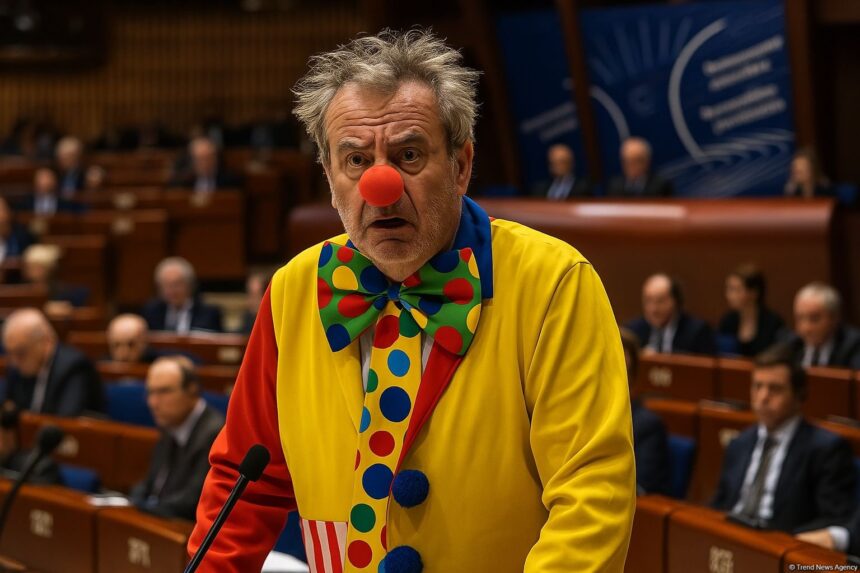
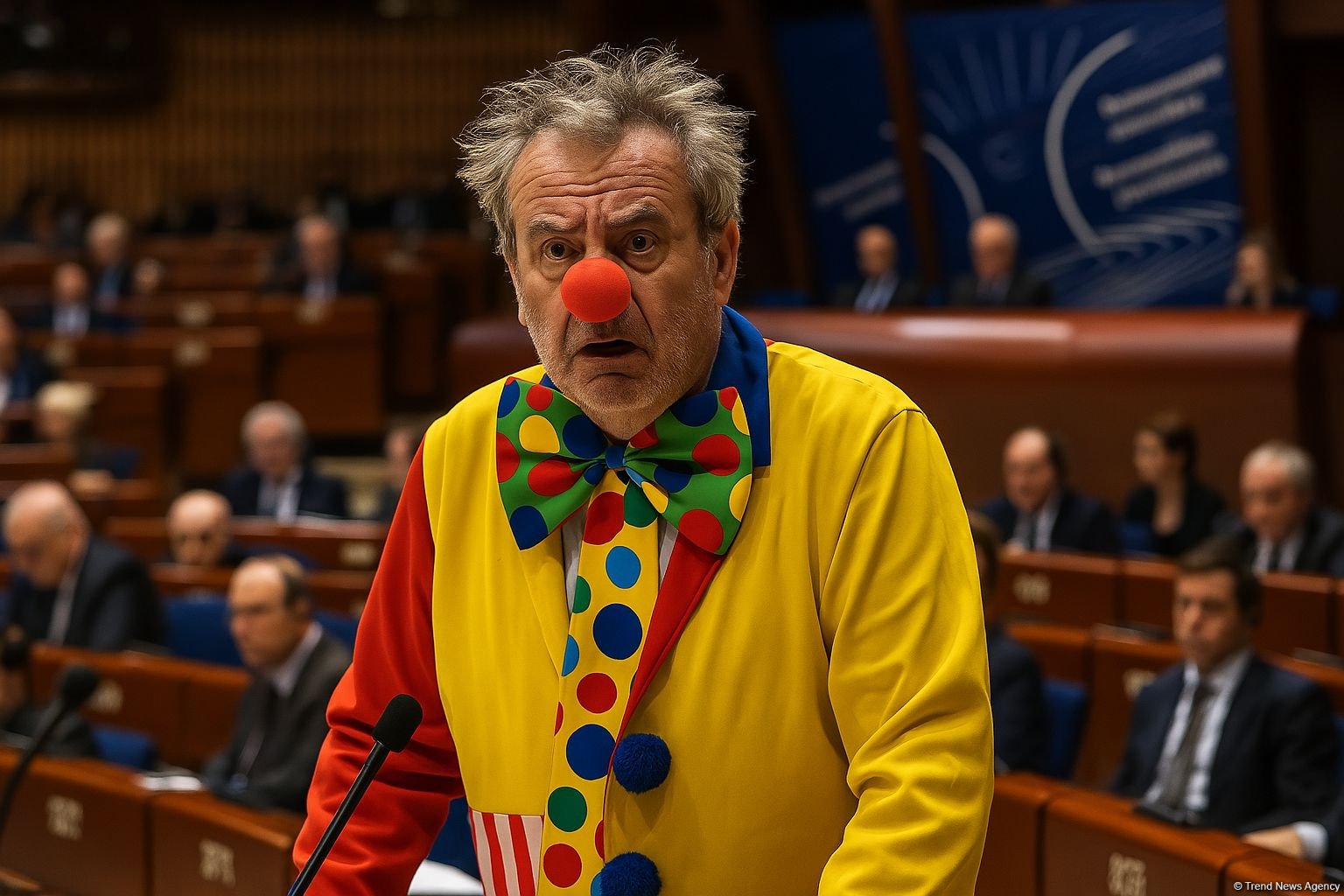
him to break diplomatic norms, engage in political buffoonery, and
behave rudely. It is the fear of Azerbaijan’s growing international
influence, energy resources, strategic position, and independent
policy. Instead of accepting this reality, Rousopoulos attempts to
cover it up with emotional outbursts. As a failed representative of
Western elites, he presents his personal insecurities as a
“principled stance.”
Today, PACE is no longer an institution but a staged theatrical
performance. There is no equality in this theater—only directors
and puppets. Rousopoulos is a bad director: shouting, accusing,
lying, but the audience is increasingly dwindling. Azerbaijan is
one of the first countries to leave this theater with its head held
high. President Ilham Aliyev was right: the world is indeed
changing. This is the era of sovereignties. It is an era where the
old, hypocritical, and neo-colonial approaches hidden behind the
mask of the “Council of Europe” are no longer relevant. Azerbaijan
will no longer play by these rules.
In his speech, Rousopoulos claims that Azerbaijan has refused to
cooperate with the Council of Europe for two years. However, he
forgets that during these two years, PACE has engaged in political
pressure rather than cooperation. No inquiry, statement, or
delegation aimed at objective evaluation took place. The reports
and resolutions were based on pre-written scripts, formed in
Armenian-friendly centers in Brussels and Paris. As French MP
Jacques Mer put it, “The Council of Europe has become a tool for
fighting the ‘undesirable’ rather than a forum for dialogue.
Azerbaijan was the first victim, but it certainly won’t be the
last.”
An understanding is forming within the Council of Europe that
Azerbaijan is being punished not for its actions but for its
principles. Azerbaijan refused to be an object. It refused to ask
for permission to breathe.
If Rousopoulos truly cares about human rights, he should look at
the reports released before 2020 by organizations like the UN,
Amnesty International, and Human Rights Watch regarding Karabakh.
These documents highlight ethnic cleansing in Khojaly, Shusha, and
Kalbajar, mass graves discovered in Khojavend and Fuzuli, and the
destruction of mosques turned into pigsties. Not a single PACE
body, including the Parliamentary Assembly, has ever sent a mission
to investigate these crimes. Isn’t this political blindness and
bias?
The reality is that PACE’s hysteria over human rights is tied
not to law but to geopolitical interests. The real reason is energy
and strategic concerns. Azerbaijan no longer accepts the old
European conditions of “play by our rules, or we won’t let you into
the club.” Instead, Azerbaijan sets its own terms, opens new
corridors, exports gas, invests in the Turkic world and Central
Asia, and cooperates with China and Türkiye. As Ursula von der
Leyen, President of the European Commission, confirmed in July
2022: “Azerbaijan is a reliable partner, and we want to double gas
supplies with them by 2027.” How can the same actor be called a
“dictatorship” on one hand, and a “reliable partner” on the other?
This is classic Western hypocrisy and cognitive dissonance. And to
conceal this dissonance, dirty work is assigned to figures like
Rousopoulos. By attacking Azerbaijan, he tries to cover up the
hypocrisy that is being formulated in the backrooms of Brussels and
Strasbourg. Those who beg for Azerbaijani gas behind closed doors
are now trying to slander it in the public eye.
Azerbaijan has already proven that it can protect its honor,
interests, and people—whether on the battlefield, at the diplomatic
table, in the energy sector, or in the cultural field. Exiting PACE
(which, in fact, has already happened) is not a sign of weakness,
but a release from a burdensome and useless load. Today, every
alliance must be based on practical interests. Azerbaijan is moving
according to this principle: bilateral relations, interest-based
alliances, and strategic projects. In this context, Azerbaijan’s
Foreign Minister Jeyhun Bayramov’s words are relevant: “The Council
of Europe has become a tool of pressure. We are not interested in
participating in a staged performance where roles are distributed
according to pre-written scripts.”
Theodoros Rousopoulos tries to present himself as a champion of
democracy, but behind his pompous rhetoric, there is something
else—anxiety, helplessness, and the fear of losing control over the
last moral monopoly. Rousopoulos is the mouthpiece of an old,
outdated order. No matter how loudly they deny it, fear resides
within their miserable soulы. History will set everything right,
and when the pages of the Council of Europe are rewritten in
history books, Rousopoulos’ name will be cited not alongside the
human rights declaration but as an example of how the collective
West’s sense of morality and justice crumbled.
This is the fate of political buffoons…
Stay up-to-date with more news on Trend News
Agency’s WhatsApp channel