
Baku, Azerbaijan, April 20. Azerbaijan, located
at the crossroads of East and West, has a rich historical and
cultural heritage. In different periods of history, our country
became a homeland for representatives of different peoples,
cultures and confessions who migrated here. Multiculturalism and
tolerance, which have centuries-old historical traditions in
Azerbaijan, are important directions of state policy and play a
great role in the life of Azerbaijani society.
The careful attitude to the historical heritage, preservation
and restoration of the monuments of German culture in the republic
at the state level are one of the bright examples of the policy of
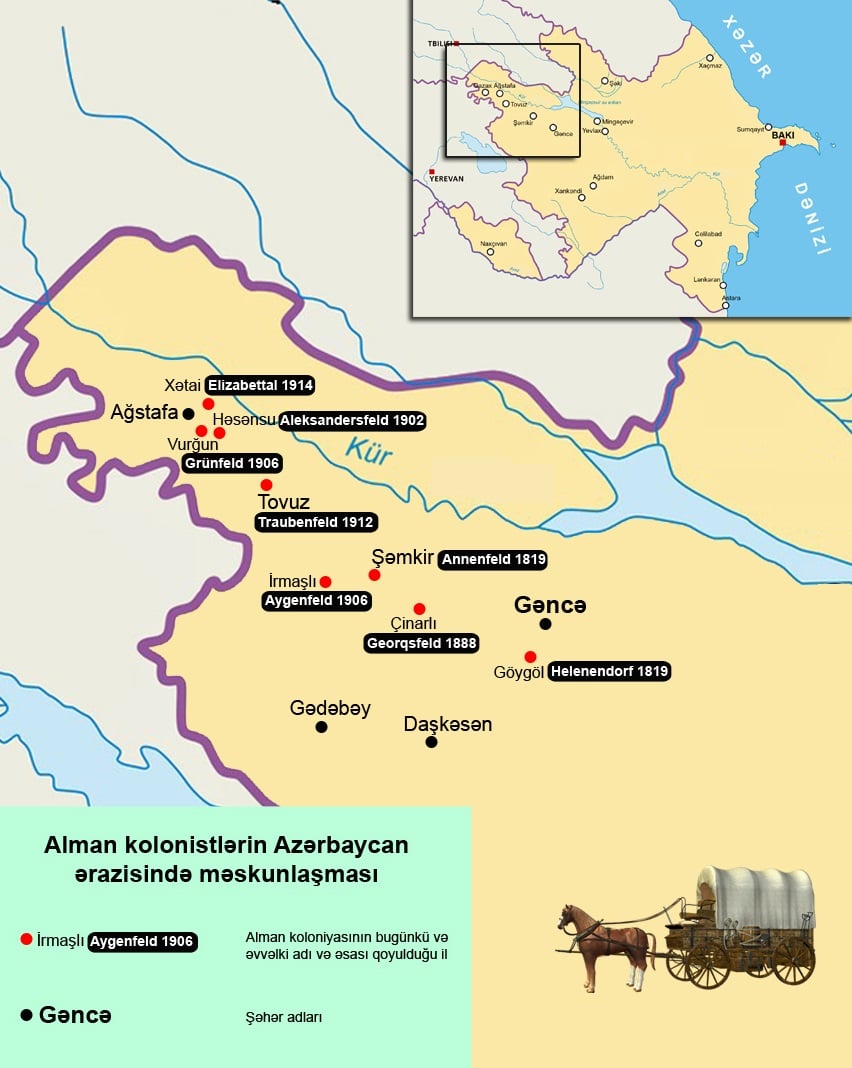
multiculturalism and tolerance. The resettlement of Germans and
their settlement in the territory of Azerbaijan dates back to the
first decades of the XIX century. Starting from 1816-1818, a group
of German peasants resettled in the South Caucasus, and German
settlements were established in Azerbaijan – Elenendorf, Annenfeld,
Georgsfeld, Alekseevka, Grunfeld, Eigenfeld, Traubenfeld,
Elizavetinka – located mainly in Goygol, Shamkir, Gazakh, Tovuz,
Agstafa districts. The German community also settled in Baku
city.
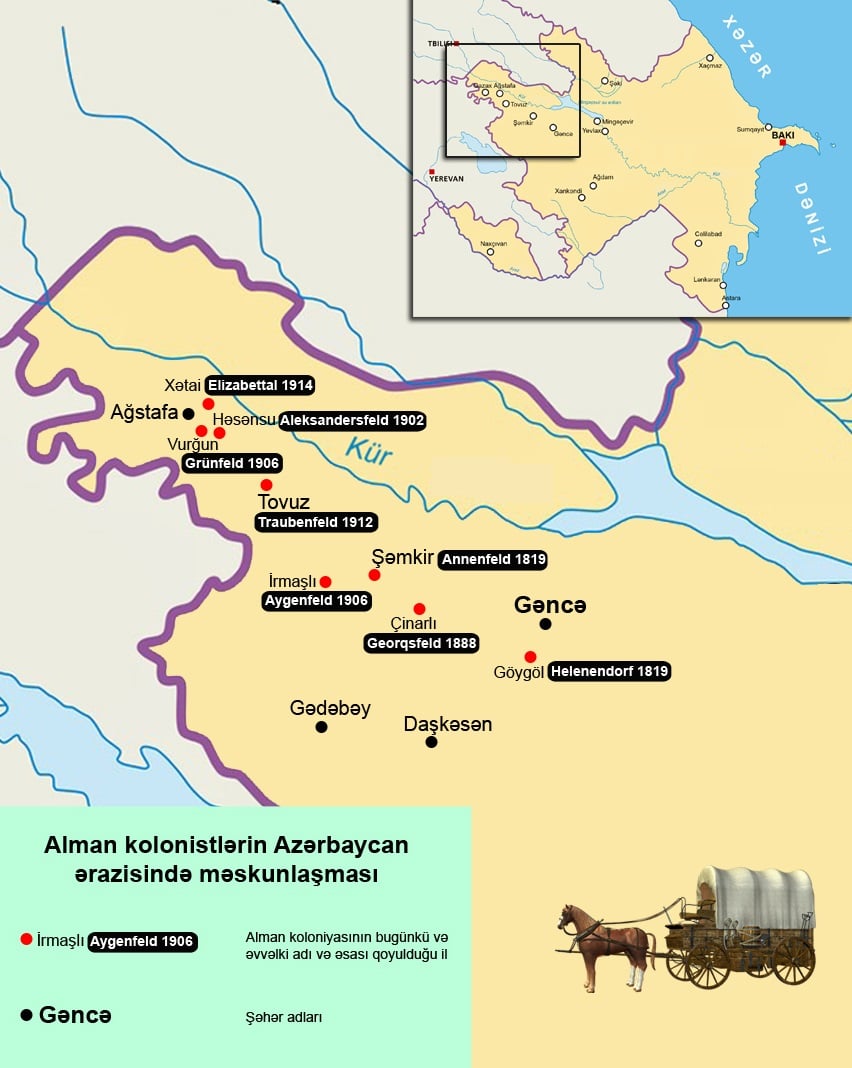
Map of German Settlements
In those years, German schools and joint ventures were
established, and, of course, Lutheran kirches. The first Lutheran
churches were erected following the designs of German architects A.
Eichler and F. Lemkuhl. The lecturer of the Helenendorf College F.
Zimmer noted: “The members of the congregation adhere very strictly
to church rites. They rarely miss a service and look with prejudice
at anyone who does not attend church carefully. As soon as the
bells are rung, all members of the family head for church.”
As the number of settlements and inhabitants increased, it
became necessary to build religious buildings in different places
of Azerbaijan.
In 1817, several hundred families of Swabian Lutheran-pietist
natives arrived in the South Caucasus with the permission of
Emperor Alexander I. Of them 120 families arrived to the territory
of Azerbaijan and founded Helenendorf (Goygol) settlement here.
With its foundation the activity of Lutheran community began. The
first religious rites were conducted under the guidance of school
teacher Jakob Kraus. Later, in 1832, a pastor from Hanover was
invited here.
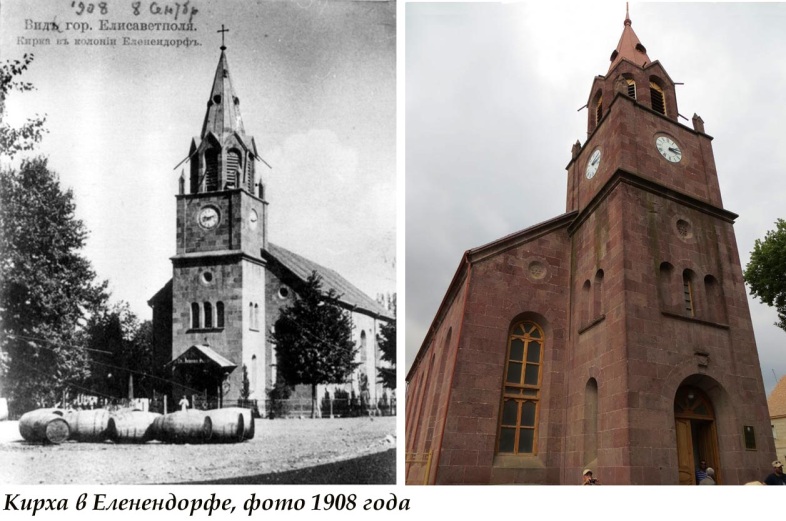
German Church in Helenendorf
(Goygol)
In 1854, it was decided to build a stone church building for the
Lutheran congregation. On April 24 of the same year, the foundation
of the church was laid. The works occupied three years, and on
March 10, 1857 the consecration of the new church was held, which
was named St. John’s Church, becoming the first Lutheran church in
Azerbaijan, in honor of which a salute of five cannon shots was
given. Georg Heinrich Reitenbach became the first pastor. The
church, built in neo-Gothic style, was equipped with an organ
manufactured by the company “E.F.Walcker & Cie.” located in
Ludwigsburg. The church, built of red stone, has a clock tower, 16
large and 2 small windows and two entrance doors. The windows,
doors and ceiling are made of wood, the floor is made of broom
tiles and the roof is tiled.
Following Azerbaijan’s restoration of independence in 2001, the
church was included in the list of immovable monuments of history
and culture. In 2008, the building was thoroughly renovated.
Currently, the Lutheran Church is protected not only as one of the
historical symbols of Goygol district, but also as an example of
Azerbaijani multiculturalism. Since 2004, this architectural
monument has been functioning as a district history and local
history museum. Inside the building there is a special corner
reflecting the way of life of Germans and the history of
wine-making.
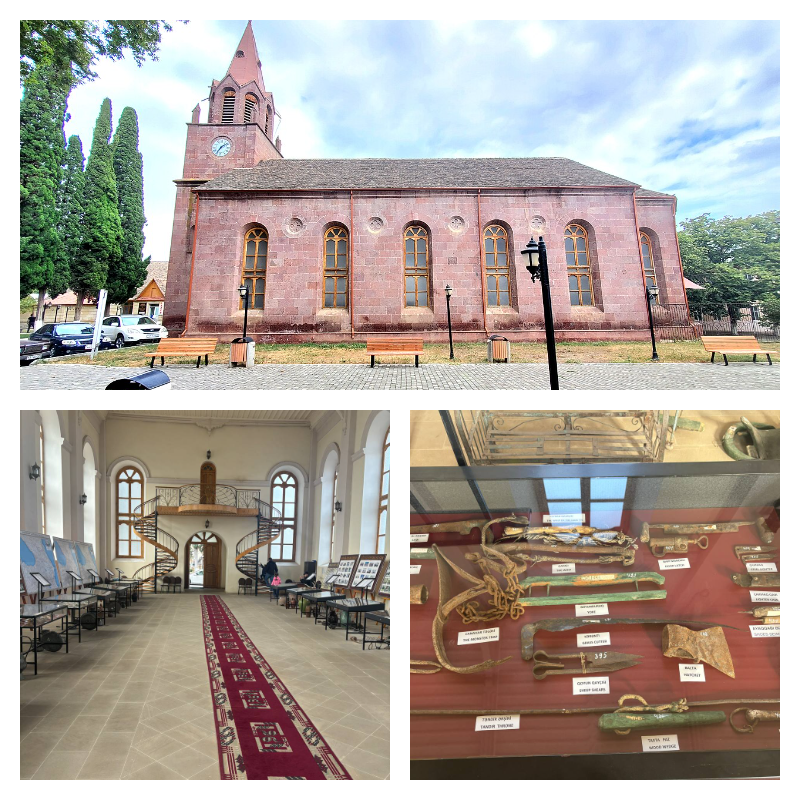
German Church in Goygol
Lutheran Church in Elizavetpol (Ganja) was built in 1885 on the
donations of Azerbaijani Muslims for immigrants from Germany.
Interestingly, the eclectic style structure was built of tufa. The
total area is about 650 square meters. This church was first opened
on September 18 in one of the large halls of the Elizavetpol men’s
gymnasium and was expanded over time.
Inside, the building is divided into a central hall and a foyer.
Built in Romanesque-Gothic style, it was characterized by
simplicity and expressiveness, a successful choice of place,
arranged without much luxury and refinement, which was typical for
religious buildings of the Lutheran faith. The German Lutheran
Church functioned as a cultural center of Ganja in the years after
the Second World War. Since 1986, when the Ganja State Puppet
Theater was established, performances for children have been
screened here.

Lutheran Church in Ganja
The Church of the Savior in Baku, also known as the Lutheran
Church, designed by architect Adolf Eichler in the Neo-Gothic
style, is located in the heart of Baku. There is an opinion that
Eichler was inspired by the Church of St. Elizabeth in Marburg.
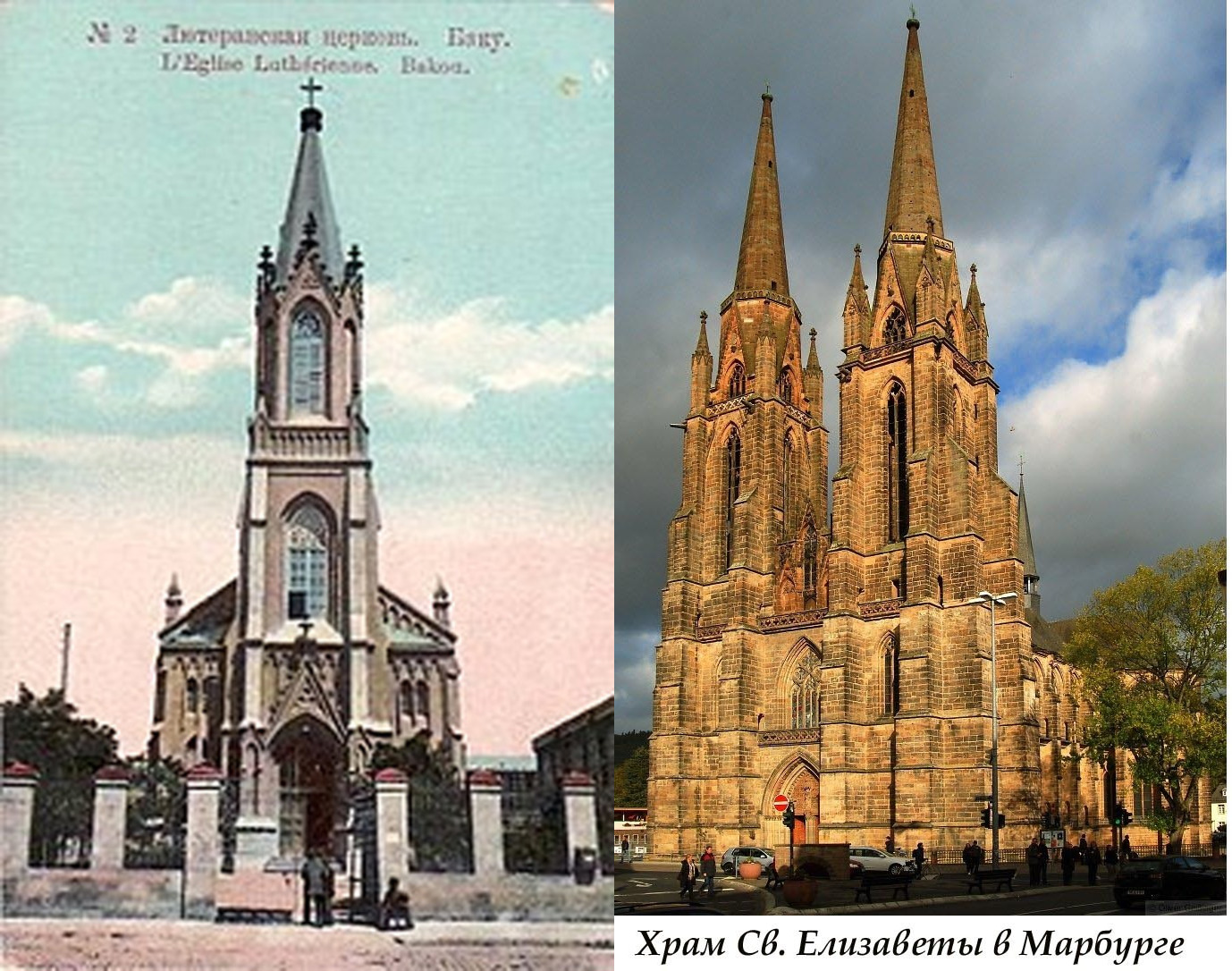
Lutheran Churches in Baku and
Marburg
The groundbreaking ceremony took place on March 21, 1896 with
the participation of the heads of the Baku City Duma. The
consecration ceremony, which took place on March 14, 1899, gathered
more than a thousand people, among whom were present the famous
oilman Emmanuel Nobel (son of Ludwig Nobel – inventor, entrepreneur
and philanthropist, in the future one of the founders of the Nobel
Prize), his stepmother and the second wife of Ludwig Nobel.
On June 24, 1898, a thirteen-pound (213 kilograms) gilded cross
was erected on the spire of the building. At the beginning of 1899
the church bells and organ were installed. On April 23, 1900, the
first concert of organ music was held, at which works by Johann
Sebastian Bach were performed.
Interestingly, some time after the assassination of the former
First Secretary of the Central Committee of the Communist Party of
the Azerbaijan SSR Sergey Kirov in 1934, the Soviet sculptor Pinhos
Sabsai received an order to erect a monument to Kirov in Baku. He
required a room with very high ceilings, which could accommodate
the sculpture together with the pedestal. Sabsai asked the kirch to
provide him with a workshop. Despite the fact that at that time
there was an order to demolish the kirk, Sabsai was allowed to do
so.
Following repair and restoration works carried out on the order
of the head of state, the building of the former Lutheran church in
Baku, the Chamber and Organ Music Hall of the Azerbaijan State
Philharmonic named after Muslim Magomayev, was inaugurated in 2010,
attended by President of Azerbaijan Ilham Aliyev and First Lady
Mehriban Aliyeva. Throughout these years, various concert programs,
including those of foreign masters, and creative evenings have been
constantly held here.

Lutheran Church in Baku – Past and
Present
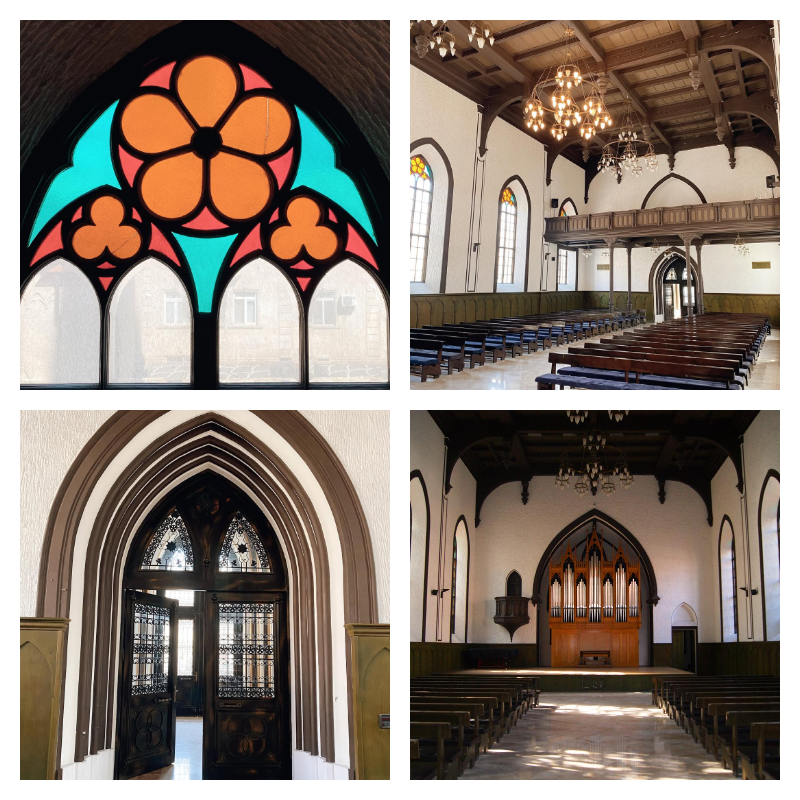
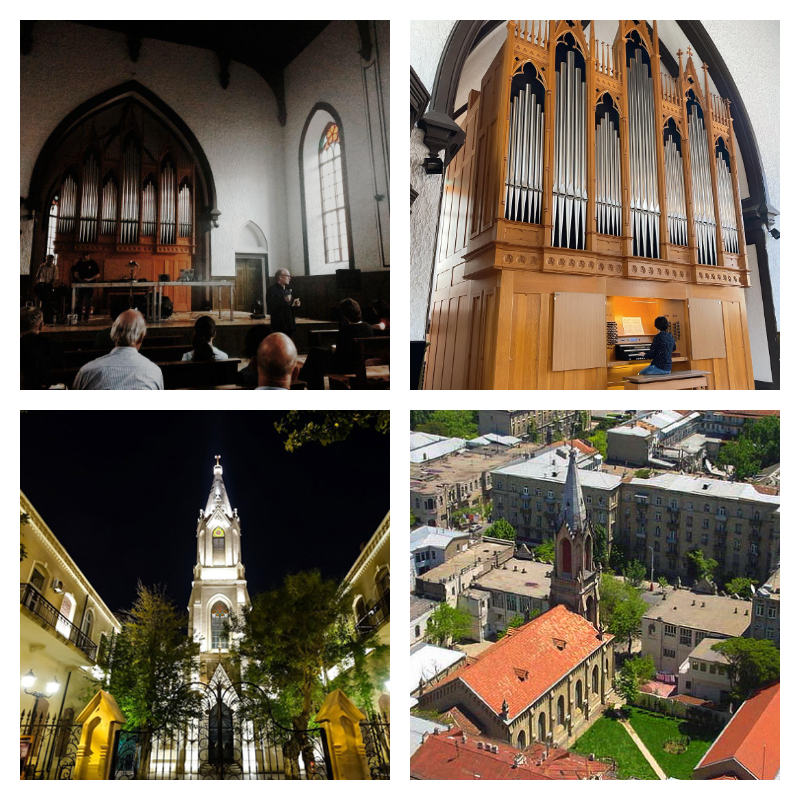
Lutheran Church in Baku
The Lutheran Church in Annenfeld (Shamkir) was built in 1909,
also in neo-Gothic style, on donations from businessmen Johann
Beppl and Johann Beck. The architect was Ferdinand Lemkuhl. Its
consecration in 1911 was carried out by Baron von Engelhardt,
Ober-pastor of the Transcaucasian Evangelical Lutheran Communities.
During the Soviet years the building was used as a House of
Culture, House of Teachers, and since 1980s as a historical and
ethnographic museum. After Azerbaijan regained its independence,
the church building was included in the list of historical and
cultural monuments. A museum describing the life history of the
German community was created, and interesting photographs and
household items were presented.
In 2012-13, on the initiative of the Ministry of Culture and
Tourism of Azerbaijan, the church was thoroughly reconstructed, an
organ was installed, recreated based on the surviving drawings, on
which teachers of the local music school now play during festive
events. The carefully restored church has regained its former
beauty and elegance. The reconstruction works carried out within
the framework of the Heydar Aliyev Foundation’s project “Azerbaijan
– Address of Tolerance” became another indicator of the mission to
maintain the historical past and religious and cultural values of
our state. In 2013, President of Azerbaijan Ilham Aliyev
familiarized himself with the restored building of the German
Lutheran Church in Shamkir.
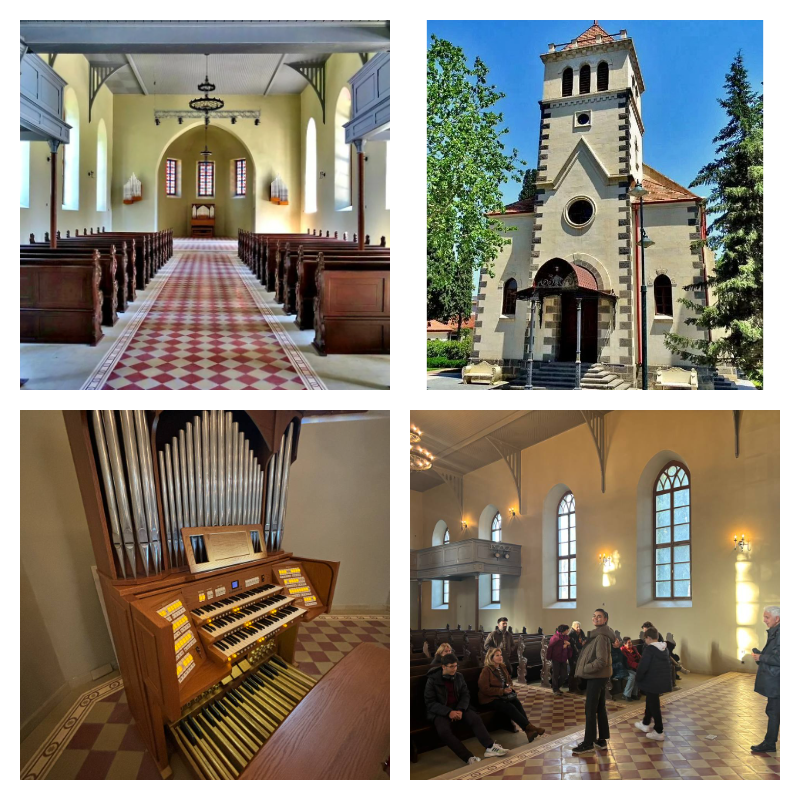
Lutheran Church in Shamkir
German cultural heritage in Azerbaijan is carefully protected by
the state. Multiculturalism and tolerance, which have centuries-old
historical traditions in Azerbaijan, are important directions of
state policy and play a great role in the life of Azerbaijani
society.