
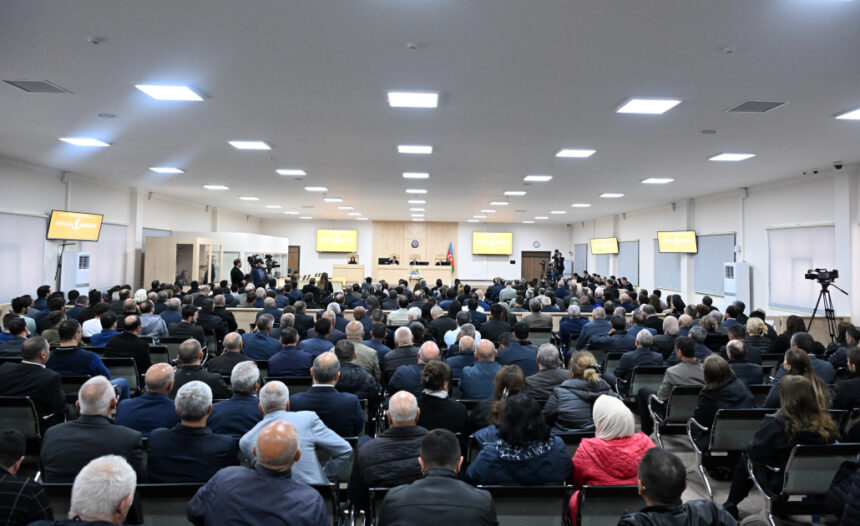
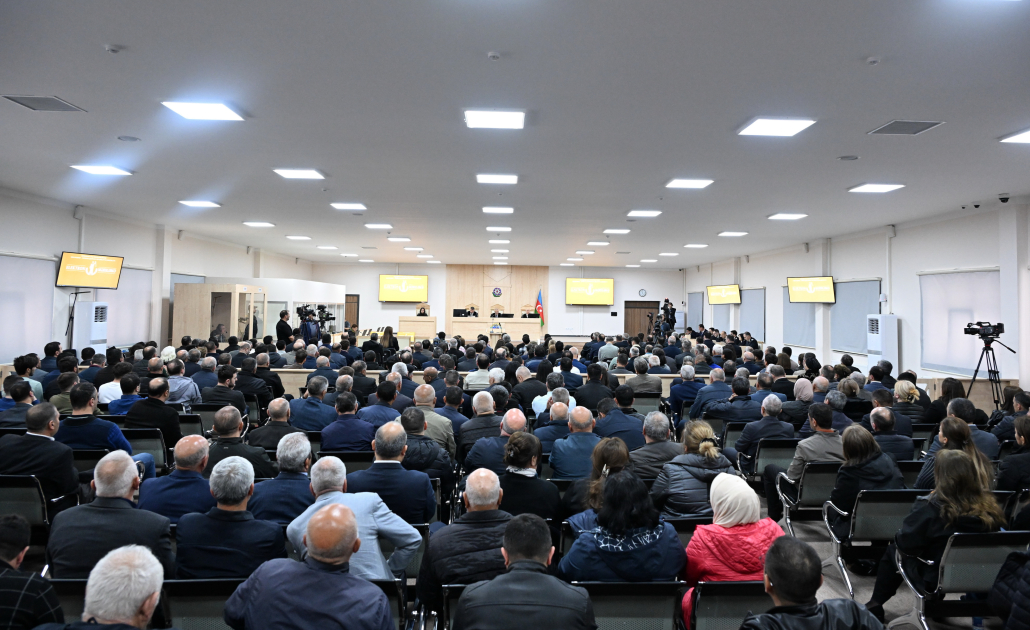
Baku, Azerbaijan, April 29. The trial of
Armenian citizen Ruben Vardanyan—charged with crimes against peace
and humanity, war crimes, terrorism, financing terrorism, and other
serious offenses under Azerbaijan’s Criminal Code—continued on
Tuesday at the Baku Military Court, Trend reports.
Presided over by Judge Zeynal Aghayev, with judges Anar Rzayev
and Jamal Ramazanov (and reserve judge Gunel Samadova), the hearing
was held in open session. The defendant was provided with
interpretation services in his native Russian language and was
represented by his lawyer of choice, Avraam Berman.
Before witness testimonies commenced, Judge Aghayev explained
the legal rights and responsibilities to the victims attending for
the first time and introduced the participants in the trial,
including court personnel, prosecutors, interpreters, and
others.
Ruben Vardanyan and his lawyer objected to the composition of
the judicial panel, arguing that previous motions had not been
granted and they had not been given full access to court session
minutes. They claimed the judicial panel displayed bias in favor of
the prosecution.
Prosecutor Vusal Aliyev, senior assistant to the prosecutor
general, responded by stating that the court had already addressed
those concerns in earlier sessions and emphasized that the defense
had full opportunity to review the minutes. He stressed that the
mere rejection of motions does not constitute evidence of bias.
The victims present urged the court to dismiss the objection.
After deliberation, the court rejected the defense’s motion, citing
the absence of concrete evidence under the Criminal Procedure Code
to support claims of judicial partiality.
Following the decision, victim testimonies were heard.
Nurlan Baghirov, a serviceman of the Internal Troops of the
Ministry of Internal Affairs, recounted an armed attack by remnants
of the Armenian armed forces and illegal armed groups. He stated
that 14 servicemen—12 from the Internal Troops and 2 from the
Ministry of Defense—were killed, with several others injured,
including himself. He described being targeted with gunfire and
hand grenades.
Shamil Israfilov also testified that he was wounded by a grenade
blast during the same attack. Under questioning by prosecutor Fuad
Musayev, he confirmed that 14 servicemen were killed and 24 injured
in the incident.
Vusal Eyyubov stated that he was wounded during the assault and
that several of his fellow servicemen were also killed or
wounded.
Tajaddin Karimov, a serviceman of military unit N, testified
that he was injured in a mine explosion while clearing a supply
route in the direction of Talish village—formerly part of Tartar,
now within the Aghdara region. He stated that 59 newly planted
mines were neutralized in the area, all of which were of Armenian
origin and laid in recent years. “My fellow servicemen avoided
injury because they were positioned at a distance,” he noted.
Javanshir Sultanov testified that he sustained injuries while
preventing sabotage attempts by Armenian armed groups.
Seymur Aghakarimov described being wounded by the explosion of a
mortar shell fired by Armenian forces.
Vagif Babayev, an employee of the Azerbaijan Mine Action Agency
(ANAMA), stated he was injured in a mine explosion in the Zangilan
region when an armored vehicle struck an anti-tank mine. He was
nearby and sustained multiple injuries. He emphasized that
civilians are the primary victims of Armenia’s continued use of
landmines.
The court also presented forensic medical examination results on
the victims.
The next court session is scheduled for May 6.
The forensic medical examination regarding the victim was also
read out in court.
Ruben Vardanyan faces charges under multiple articles of the
Criminal Code of the Republic of Azerbaijan, including Articles
100.1, 100.2 (planning, preparing, initiating, and waging a war of
aggression), 107 (deportation and forced displacement of the
population), 109 (persecution), 110 (forcible disappearance of
persons), 112 (deprivation of liberty contrary to international
law), 113 (torture), 114.1 (mercenary activity), 115.2 (violation
of the laws and customs of warfare), 116.0.1, 116.0.2, 116.0.10,
116.0.11, 116.0.16, 116.0.18 (violations of international
humanitarian law during armed conflict), 120.2.1, 120.2.3, 120.2.4,
120.2.7, 120.2.11, 120.2.12 (intentional murder), 29.120.2.1,
29.120.2.3, 29.120.2.4, 29.120.2.7, 29.120.2.11, 29.120.2.12
(attempted intentional murder), 192.3.1 (illegal entrepreneurship),
214.2.1, 214.2.3, 214.2.4 (terrorism), 214-1 (financing of
terrorism), 218.1, 218.2 (creation of a criminal group), 228.3
(illegal acquisition, transfer, sale, storage, transportation, and
possession of firearms, ammunition, explosives, and devices),
270-1.2, 270-1.4 (acts threatening aviation safety), 278.1
(forcible seizure or retention of power, forcible change of the
constitutional structure of the state), 279.1, 279.2, 279.3
(creation of armed formations not provided for by law), and 318.2
(illegal crossing of the state border of the Republic of
Azerbaijan).
Stay up-to-date with more news on Trend News
Agency’s WhatsApp channel