
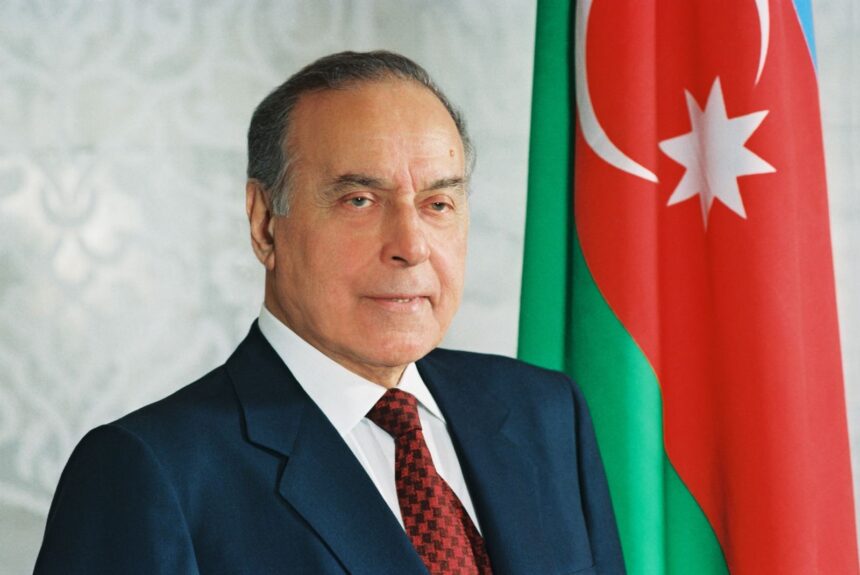

Baku, Azerbaijan, May 10. Today, Azerbaijan
commemorates the 102nd anniversary of the birth of National Leader
Heydar Aliyev.
Heydar Aliyev was born on May 10, 1923, in Nakhchivan. After
graduating from the Nakhchivan Pedagogical College in 1939, he
enrolled in the Faculty of Architecture at the Azerbaijan
Industrial Institute (now the Azerbaijan State Oil and Industry
University), but his studies were interrupted by the outbreak of
World War II.
He began his public service career in 1941, holding key
positions in the People’s Commissariat of Internal Affairs and the
Council of People’s Commissars in the Nakhchivan ASSR. In 1944, he
joined the state security agencies, receiving specialized training
in Leningrad and Moscow. In 1957, he graduated from the Faculty of
History at Baku State University. Over a 25-year career in the
security services, he rose through the ranks to become Chairman of
the State Security Committee under the Council of Ministers of the
Azerbaijan SSR in 1967, with the rank of Major General.
In July 1969, Heydar Aliyev was elected First Secretary of the
Central Committee of the Communist Party of Azerbaijan, becoming
the republic’s leader. He joined the Soviet Union’s top leadership
in 1982 as a member of the Politburo and First Deputy Chairman of
the USSR Council of Ministers, overseeing major areas of economic,
social, and cultural policy.
He served as a deputy in both the USSR and the Azerbaijani
Supreme Soviets for two decades. In October 1987, he resigned in
protest against the political course of the Soviet leadership.
On January 21, 1990, the day after the Soviet army’s violent
crackdown in Baku, Heydar Aliyev publicly condemned the massacre,
calling for those responsible to be held accountable. In July 1991,
he left the Communist Party in protest against the central
government’s policies, particularly its handling of the escalating
Nagorno-Karabakh conflict.
Returning to Azerbaijan in 1990, Aliyev initially settled in
Baku, then moved to Nakhchivan, where he was elected to the Supreme
Soviet. Between 1991 and 1993, he served as Chairman of the Supreme
Assembly of the Nakhchivan Autonomous Republic and Deputy Chairman
of the Azerbaijani Parliament. In 1992, he was elected Chairman of
the New Azerbaijan Party at its founding congress in
Nakhchivan.
In mid-1993, as Azerbaijan faced political turmoil and the
threat of civil war, the people turned to Heydar Aliyev to restore
stability. The country’s leadership invited him to Baku, and on
June 15, 1993, he was elected Chairman of the National Assembly. A
month later, he assumed the powers of the President.
On October 3, 1993, Heydar Aliyev was elected President of
Azerbaijan. He was re-elected in 1998. Though he initially agreed
to run in the 2003 election, he later withdrew due to health
concerns.
Heydar Aliyev passed away on December 12, 2003, at the Cleveland
Clinic in the United States. He was laid to rest at the Alley of
Honor in Baku on December 15.
His legacy lives on in an independent and sovereign Azerbaijan.
The country’s Victory in the 44-day Patriotic War is widely seen as
the result of the foundations laid under Heydar Aliyev’s leadership
– from strengthening the military to building a resilient state.
Under President Ilham Aliyev, the liberation of Azerbaijani lands
became a proud chapter in the nation’s history and a powerful
affirmation of Heydar Aliyev’s vision for a strong, united, and
independent Azerbaijan.