
Getting lost in an excellent book is one of the best gifts we can do to ourselves. But what is happening in our brain As it converts spiders from letters to whole worlds in our heads?
“Despite the extensive neuroscientific research, little is known for organizing language in the human brain,” said neuroscientist Sabrina Turks from the Max Planck Institute in Germany, according to Science Alert.
To find out more about reading, Turker and her associates carried out a meta-analysis that gathers the results of 163 experiments that included brain tomography from a total of 3,031 adults. Their research was recently published in the magazine Neuroscience & Biobehavioral Reviews.
It is well known that the left hemisphere of the brain is the center of linguistic processing, so it is not very strange that all kinds of reading seemed to activate the specific side of the brain. “We found a high processing specialty for reading letters, words, suggestions and texts exclusively in the left hemisphere,” the team writes.
The role of the cerebellum
In the past, neuroscience was to some extent ignored the role of the cerebellum in the language. Indications that this may be an omission emerged from a study under the leadership of Turker in 2023, which showed that the cerebellum is involved not only in the processing of sounds, but also in the creation of meaning – two critical components of language.
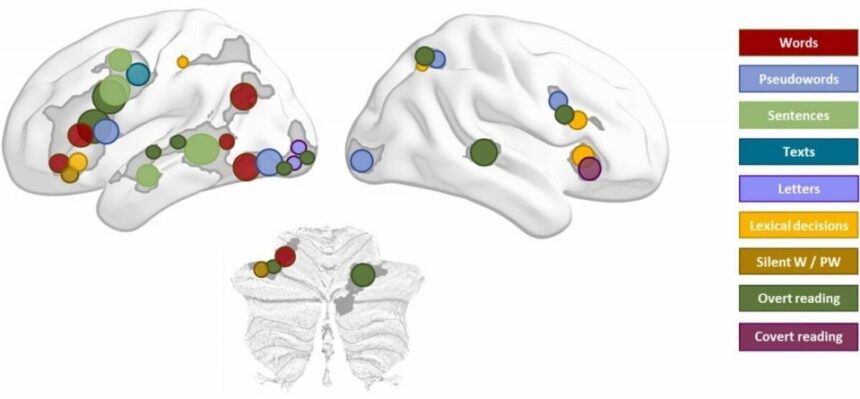
Now, it seems that they are also busy when we read. The new study found that the right cerebellum was particularly active in all kinds of readers. Some areas of the right cerebellum appeared much more active when reading by voice, which suggests that it is vital for our ability to translate written words into speech.

The new study mapped the areas of the brain that are activated by different reading tasks
Turker et al., Neuroscience & Biobehavioral Reviews, 2025
The left cerebellum, on the other hand, seemed particularly active when reading words (as opposed to reading letters, sentences or texts).
“While the left -wing cerebellum appears to have a stronger semantic participation during reading, the right -legged cerebellum has contributed mainly to overall reading processes, probably because of its role in speech production,” the authors said.
Reading loudly and silently
They also compared data about reading with voice and silent reading. Voice reading was more likely to activate acoustic and motor areas, while silent reading was based on areas that coordinate multiple cognitive requirements.
Silent word reading activated the left frontal, cerebral and temporal cortex more consistently compared to the reading it required to interpret to decode the implied meaning. This method of reading tends to activate both sides of the lower frontal and central areas of the brain.
The authors say that their study “extends our understanding of the neuronal architecture governing reading, confirms the findings of neurotransmission studies and can provide valuable neuronal information about reading models”.
Source: cnn.gr