
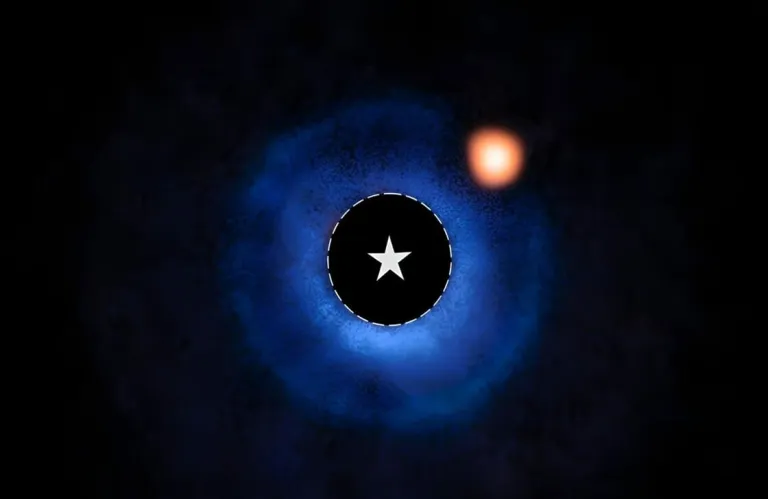

The James Webb Space Telescope recorded another impressive discovery: it has identified a distant planet with features that may indicate life -friendly conditions, according to NASA and other space services.
Astronomers identified “unmistakable elements” for a planet with a mass of about 100 times larger than the Earth, orbiting the red dwarf Twa 7 (or CE Antilae), 34 years of light from our planet. The new celestial body, named TWA 7B, was recorded directly by the James Webb’s telescope, the most powerful telescopic tool placed in space to date.
Planet with temperature that favors life
A first analysis shows that it is a young and relatively cold planet, with an estimated temperature close to 120 degrees Fahrenheit (about 49 ° C). Scientists recall that life can theoretically grow in a temperature range of 5 to 251 degrees Fahrenheit (−15 ° C to +122 ° C), which makes the finding particular interest.
The observation took place when an international team of researchers identified a weak source of infrared radiation on a debris around TWA 7, about 50 times larger than that between Earth and Sun. Scientists have used the average webB infrared (Miri) to isolate the star light and reveal the dim objects near it – a high contrast technique that allows for immediate portion of planets.
If confirmed, this is the first time that James Webb has directly depicted a planet – as opposed to earlier discoveries through the technique of gravitational lens, which is based on the theory of Albert Einstein’s general relativity.
The source of infrared radiation appears to be located within the three dust rings surrounding the star, which fits the expected position of a planet of this mass and explains the structure of the debris disc.
Twa 7 is one of the youngest stars with a well -known debris disc. The study was published last week in Nature Magazine, with researcher Anne-Marie Lagrange from the Paris Observatory and Grenoble Alpes University stating: “Our observations reveal a powerful candidate for a planet that forms the structure of the Twa 7.”
The co-author of the study, Mathilde Malin, an assistant researcher at Johns Hopkins University and the Space Telescope Science Institute in Baltimore, described the discovery as a “fascinating step forward in understanding planetary systems”.
The finding highlights the capabilities of the Webb’s telescope to reveal low -mass worlds orbiting around nearby stars – planets that until recently remained invisible under the glow of their mother’s stars.
The mission now focuses on confirming the nature of the TWA 7B and the analysis of its natural characteristics, which may in the future answer the question of life beyond the earth.
With information from ABC News / Source: Lifo.gr