
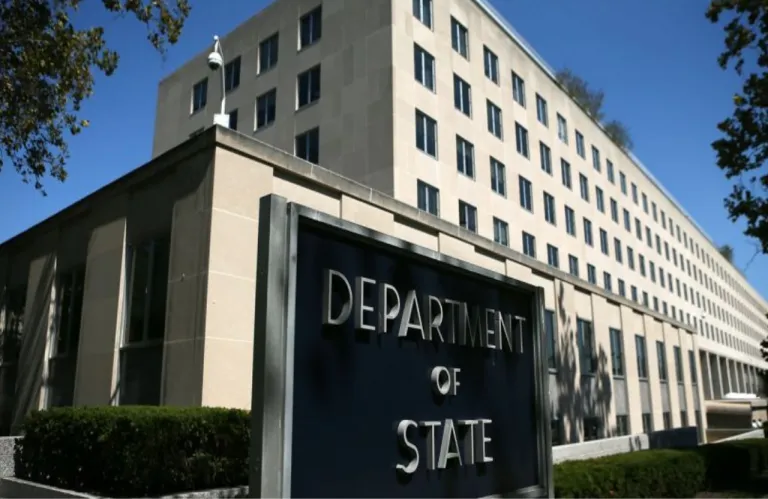
There have been no significant changes in the human rights situation in the Republic of Cyprus, reports the US Foreign Ministry report on human rights for 2024. The report also covers the occupied areas.
Initially, in the summary of the report, it is noted that “the government of the Republic of Cyprus was the only internationally recognized government on the island, but since 1974 the northern third of Cyprus was governed by Turkish Cypriots”. This region, he adds, “was proclaimed as the” Turkish Republic of Northern Cyprus “in 1983. The United States did not recognize the” TRNC “. Turkey was the only country to recognize it. A significant number of Turkish troops remained on the island. A neutral zone, or a “green line”, patrolled by a UN peacekeeping force, separated the two areas. This report describes the developments in both communities. “
The report notes that “there have been no significant changes in the state of human rights in the Republic of Cyprus or in the region governed by Turkish Cypriots during the year”.
Important issues of human rights in the Republic of Cyprus, adds, included reliable reports of harsh, inhumane or degrading treatment or punishment. “Although the government of the Republic of Cyprus has taken measures to identify and punish officials who committed human rights violations, there have been limited incidents of impunity.”
He states that “in the area governed by Turkish Cypriots, important human rights issues included reliable reports of harsh, inhumane or degrading treatment or punishment, and serious restrictions on freedom of expression and freedom of the media, including the media, including
He adds that the “authorities” in the area governed by Turkish Cypriots rarely have taken reliable steps or actions to identify and punish “officials” who committed human rights violations. There were indications of extensive impunity. “
Concerning freedom of the press, it states that the law of the Republic of Cyprus provided for freedom of expression, including the press and other media, and the government generally respected this right.
“Independent SMEs, effective judicial power and a functional democratic political system were combined to promote freedom of expression, including members of the media,” he notes.
For the occupied territories, it states that the “law” provided for freedom of expression, including members of the press and other media, but the “authorities” “did not respect this right”.
He adds that the law of the CC criminalized the incitement of hatred and violence based on race, color, religion, national or ethnic origin or sexual orientation. Such acts were punished by imprisonment of up to five years, a fine or both.
For those occupied, he says that the offense of the Turkish Cypriot “government” and “officials”, as well as the Turkish government and its officials “was a criminal offense”.
“While individuals could sometimes publicly criticize the ‘principles’ without retaliation, human rights defenders, NGOs and the press reported a significant increase in harassment and threats against critics of the ‘TRNC’ president, the Turkish government of the Turkish Army and Turkish Army, Turkish Army and Turkish Army. Tayyip Erdogan. “
In addition, he states that the trial of the Left Movement member Abdullah Korkmazan and three others accused of “conspiracy for the creation of a secret alliance” and infringement of the “TRNC President” continued. Korkmazan was released on a guarantee and was forced to appear in a “police” section weekly.
Regarding the rights of workers, it states that the law of the CC provided for employees to set up and integrate into independent unions, collective bargaining and legal strikes. Both discrimination against trade unions and redundancies for trade union activity were illegal.
“The government has generally implemented the current labor law and investigations were sufficient in the public sector. The penalties for violations, which were mainly made in the non -public sector, were smaller than those for similar civil rights violations. Violations rarely occurred in the public sector and the penalties were regularly imposed against the offenders. “
The report notes that the government of the CC generally protected the right of trade unions to conduct their activities without interventions and employers generally respected the right of workers to form and participate in independent unions and to negotiate collectively.
There have been individual reports that private sector employers discouraged trade union activity due to the sporadic application by the CC of employment regulations that prohibit discrimination against trade unions and the indirect threat of employers for arbitrary dismissal for trade union activities.
For the occupied territories, it states that the “law” protected the rights of workers, in addition to members of the “police” and other Turkish Cypriot “security forces”, to form and participate in independent unions of their choice without prior permission.
Trade unions, he adds, also said that the “police” “systematically arrested some trade union members during peaceful demonstrations to intimidate other protesters.”
In addition, “teachers ‘unions said that the educational authorities threatened recently appointed teachers if they participated in demonstrations conducted by teachers’ unions against the” authorities “decision to demand all -day teaching. Teachers’ unions also said that some of the salaries of their members were withheld by the educational “authorities” to participate in the protest. “
Regarding the safety of the individual, torture and the harsh, inhumane or humiliating treatment or punishment, he states that the Constitution and the law of the Republic of Cyprus prohibited such practices, but there were reports that government officials implemented them.
It notes that the Committee on the Prevention of Torture (CPT) in its report in May on its visit to Cyprus in 2023 described “harsh conditions” and “lack of structure and routine” for prisoners in the Cyprus Prison Department, which was equivalent to “inhumane”. The CPT adds, “he claimed that prison staff were slapping prisoners and holding wooden sticks to intimidate them, and that he used verbal insults, including racist comments against foreign prisoners.”
“In the area governed by Turkish Cypriots, the” law “did not explicitly refer to torture, but prohibited the abuse of prisoners by the” police “under the article of the” Criminal Code “that covers the attack, violence and beating.
He notes that “NGOs reported abuse and abuse of” police “prisoners in detention centers and” central prisons “. “Turkish Cypriot NGOs reported a lack of security cameras in detention centers and that” central prisons “allowed” police “and” guards “to abuse the detainees unpunished. The NGOs also reported that security cameras in the old “central prison” did not directly feed the “Ministry of the Interior”, allowing abuse because the camera material could be interrupted and altered, “the report said.
KEPE