
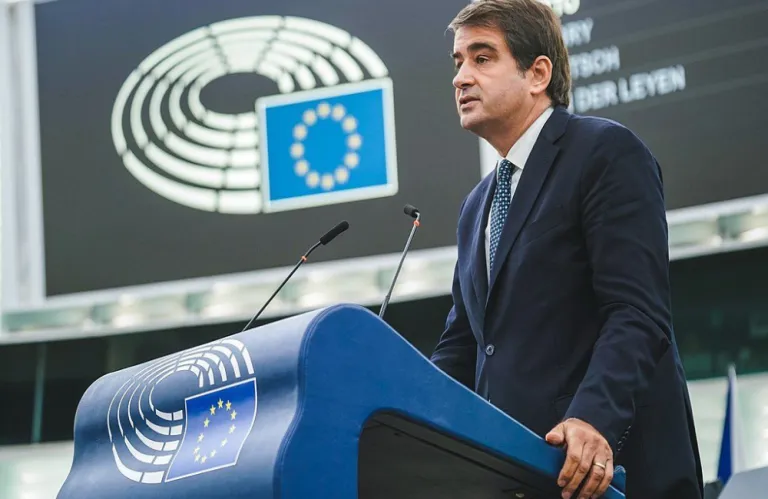
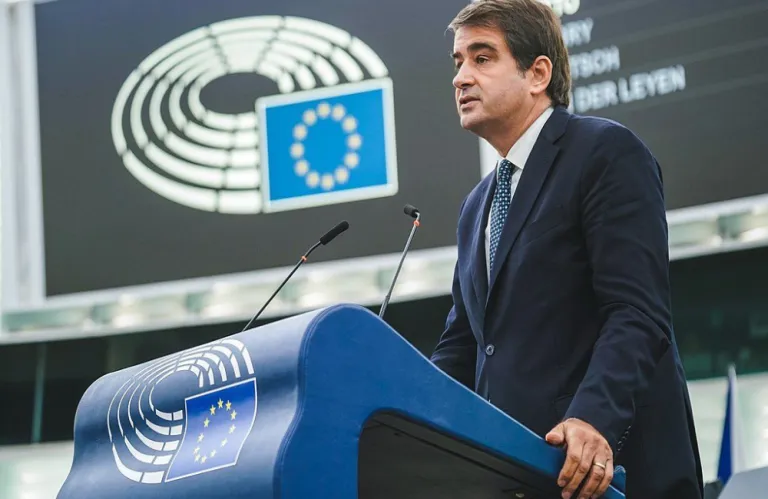
More investment is needed in EU regions bordering Russia, Belarus and Ukraine, European Commission Executive Vice-President Raffaele Fito said on Wednesday after the end of the College of Commissioners in Brussels, as he presented a strategy for the Union’s eastern border with Russia. According to the Commission, due to the stagnation of the economy, people are increasingly moving away from the border areas in Finland, Estonia, Latvia, Lithuania, Poland, Slovakia, Hungary, Romania and Bulgaria.
“These are not just national borders. It is a European border,” Raffaele Fito stressed during the presentation of the strategy to strengthen the resilience and economic development of the EU’s eastern border regions, as described in the communiqué which states that the aim is to address the unique challenges faced by these regions, such as hybrid threats, migration, economic pressures and deforestation.
Fito said that areas that were once centers of trade and tourism are now being transformed into zones of security, military mobility and emergency preparedness infrastructure. “People are moving away from these areas due to economic stagnation and increased insecurity,” he noted, adding that the Commission has already taken steps to strengthen financing and resilience through cohesion policy and the EastInvest platform, which will bring together financing tools from the European Investment Bank (EIB) Banking Organization, the European Bank for Reconstruction and Development (EBRD) and other financing sources. “The goal is more accessible, coordinated and locally adapted financing, including municipalities,” he stressed.
Eastern border Member States are already actively negotiating the availability of more funding from the upcoming EU budget (2028-2034). This will not only concern defense, but also the financial support of their border regions. While at the end of 2025 the Union committed to help the border regions by building a so-called wall of drones to protect the eastern border, with a completion horizon of 2027.
The strategy includes five main axes of action: security and defense, with the Commission proposal for the creation of the monitoring system for the eastern wing of the EU, the Eastern Flank Watch, as well as the strengthening of the defense against drones through the European Defense Initiative against Drones, alongside the strengthening of military mobility and the protection of critical infrastructures, with the aim of dealing with hybrid threats and strengthening cooperation with NATO. “Security and defense are a prerequisite, but these areas also need investment, services and economic prospects,” Fito said.
Investments and development with the EastInvest platform, energy and bioeconomy, with the Commission promoting the development of bio-industries, energy autonomy and the circular economy, with the aim of reducing dependence on external energy sources and strengthening local resilience. In addition, in terms of connectivity, it concerns the improvement of transport and digital infrastructure by strengthening connections with Ukraine and Moldova, while the Commission will support the development of the Rail Baltica railway network and the strengthening of Baltic ports. Furthermore, emphasis will be placed on digital connectivity, with the aim of covering gaps in broadband infrastructure and promoting 5G technology.
The Commission will support initiatives to combat deforestation, strengthen education and access to basic health and social care services, with an emphasis on strengthening local self-government and promoting social entrepreneurship, with the aim of empowering local communities.
Raffaele Fito also announced that this strategy will be followed by a high-level conference on 26 February 2026, which will be attended by prime ministers and ministers from the affected member states. During the event, the declaration of intent to create the EastInvest platform will be signed by the participating financial institutions.
To monitor the strategy, the Commission plans an annual high-level political dialogue, while the member states concerned by the strategy are invited to integrate these proposals into their national and regional development plans, with the aim of strengthening the resilience and economic development of the eastern regions. “This communication is not the end of the process. We will continue to work with and for these areas,” Fito concluded.
Source: KYPE