
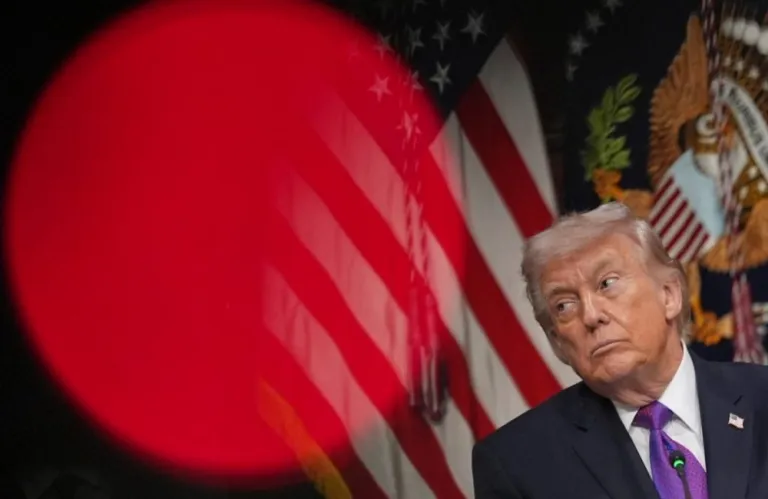
Last December, the US Secretary of Defense, Pete Hegsethpresented the current administration’s National Defense Strategy, arguing that the President Donald Trump is the true heir to Ronald Reagan’s ‘peace through strength’ strategy. A key part of this strategy, according to Hegseth, was the Weinberger Doctrinewhich set the principles for when and how the US should use military force. He even claimed that the Enterprise Midnight Hammer last June against Iran was an “exemplary example” of this doctrine, with strikes that “destroyed Iran’s nuclear program.”
However, what about the current war against Iran? Can withstand Operation Epic Rage against the principles of Weinberger? Hegseth would certainly struggle to support such a thing — and for Trump, it could ultimately spell trouble, according to a Politico analysis. In a speech in November 1984, then-Secretary of Defense Caspar Weinberger described six principles of military engagement learned from the lessons of the disastrous mission in Lebanon and the failures in Vietnam. Expectedly, Trump’s war on Iran fails to meet almost every one of them.
The absence of vital interests and unclear goals
First, Weinberger stipulated that force should only be used if a vital national interest is at stake. Although Iran is ruled by a theocratic regime, the US has lived with it for nearly half a century. Moreover, Tehran is today weaker than ever, with its economy in ruins, its proxies decimated by Israel, and its allies in Syria driven out. With its nuclear program buried deep underground after last year’s bombings and its military capabilities severely damaged, it is hard to argue that a weakened Tehran posed a sufficient threat to vital US interests to warrant a pre-emptive war.
Then come the second, third, and fourth principles: the need for clearly defined goals, full commitment to their achievement, and the development of sufficient power. In Iran’s case, there are problems with all three. Trump and his associates have cited a variety of different goals, from overthrowing the regime to destroying the country’s missile capabilities. Regime change is difficult to achieve from the air alone, yet Washington does not appear intent on deploying ground troops. The question of what political goal is served by disarming Iran and what would constitute success remains unanswered by the administration.
The bypassing of Congress and the failure of diplomacy
Finally, there are the two most critical principles: securing public and congressional support, and using war as a last resort. Here, the administration didn’t even try. In his State of the Nation address, Trump spent just three minutes on Iran and never presented the arguments for war to the audience. Unlike his predecessors, Bush Sr. and Bush Jr., Trump has completely ignored Congress, despite its constitutional role in declaring war.
As for the sixth principle, ongoing war is anything but a last resort. The US has twice engaged in talks with Iran, but Trump chose war over seeing whether a deal was possible. His negotiating team, consisting of Jared Kushner and Steve Witkoff, lacked expertise in nuclear weapons. Witkoff’s claims about Iran’s nuclear material contradicted the International Atomic Energy Agency’s evidence that Iran was neither close to acquiring a nuclear weapon nor intent on a first strike against US forces.
Trump’s decision was not a last resort, but a dangerous risk, inconsistent with the Weinberger Doctrine. While any gamble can pay off, it is far more likely to end badly, with a new Iranian regime bent on revenge. Just as Bush paid the price for Iraq and Biden for Afghanistan, so there will be a heavy political price for Trump for this unnecessary and dangerous gamble next November.
ertnews.gr