
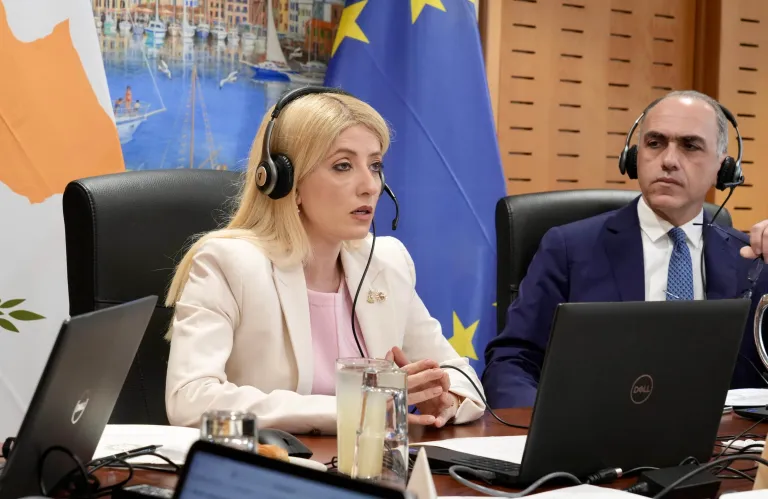
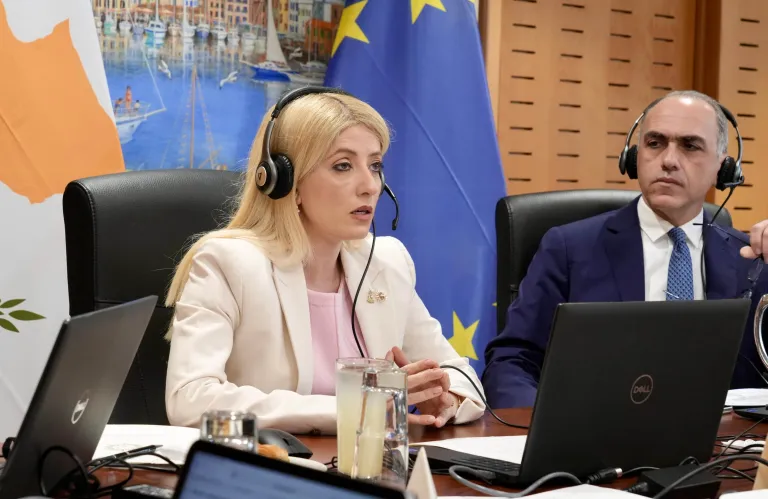
The crisis in the Mediterranean poses challenges for the EU and requires solidarity in order to build a stronger and safer Europe, its Parliament Speaker Annita Dimitriou said on Monday in her opening speech to the Plenary of the Conference of Parliamentary Committees on European Affairs (COSAC) held via video conference, noting that decisive action “is imperative”.
He called on the European Union to “actively promote de-escalation” through urgent diplomacy to prevent a wider conflict, protect civilians and secure energy supply chains. Responsible and coordinated action is necessary at this critical moment, he stressed.
In her speech, Mrs. Dimitriou noted that the House of Representatives held the meeting online, not because Cyprus is an unsafe country, but because of the suspension of flights to Cyprus due to the conflict in the Middle East.
“This reminds us that we live in a difficult and turbulent time, which is unfortunately also linked to the influence and challenges of social media, misinformation and toxicity,” he said, noting that “it is our duty to act with seriousness and responsibility and inspire confidence in citizens.”
Underlining that Cyprus remains a pillar of stability, Ms. Dimitriou stated that the country is fully implementing the national plan “ESTIA” to facilitate the removal of Europeans and third country nationals as the conflict in the Middle East escalates. The Government is closely coordinating with its partners to provide humanitarian infrastructure, acting responsibly in these difficult circumstances, he added.
He also said that the Presidency of the Council of the EU “offers Cyprus the opportunity” to address key issues such as geopolitical conflicts, irregular migration, energy insecurity and economic instability, as well as their impact on all member states. At a time of heightened tensions, coordinated European action is essential, he said.
Cyprus, added the President of the Parliament, “must continue initiatives that strengthen its role as a diplomatic bridge, promoting cooperation between the EU and the countries of the Middle East”. Diplomatic and security dialogue is critical in this turbulent period, and cooperation must focus on reliable partners who share the EU’s values and principles, he added.
“A European Union that enjoys strategic autonomy in defence, security, technology, economy and energy must guide policies towards a stronger and more resilient Union, capable of acting as an independent global actor,” said Ms Dimitriou.
He also said that the Mediterranean region faces serious interconnected challenges and that the EU is called upon to demonstrate its ability to tackle complex crises through collective action, turning plans into tangible solutions, “especially during this challenging period for our region”.
Recent developments show that Europe needs to lead and can act as a catalyst, he said. The challenges Cyprus faces are European challenges and Europe’s challenges are also Cyprus’ challenges. Everything that happens in Cyprus concerns Europe, just as Europe’s decisions concern Cyprus,” he added.
Referring to the Political Guidelines for the European Commission 2024-2029, which “provide a strategic compass with a focus on sustainable prosperity, competitiveness and security”, as well as the adoption of the Pact for the Mediterranean which, she noted, strengthens relations between the EU and its southern Mediterranean partners, Ms Dimitriou said that open dialogue allows parties to understand each other’s perspectives and identify common ground. “Declarations, agreements and political frameworks must act as catalysts for action and not remain symbolic gestures,” he added.
“Decisive action is imperative. The crisis in the Mediterranean creates challenges for the EU and requires solidarity to build a stronger and safer Europe. It also requires adherence to international law, European values and respect for territorial sovereignty, particularly during this period of regional instability,” said Ms. Dimitriou.
The Speaker of the House also stated that Ukraine “is an example of a violation of territorial sovereignty, as is Cyprus”, noting that since July 1974, more than 30% of the Republic of Cyprus has been under illegal military occupation by Turkey following a military invasion. “The island remains divided. Cyprus, therefore, expresses solidarity with Ukraine and firmly supports its efforts to ensure sovereignty, territorial integrity and the principles of international law,” he said.
Referring to the escalating situation in the Middle East, Ms Dimitriou called on the EU “to actively promote de-escalation through urgent diplomacy to prevent a wider conflict, protect civilians and secure energy supply chains”. Responsible and coordinated action is necessary at this critical moment, he stressed.
According to Dimitriou, COSAC “provides an important forum for representatives of European citizens to engage in dialogue, formulate political commitments and define common priorities”. A forward-looking approach that combines domestic strength with openness, cooperation and global engagement remains essential, he said.
With unity we can face every challenge, defend our values and principles and build a future of peace, prosperity and security for all, Ms. Dimitriou concluded.