
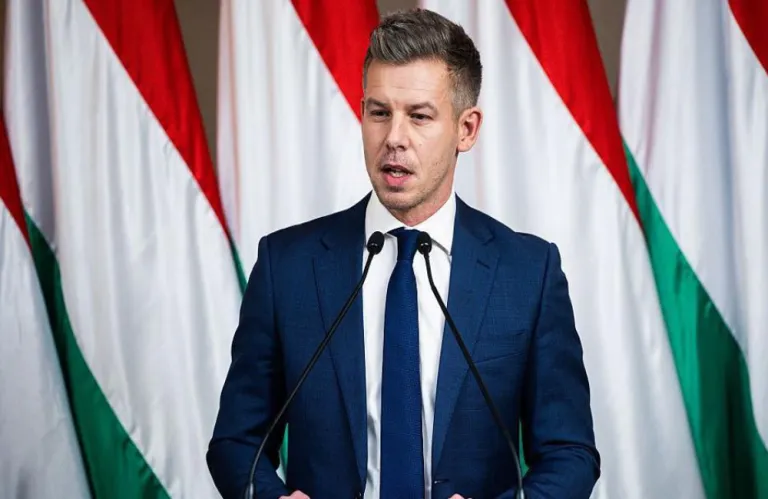
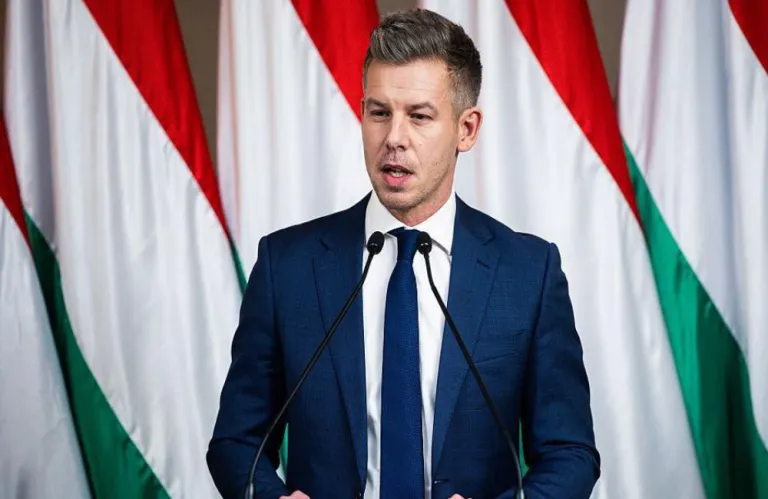
Peter Magyar is not a ‘typical’ leader of the opposition. He is a man who grew up politically in Viktor Orbán’s orbit, served in state and institutional positions, lived inside the power apparatus and finally became the one who, according to the results and international reports of April 12, 2026, led the Tisza party to victory that ended Orbán’s 16-year rule in Hungary.
Magyar was born in 1981 and, as he himself has said, was fascinated by politics from a very early age, seeing as a child the period of transition after the fall of communism. According to Reuters and AP, he even had a photo of the then-young Viktor Orbán, whom he saw as a symbol of the democratic change of the early 1990s, on the wall of his childhood room.
This political attraction turned into joining Fidesz in 2002, when he was 21 years old. From there, his path evolved within the state and party ecosystem built by Orbán: he studied law, worked as a lawyer, and then moved through a series of positions in institutions and organizations connected to the Hungarian state. His official CV at the European Parliament states that he was a trainee judge in 2003, a lawyer in 2006, a lawmaker for EU affairs at the Ministry of Foreign Affairs in 2010, head of the EU Legal Affairs Directorate at the Hungarian Development Bank in 2018, a member of the management of Hungarian Public Roads, managing director of the Student Loan Center in the period 2019-2022 and later head of Good Farming Ltd.
In his personal life, his most famous public connection was his marriage to Judit Varga, one of the most prominent political figures of the Orbán regime and later Minister of Justice. They married in 2006, lived for a time in Brussels and had three children. The AP reports that during his years abroad, Magyar worked for Hungary’s foreign ministry and as a diplomat in the country’s permanent mission to the European Union, while at one point taking on the role of a stay-at-home father. The couple divorced in 2023.
The big turning point came in 2024. His name was immediately associated with the political storm caused by the pardon scandal in a case involving an accomplice in a case of child sexual abuse. The then president Katalin Novak resigned, while Judit Varga also left. The next day, Magyar gave an interview that went viral, openly attacking the Orbán system, denouncing corruption, a closed circle of power and a propaganda machine. This was the moment he moved from the background to the center of the political stage.
From there, the rise was explosive. On March 15, 2024 he spoke in front of thousands of supporters in Budapest and soon his political venture took an organized form through Tisza. In the 2024 European elections the party registered around 30%, turning Magyar into an MEP and the strongest opposition pole against Fidesz. His official CV in the European Parliament states that from 2024 he is the president of TISZA and a member of the European Parliament.
His political stigma is not easy to fit into a simple ideological box. International analyzes describe him as center-right and pro-European, but not as a classical liberal. His campaign emphasized corruption, the rule of law, health, transport, low wages and inflation — everyday problems that directly affect Hungarian voters. At the same time, he took a more cautious or conservative stance on some issues, avoiding hard-line positions on issues that could polarize a wider electoral audience.
This is exactly what Maiard’s paradox is: he is a product of the very system he promises to deconstruct. For some, this is its biggest drawback. The insider who never fully cut the umbilical cord with Hungarian conservatism. For others, it is its greatest asset. The only one who knew first hand how the Orbán regime works and therefore the only one who could effectively strike it down. The AP notes that it is precisely this “insider” knowledge that led many voters to believe that he is the first truly credible alternative to Orbán since 2010.
His public image also played a role. Reuters and AP describe a politician who has managed to turn his rallies into mass events, with personal contact, selfies with supporters and an almost “cinematic” dynamic, particularly in a society weary of the traditional opposition’s inability to seriously challenge Orbán. His campaign used patriotic symbols, national vocabulary and a narrative of “moral restoration” of the country, attempting to wrest Fidesz’s monopoly on patriotism.
His personal journey, however, was not left out of political controversy. After his break with power, his ex-wife Judit Varga accused him of abusive behavior during their marriage. He denied the accusations and argued that it was a political attempt to discredit him after he turned against Fidesz. This issue remains part of his public image and explains why, despite his rapid rise, he remains a divisive figure.
Today, however, the main political fact is different: Peter Magyar is no longer just the former man of the system. He is the winner of the 12 April 2026 election in Hungary, with Viktor Orbán conceding his defeat. Reuters and AP reported that Tisza secured a clear lead and is on course for a historic parliamentary victory, ending a 16-year period in which Orbán dominated the country’s political system.
The crucial question from now on is whether Magyar will turn out to be just the man who defeated Orbán or the politician who will succeed in changing Hungary after Orbán. Because his power was born precisely from his double identity: he is at the same time the insider and the subversive, the familiar and the new, the conservative patriot who tried to wear the suit of change. And just like that, the man who once had Orbán on his bedroom wall finally found himself writing his political end.
Source: huffingtonpost.gr