

The dream of the US president is to give a new impetus to the American car industry
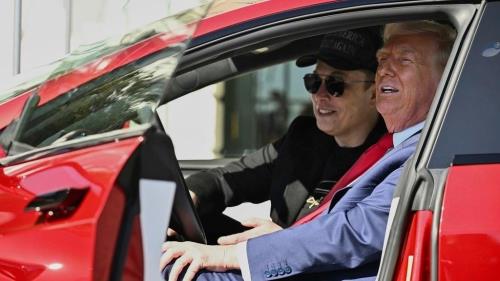
By Dimitris Soulta / Photo: US President Donald Trump and businessman, Ilon Musk in a Tesla (AP Photo / Ben Curtis)
If Donald Trump has been unmistakable for something that has taken over the country’s duties. And if the previous announcements were partially considered negotiating weapons, the latest 25% decision on cars imported has lit fires in international markets, which is doubtful if they can easily erase.
Already after the announcement of Trump, the US, Europe and Asia have taken the possessions. Especially in Germany, which is the largest car export in the US, the situation is indicative: Porsche AG titles fell 5%, Mercedes-Benz Group AG by 5.2%, BMW AG by 4.9%and Volkswagen AG (which owns Audi and Lamborghini) by 4.3%. Similar was the climate in the US, where the three largest car manufacturers fell significant: General Motors (-8%), Stelantis (-4%) and Ford Motor (-2%).
Was that Trump’s goal? Of course, it was not, since he believes that the unstable climate in the markets will last for a short time and soon everyone will adapt to the new data, the rules of which he himself sets.
Can Detroit be resurrected?
The US president’s dream is to give a new impetus to the American automaker. To limit imports and mainly push American and foreign companies to re -establish factories in the US. He may be envisioned to “resurrect” Detroit, which for decades has been about the center of the Earth in the development of the car. An ambitious goal, though practically impossible, at least with today’s data. Setting up a car industry is a precise investment and the motivation is not enough to “pay duties”. Even in the best scenario it will take years to recover production within the walls.
The battle for spare parts and costs for Tesla
Another big problem that industries are called upon to overcome is car spare parts. Even in those built in the US, much of the spare parts used comes from abroad. And Donald Trump was clear that the spare parts were also charged. The same problem, although to a lesser extent than others, is faced by Trump’s partner, Ilon Musk, who may have his factories in Texas and California, but uses spare parts that come from abroad. Whatever the first estimates, they refer to increases in cars prices ranging from 4,000 to 10,000 euros.
The great German “patient” receives a new blow
The one that will be most affected by any other Trump duties is the German automotive industry. Americans are its largest and best customers. 73% of European Union exports to the US are made by the three largest German automakers, according to research firm Jato Dynamics. It is extremely serious to blow, as it is extremely unlikely for the Germans to choose the US to produce their cars. While the German economy is perhaps at the most difficult time in its post -war history, as the government has decided on a spectacular increase in defense spending, a new blow to the flagships of its industry may seem critical to the immediate future of the European “locomotive”.
The answer from Europeans and Asians and the spiral of recession
Two of the largest centers of the global automaker, the EU And the countries of Asia have essentially heralded analogue response to Trump duties. A reaction that was apparently expected by the US government. The question is where this open economic war will lead. The Trump side believes that being the strongest player on the chessboard will be able to impose its policies and after a few months’ turmoil the markets will return to regularity.
A highly likely scenario, however, based on as long as the experience of the last two centuries tells us, is that duties in critical economy is creating inflationary pressure and this in turn leads to more expensive money. Fed Commander Tom Barkin even spoke of a time of “zero visibility”. And it matters when it sounds from the mouth of the central banker. In it the “fog” is currently moving the international economy and the great fear is that new data is likely to lead to a new spiral of recession, which no one knows if even large economies can withstand.
Source: cnn.gr