
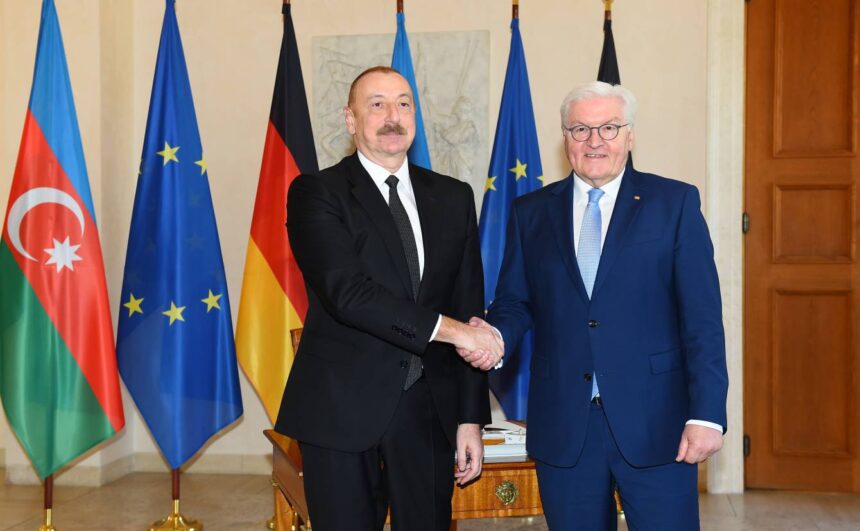
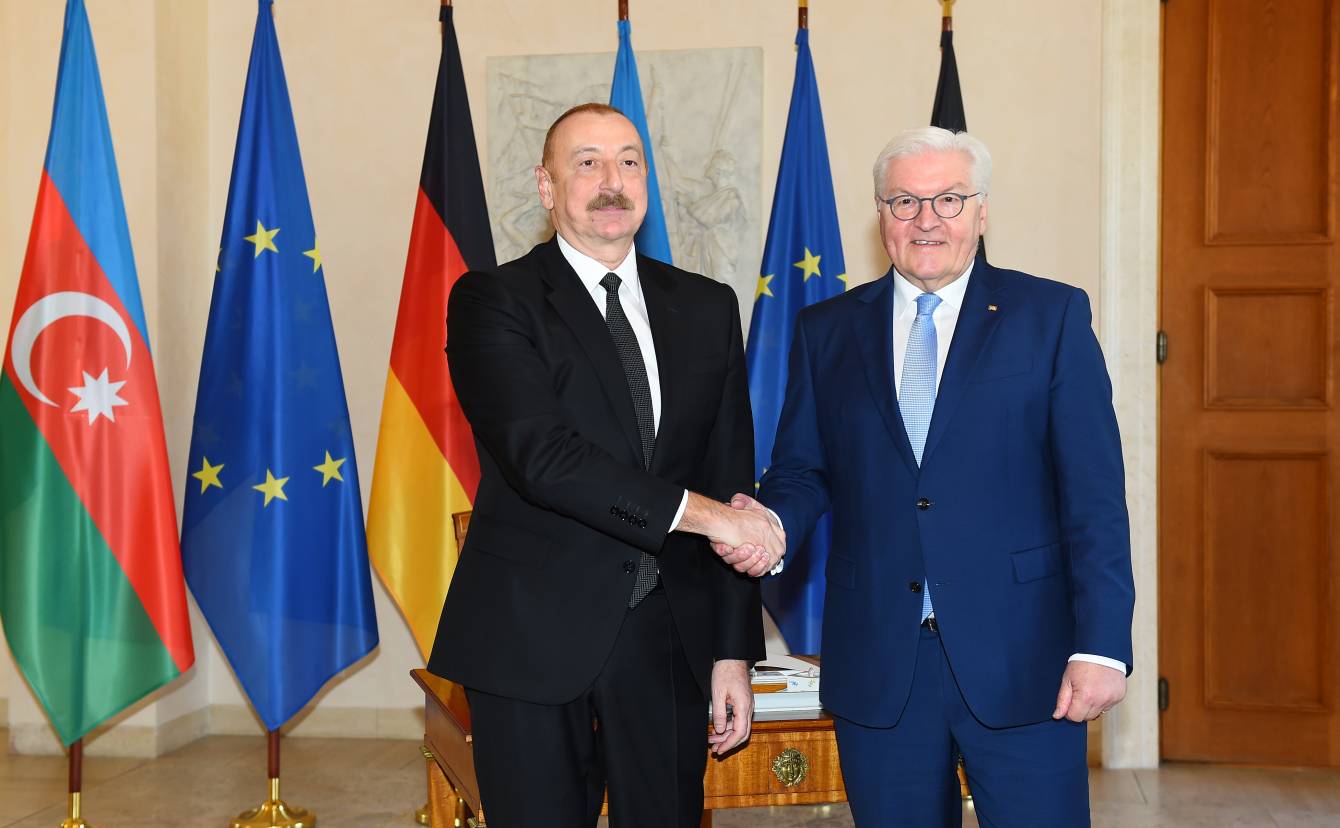
Baku, Azerbaijan, April 2. The visit of German
President Frank-Walter Steinmeier to Baku is taking place against
the backdrop of growing political and economic cooperation between
Azerbaijan and Germany.
In recent years, the two countries have demonstrated a strong
desire to deepen their collaboration in key areas such as energy,
transport, investment, and trade.
For instance, trade turnover between Azerbaijan and Germany has
shown steady growth. In January-February 2025, the volume of trade
between the two countries reached $485.4 million, an increase of
$315.1 million (2.8 times) compared to the same period in 2024.
Today, Germany ranks fifth among Baku’s largest economic
partners.
One of the main areas of cooperation is energy. Germany, seeking
to diversify its energy resource supplies, is increasingly
interested in projects where Azerbaijan plays a leading role.
In January-February 2025, Azerbaijan exported 500,000 tons of
oil and petroleum products to Germany, worth $276.5 million.
Compared to the same period in 2024, this represents a significant
increase: 5.3 times in value and 6.1 times in volume. During this
period, Germany ranked second among the countries to which
Azerbaijan exported the largest volume of oil.
Azerbaijan is already an important supplier of natural gas to
Europe through the Southern Gas Corridor. At the same time, Baku is
actively investing in expanding export routes and offering Germany
promising opportunities for cooperation in green energy, including
wind and solar energy projects.
In November 2024, German Vice Chancellor Robert Habeck discussed
gas exports and cooperation in renewable energy sources (RES) with
Azerbaijan’s Energy Minister Parviz Shahbazov in Baku. This
included the use of the Caspian’s wind potential and the production
of green hydrogen. Earlier, in March 2023, at the Berlin conference
“Energy Transition Dialogue,” Shahbazov held talks with over 20
German companies, including Siemens Energy, Uniper, and Notus
Energy, regarding electricity transmission and the development of
hydrogen projects.
Another crucial area is transport logistics. Azerbaijan plays a
key role in the development of the Middle Corridor – the route
connecting China and Europe through Central Asia and the Caucasus.
Germany, as the largest economy in Europe, is also interested in
integrating its logistics chains with this route, which opens up
additional opportunities for deepening cooperation.
In recent years, President Ilham Aliyev has been actively
promoting a foreign policy aimed at expanding international
relations, including close cooperation with Germany. During one of
his visits to Berlin, President Ilham Aliyev met with
representatives of 30 major German companies to discuss investment
prospects in Azerbaijan. This indicates that Germany recognizes
Baku’s economic potential and sees Azerbaijan as an important
partner in the region.
Moreover, Azerbaijan has established itself as a leading power
in the South Caucasus, a country that not only regional states but
also major global players must reckon with. Energy, logistics, and
sustainable development issues make Azerbaijan an indispensable
partner for Europe.
The economic benefits of the partnership are clear: Azerbaijan
provides Europe with energy resources, participates in the
formation of new transport architecture, and offers promising
opportunities for German investors. In this context, developing
relations with Azerbaijan is not only desirable for Germany but
also a strategically necessary step.