
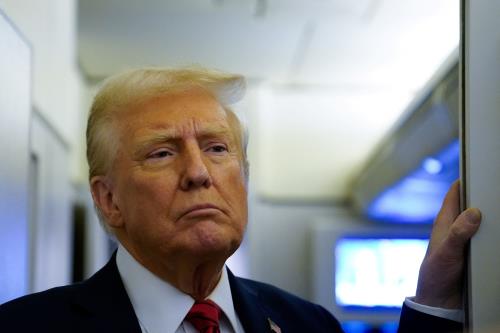

But why has he not yet managed to secure the truce? The British network lists in its analysis of the 5 reasons, which have braked its plans for the Ukrainian.
“I will solve the Ukrainian in 24 hours as soon as I become president,” Donald Trump promised with absolute confidence during his election campaign.
The same reiterated by the then Republican presidential candidate and in his meeting with Ukrainian President Voltimir Zelenski last September in New York: “If we win, I think we will solve it very quickly,” Trump said then.
But two months after Trump’s swearing -in, they probably now realize in the White House that trying to end a collision so wild and complicated can take a long time, the BBC comments. After all, Trump himself in a televised interview last weekend admitted that he was “a little sarcastic” when he promised to end the war in Ukraine in one day.
But why has he not yet managed to secure the truce? The British network quotes the five reasons, which have braked the US president’s plans for the Ukrainian.
Trump overestimated his negotiating abilities
The first reason is that Trump probably fell out of his estimates of his ability to conclude agreements on the power of his personal diplomacy.
It has long been claimed that any international problem can be solved if it is sitting on the table with another leader and closing a deal. Trump spoke for the first time with Russian President Vladimir Putin on February 12, writing their half -hour telephone conversation as “extremely productive”.
The two leaders re -sought on March 18, but their telephone conversations were fruitless. Instead of the immediate temporary 30 -day truce that Trump wanted, the only thing he managed to get from Putin was a promise to end Russian attacks on Ukrainian energy infrastructure, a commitment he defamed a few hours after the phone call, as Kiev’s.
Putin is not in a hurry
The second reason, according to the BBC analysis, is that Putin made it clear that he does not intend to rush to close an agreement. The Russian president made his first public comments regarding the negotiations during a press conference with his friend, Alexander Lukashenko, last week, a month after his first telephone contact with Trump.
Putin has made it clear that he opposes the two -phase of the White House for a temporary ceasefire before the Ukrainian settlement, noting that “the causes of the war” must first be resolved, as he said, the fear of the Kremlin for the sake of the Nathews.
At the same time, he raised a number of questions that need to be answered and set conditions that need to be fulfilled before an agreement was closed.
Wrongly focused Trump on Zelenski
The third reason, as the British network notes, is that it was probably incorrect for the Trump government’s strategy to focus its attention on the Ukrainian side. Trump believed that Zelenski is the obstacle to ending the war.
Western diplomats recognize that Kiev was slow to realize how much the international environment changed with Trump’s return to the White House. But Washington’s pressure in Kiev, which led to the offensive attack of Trump and his vice president, Jay Di Vance, against Zelenski at the Oval Office was wasting time, efforts and political capital, while causing the US relations with Europe with Europe.
The complexity of the conflict
The fourth reason, cited by the BBC, is the complexity of the Russian-Ukrainian conflict that makes any arrangement effort difficult. Kiev’s proposal was for a cessation of attacks on the air and sea, which could be relatively easily monitored.
But in their talks with the Ukrainians last week in Jeddah, Saudi Arabia, Trump’s envoys insisted that any immediate ceasefire should be applied to more than 1,200km long in the east, which was much more so entertained. And of course Putin rejected the proposal.
But even the Russian president’s consent to end attacks on energy infrastructure finds difficulties, which will be the subject of technical negotiations on Monday in Saudi Arabia. Defense and Energy experts will draw a detailed list of electricity plants – nuclear or non -nuclear power plants – which will be protected, while attempting to agree on which weapons systems should not be used by both sides. However, it may take time to determine what is political and energy infrastructure as Kiev and Moscow do not talk directly, but with Washington in between.
White House focusing on Ukraine minerals
The fifth speech is, according to the British network, the Trump government’s focus on the economic benefits of a US truce, which has gone attention to the priority of ending hostilities. Trump and his advisers spent valuable time trying to end up with Kiev on a framework agreement to assign US access to Ukraine’s rare land companies. “Someone saw this as US investment in the future of Ukraine, others as a blackmailing detachment of its natural resources,” the British network says.
Zelenski initially demanded from the US security guarantees that would prevent a future Russian attack in exchange for the mineral agreement, with the Trump government opposing that the presence of US mining companies and their Ukrainian employees will operate. The Ukrainian president eventually attacked the pressures to sign the agreement without security guarantees, but Washington has not yet approved it by looking forward to improving its terms so that it could include any access or even ownership of Ukrainian nuclear power plants.
The truth is, the BBC says, that without Trump’s pressure, they would not even begin consultations on the end of the war. But, as developments in the last two months show, the goal is difficult to achieve soon.
Source: iefimerida.gr