
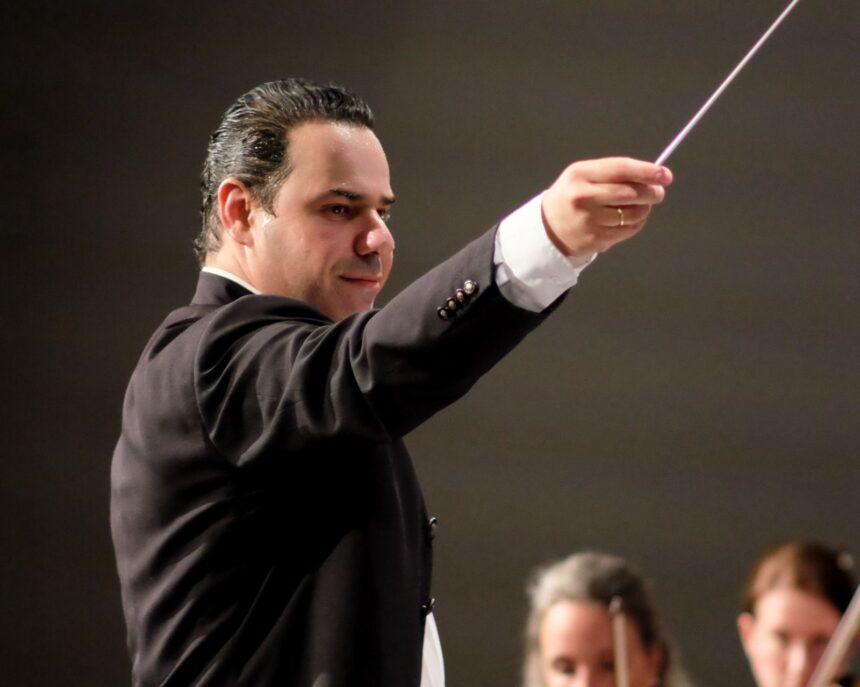
Anar Bramo (Ibrahimov), born in 1981 in Baku, has made
significant achievements in the world of music. In 2002, 185 years
after Paganini’s death, he became one of the 14 violinists honored
to perform on Paganini’s “Sivori” violin. Between 2003 and 2007, he
was a member of the famous “Kremerata Baltica” chamber orchestra,
invited personally by Gidon Kremer. Since 2010, he has been a
member of the “Südwestfalen Philharmonie” symphonic orchestra in
Germany. In 2023, he became a finalist and prizewinner in the “BMI
Conducting Competition” held in Bucharest. In 2024, he was awarded
the first prize at an international conducting competition in
Portugal. Since 2024, he has been appointed as the new chief
conductor of the “Oberberg” region’s symphonic orchestra
(Sinfonieorchester des Oberbergischen Kreises).
Trend
presents an interview with Anar Bramo, a renowned conductor,
violinist, composer, and international competition winner,
currently residing in Germany.
What led you into the world of
music?
I believe that becoming a musician was part of my destiny. My
father, a violinist, has been playing with the State Symphony
Orchestra under the guidance of the legendary Niyazi since he was
22. My mother, a harpist, was the first-prize winner of the last
Transcaucasian competition. My uncle, a renowned cellist, and
People’s Artist, was a student of the great Mstislav
Rostropovich.
Growing up in such a musically rich environment, I began playing
the violin at the age of five and had my first performance on the
Philharmonic stage at just seven. By the time I was 17, I was
accepted into the Baku Music Academy, and during my first year, I
had the honor of performing Brahms’ Violin Concerto with the State
Symphony Orchestra.
You moved to Germany specifically for music, more
precisely for violin. Could you tell us about the journey from
Azerbaijan to Germany?
Two pivotal events led me to Germany in 2002. First, I graduated
with distinction from the Baku Music Academy. Second, I was
selected to participate in the Tchaikovsky Competition, becoming
the first Azerbaijani violinist to compete in this prestigious
event.
While I didn’t win due to my limited experience, my performance
and potential caught the attention of the jury. Several members
recommended that I pursue further studies in Moscow or the US,
while many esteemed musicians encouraged me to apply to the
world-renowned music conservatories in Germany, where the finest
teachers teach.
Following the competition, I realized that I needed to continue
my education to refine my skills. After consulting with my parents,
we decided that Germany would be the ideal place for my studies,
given its world-class conservatories and strong orchestral
traditions. By the end of 2002, I successfully passed the entrance
exams for the Essen University of Arts (Folkwang University of the
Arts), marking the beginning of my journey in Germany.
What has the German music school given
you?
It’s no secret that Germany is a country rich in cultural life.
The best musicians perform here, the most renowned pedagogues
teach, and the strongest orchestral traditions exist. All of this
creates the ideal conditions for developing musical talent.
Making full use of these opportunities, I graduated from three
universities, not just one or two in Germany, in Essen and Cologne,
and one in Graz, Austria. I graduated from all three institutions
with distinction.
Who supported you the most in
Germany?
My journey to Germany was only possible thanks to the unwavering
financial and moral support of my parents. Despite not being
wealthy, they sent me money for an extended period, earned through
their hard work, so I could adjust to life in a foreign country,
learn the language, and find employment.
In fact, I owe all my success to them. They raised me and my
sister in a way that ensured we had a happy childhood, provided us
with a good education, and continue to support us to this day.
I arrived in Germany on my own, without my parents. However, I
was not entirely alone, as my close friend and namesake, Fuad
Ibrahimov, was here with me. He is currently the chief conductor of
the State Symphony Orchestra.
Our friendship could fill a book, but that’s a story for another
time. I will simply say that in Germany, we always supported each
other, and our bond was crucial in helping both of us navigate and
overcome challenging moments in a foreign land.
You had the honor of performing on Paganini’s
violin. You achieved this in Azerbaijan. Could you talk about this
experience and how it was received in Germany?
Performing on Paganini’s “Sivori” violin was one of the most
important moments of my life. This happened thanks to my late
teacher, Bayandur Mehdiyev, and the then Ambassador of Italy to
Azerbaijan, Margareta Kosta. The concert was organized with the
support of the Ministry of Culture of Azerbaijan and the Heydar
Aliyev Foundation.
The violin was brought from the museum in Genoa, Italy, to Baku.
Both of Paganini’s violins (“Il Cannone” and “Sivori”) were in Baku
for just two days, and it was during this period that I had the
chance to perform on the “Sivori” violin. Imagine how nervous I
was! Over the past 160 years, only 13 people have performed on this
violin, and almost all of them were Italian. I was just 22 years
old and had never played on such a high-level violin before.
Moreover, this was not just any violin—it was a historically
irreplaceable instrument.
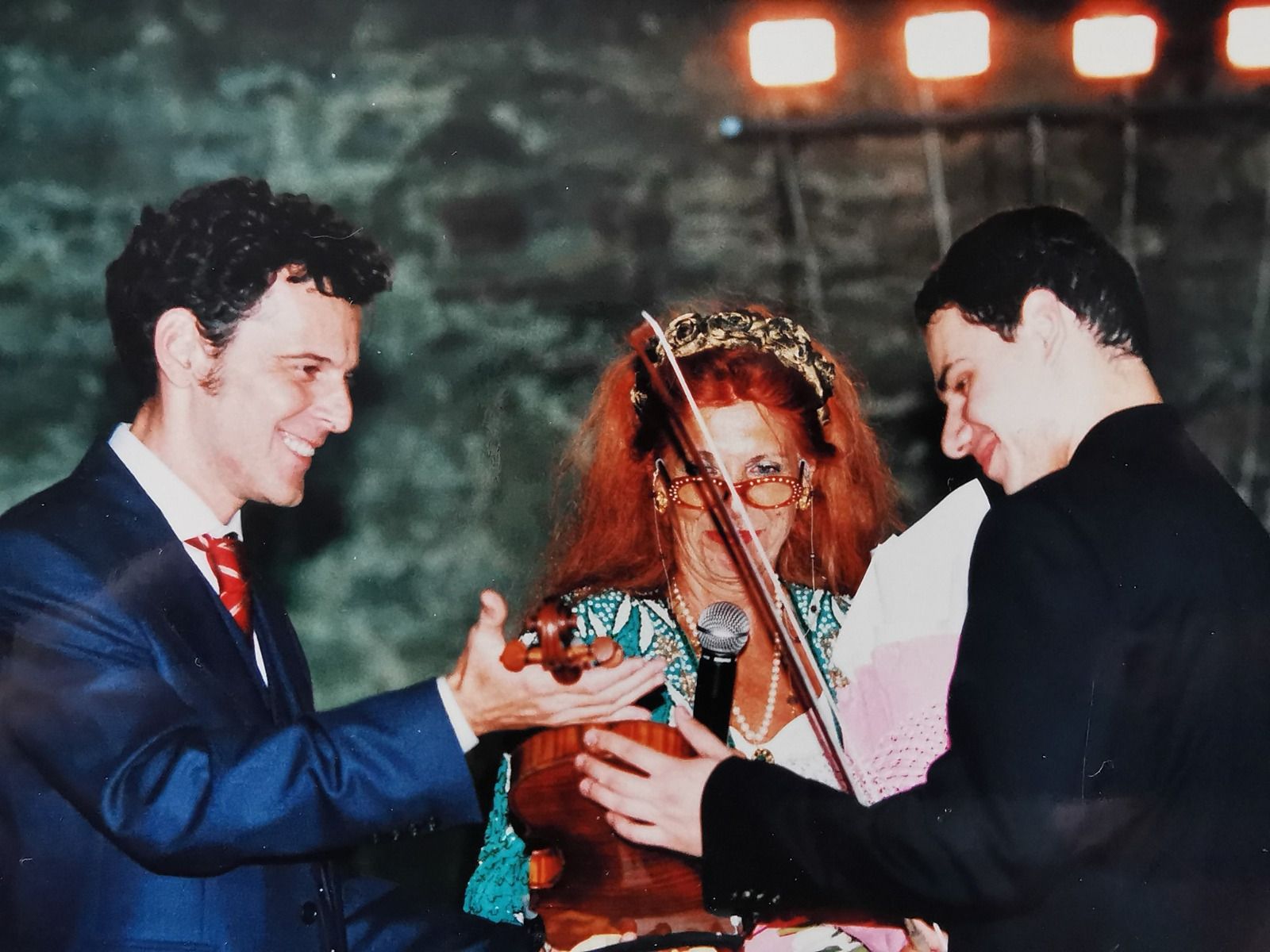
The violin was brought directly to the stage for me, and it was
introduced at the beginning of the concert. After the concert, I
returned to it on stage. The event took place at the Ateshgah
Temple, and it was an unforgettable moment for me. The sound of the
violin was powerful and beautiful, and playing it was a real
pleasure. I was grateful to fate for giving me such an opportunity,
and I felt proud that an Azerbaijani violinist’s name was now
written in the history of Paganini’s violin.
How did your appointment as a conductor
happen?
I began conducting relatively late, in 2021. I made a promise to
myself that if I didn’t succeed, I would step away from the field.
However, just two years later, in 2023, I reached the final of the
international conducting competition in Bucharest, Romania, and was
honored with the jury’s special prize. This achievement confirmed
that I was on the right path.
In the summer of 2024, I won first place in my second
international conducting competition, held in Estoril, Portugal.
Remarkably, just a month before this competition, the
Sinfonieorchester des Oberbergischen Kreises, the symphonic
orchestra of the Oberberg region in Germany, appointed me as their
chief conductor.
It was an immense joy for me when this orchestra offered me the
position of chief conductor. The year before, I had performed with
them in three different concerts, all of which were very
successful. I believe it was these performances that convinced the
musicians to select me as their conductor.
When did you start your composition
career?
In 2020, I composed the music for a song titled “Ürəyim Şuşa”
(“My Heart is Shusha”) and asked the renowned Azerbaijani poet
Leyla Begim to write the lyrics. A year later, in 2021, this song
was performed at a concert dedicated to Azerbaijani music,
organized by the State Committee for Diaspora Affairs of
Azerbaijan. The concert took place in Berlin, on the prestigious
Philharmonie stage. The song was beautifully performed by renowned
Azerbaijani singer Avaz Abdulla, with the direction of Azerbaijani
People’s Artist, maestro Yalchın Adıgozalov. Following the concert,
I received positive feedback from many German and European music
enthusiasts, which was incredibly gratifying.
It’s still too early for me to officially call myself a
composer. Currently, I am taking composition lessons and plan to
present new works in the future. If my plans materialize and my
compositions come to life, then I will cautiously begin to embrace
the title of composer.
How do European, specifically German, listeners
react to your performances? In general, how do the average Germans
recognize you – more as a violinist, conductor, or
composer?
So far, I am more widely recognized as a violinist, both in
Germany and Azerbaijan. However, following my victory in the
conducting competition, I’ve begun receiving an increasing number
of offers to conduct. For instance, I will be performing in Germany
on March 30 and in Portugal on April 5.
Have you worked with other Azerbaijani musicians in
Germany?
I have had the pleasure of performing multiple times with
various Azerbaijani musicians in Germany. Some of them include
Yalchin Adigozalov, Fuad Ibrahimov, Mustafa Mehmandarov, Avaz
Abdulla, Orkhan Jalilov, Tamila Guliyeva, Abuzar Manafzadeh, and
others.
Have you discovered any new hobbies or interests
since moving to Germany?
Since childhood, I’ve been passionate about films and make it a
point to watch new releases whenever I have free time. I also enjoy
playing table tennis, billiards, and basketball. In addition, I
love spending time in the kitchen and cooking. Since I’m quite fond
of pastries, I’ve learned to prepare a variety of cakes and
pies.
However, I don’t have much time for hobbies these days as I
prefer to spend my free time with my family—my wife and my
five-year-old daughter.