

“Chronicle of Presenter, The Unframed 70s” | Frames and Notes Explore Man, Glin Hughes
“A Chronicle, the 1970s Without Frames” is the venture presented in the exhibition with works and archives by the great Glin Hughes, hosted in N_C_ANNEX, an artistic place in the history of Cyprus since it was the last location of one of the first galleries in Cyprus. Earlier, and perhaps on this journey, the contribution of the “Decision” Gallery of the prominent Christopher Savva and the also important Welsh Artist, Teacher, Art Critic and Cinema and Cinema Announcement and Even Announcer of News, Glin Hiouz, for whom he begins.
First act of Glyn Hughes Foundation, organizing the exhibition, the 1970s, which, as they record, “was not just an artistic stage for Glin, was an act of shift: from the Western observer to the rooted witness of the Cypriot experience.” “The Foundation restarts its actions and we will probably be co -founded at Nasty Cat, Annex,” says Yianna Tsolakis on behalf of the Foundation and as one of the two curators of this report. “It’s just the beginning of the 1970s,” adds Ms Tsolakis, expressing hope that they will be able to carry out a series of reports on different themes approaching the work of the great artist. “The ’70s was a difficult time, as in this decade they are experiencing the Turkish invasion, and earlier we have bi -communal riots and Glin had contact with both communities, with Greek Cypriots and Turkish Cypriots. Remember that he taught Junior and English School, which was a mixed school. “
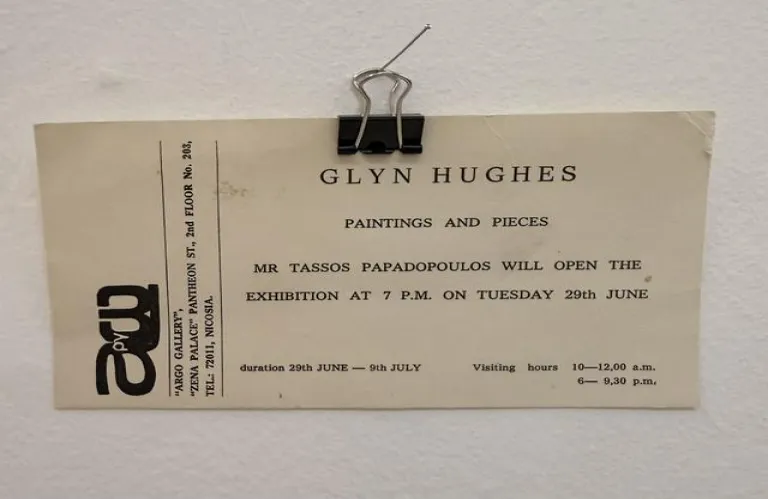
Regarding the need for Glin Hughes to the forefront, Mrs Tsolakis says that “the vision and the goal is to look at: How does Glin Hughes still be modern? Because this dialogue with Glin is still relevant or this opening to society to study GLYN, today, after so many years, 50 years later. And later, we will go even further. ” Asked why the 1970s was chosen as the starting point, Mrs Tsolaki replied: We found, basically, that there was a nice circumstance. In June 1971, about the same days as we chose the exhibition, Glin Hughes was hosted at the Argo Gallery when he was in Nicosia. In the gallery of which the last location, in Cyprus, is the place to host the exhibition. It was then, June 29, 1971 and now the exhibition opened on June 19, and on June 30, the day after the opening of the time, we are organizing a discussion with Dr Gabriel Koureas, as we chose the exhibition to close its doors on July 9, as happened in 1971. “
On the cooperation of curating with artist Athena Antoniadou, she stated that “she is an artist who is multifaceted, and as a person. He has an opinion and can certainly support this synergy. The goal is not talking about the ’70s, but today how we see what they did then and why they were important, modern and remain. ”
“I want to believe that there will always be co-care in the actions, to come in to come in with people who can offer their own visual-priests for the decade or theme. The goal is to make a synergy today. This synergy is also a reference to its own Synergies, to these gatherings he organized and brought to Cyprus. “
What does the report present?
From the 1971 cultural event, the invitation, the list of works presented at the time, but also in the space, can be released the book “Art in Argo – Nicosia, Athens 1970-2010” which makes a small reference to this exhibition, including a criticism of the Exhibition work. At the same time, there are, of course, some of the works of Glin Hughes of the 1970s, as a very interesting axis of the exhibition is that it does not only stand on these works but extends. In particular, it gives the public the opportunity to read some of his notes, the letters he received and sent, as well as a part of his photos from moments that he or she was photographing. Another element is that material, mainly photographs and programs from his work on theater are displayed. Commenting on the contents of the report, Mrs Tsolaki said that “his works may have been exposed to his large retroactive Nimac, but here he will also see personal material, which is not in chronological order, is not archived on the basis of the date, but we tried.”
“The archive is huge. He probably needed to record what he felt, happened and experienced on a personal level but also in the “Decision” gallery, at work and therefore in the schools he taught. It’s like he left all this material to find out more about him as a human being and not just Glin from his work. Perhaps the only thing that is not known is his work for theater, works, stage, masks, costumes and all that he made for performances. Glin had a very good pen, he wrote very well – when he wrote plays. One aspect I consider has not been exhausted in the past, since it seems not to be so well known. ”
For the archive and discussion scheduled for tomorrow, Monday, June 30, 2025, we also talked with art historian Dr Gabriel Kourea who were invited to coordinate. Dr. Kouraas said that he was interested in him as “how we can work it, how we can activate it and get it out of the boxes that were today”, also revealing that it is in the effort to find funding, through a European program, to be able to archive it.
Dr. Koureas also said that “Glin Hughes’ work is multidimensional, it was not just painting. He was also a teacher – after teaching Junior and English School – made sets, costumes, as well as organizing his wonderful gatherings – the so -called synergies. At that time it brought something very original and pioneering for Cyprus. It was the time when he had begun in Europe and America in the 1960s, and Glin Hughes brought this stream to Cyprus as well. ”
Glin, Dr. Kouraas emphasized, “was trying to create this artistic group, hence the idea of the Synergies we lost in the 1980s. We come across this idea again, more intensely, in the sessions project, and to some extent through the throat. “
Glyn beyond the work
How difficult was it to be unframed at that time? Glin was a Welsh, an artist and openly gay who was in Cyprus in a colonial period, and lived at a time when homosexuality was a criminal offense. Of course, he himself, as Mrs Tsolakis shares, felt that the colonial sign was not represented by him, though he was considered English. “It also plays the element of disclosure in the work and its actions. It may have been a need to penetrate and come closer to the Cyprus community. Others in similar positions, e.g. Teachers at English School, did not penetrate the community so much, they did not need such a need. They remained in their own circles, while Glin had the need to see it differently. ”
The report, Dr. Kouraas notes: “It brings you close to his world, e.g. A note is presented for the five -fold. Through it, it turns out that he saw the landscape of Cyprus. That is to say, a colonialist becomes part of the landscape of Cyprus, as his identity seems to change through the years. At the same time, his sexuality is shown in other notes. “