
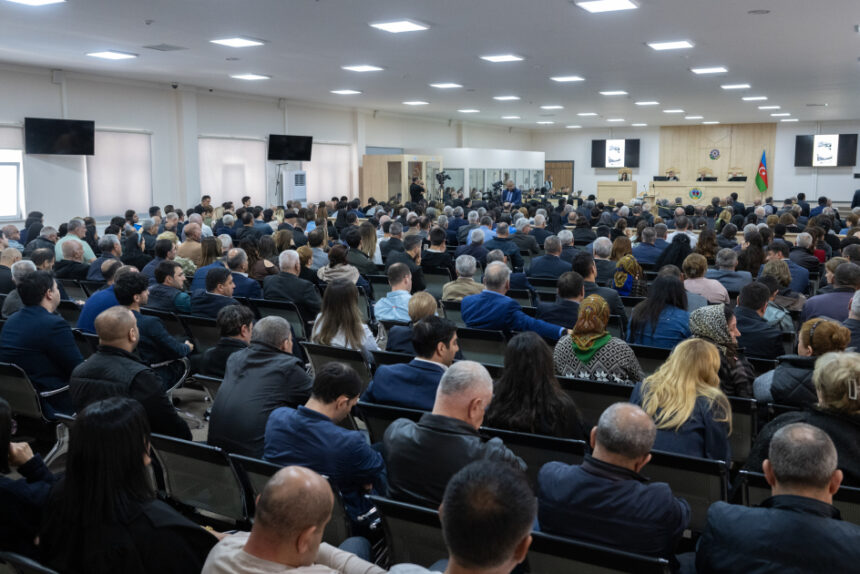
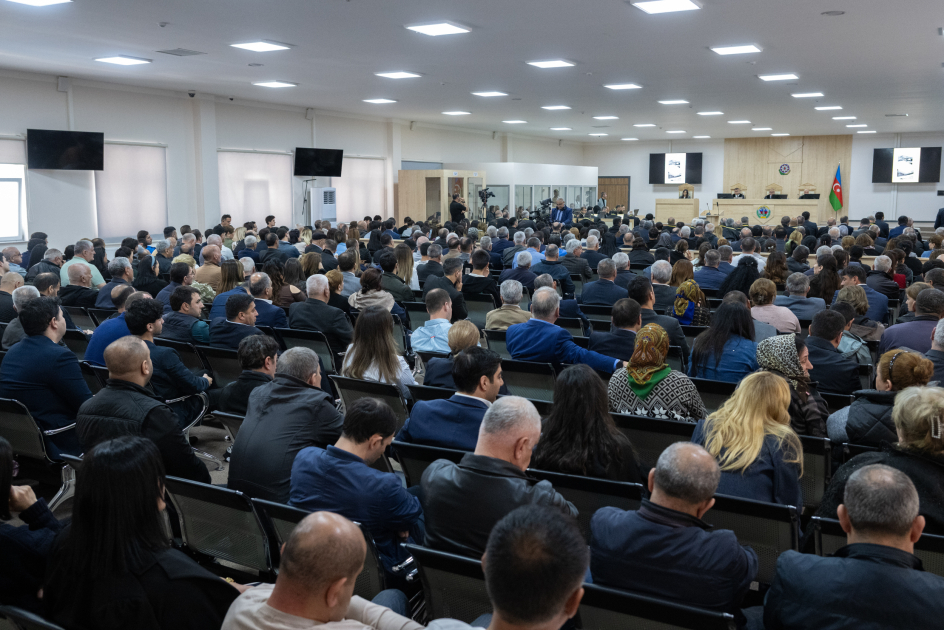
Baku, Azerbaijan, April 24. Court hearings on
the criminal case against citizens of the Republic of Armenia –
Arayik Harutyunyan, Arkadi Ghukasyan, Bako Sahakyan, Davit
Ishkhanyan, Davit Babayan, Lyova Mnatsakanyan, and others – who are
accused of committing crimes against peace and humanity, war
crimes, including the preparation and conduct of a war of
aggression, acts of genocide, violation of the laws and customs of
warfare, as well as terrorism, financing of terrorism, forcible
seizure of power, forcible retention of power, and numerous other
crimes resulting from Armenia’s military aggression, continued on
April 24, Trend
reports.
The hearings, held at the Baku Military Court, were presided
over by Judge Zeynal Aghayev and a panel consisting of Jamal
Ramazanov and Anar Rzayev (with reserve judge Gunel Samadova). Each
of the accused was provided with an interpreter for the language of
their choice, as well as defense attorneys.
Present at the hearings were the accused and their defense
attorneys, some of the victims, their legal successors and
representatives, as well as prosecutors in charge of public
prosecution.
First, the court examined documents related to the events that
occurred before the occupation of Shusha. The first fact recorded
in the protocols dates back to December 13-14, 1989, while other
events were recorded in subsequent periods.
According to the documents studied by the prosecutors, the city
of Shusha and surrounding villages were repeatedly fired upon by
Armenian armed forces with various weapons, including rockets and
artillery, before the actual occupation. In the aftermath of such
shelling, Azerbaijanis were killed, injured, and taken
prisoner.
In addition, Armenian armed forces blew up water pipelines and
high-voltage power lines in villages inhabited by Azerbaijanis,
causing serious damage to education, health, and other public
facilities, as well as to people’s homes, cars, and other
property.
Criminal cases related to these facts were initiated at the
time.
The events also included incidents commonly known as the
Malibayli and Gushchular massacres, which involved the mass killing
of civilians and the occupation of both villages.
Another protocol examined in court related to the firing on a
helicopter flying to the village of Goytala in Shusha district on
April 4, 1991. On that day, at around 12:00-13:00, flight number
27057 of the Ministry of Internal Affairs, heading to Goytala with
members of the Supreme Council of the Republic of Azerbaijan on
board, was damaged by fire opened from the Armenian-inhabited
village of Eksaok. The helicopter crashed and burned during a
forced landing in the village of Turshsu, and some of its
passengers were injured.
Another protocol disclosed in court related to the shooting down
of a passenger helicopter on January 28, 1992. It was noted that
the passenger helicopter, registration number MI-8T of “AZALPANX”
Zabrat airline under the umbrella of the AZAL civil aviation
company of the Republic of Azerbaijan, had taken off from Aghdam
airport and was headed to Shusha when it was shot down by Armenian
armed forces from the territory of the village of Karkijahan in
Khankendi. The helicopter crashed and exploded on a dirt road
leading from the village of Khalfali to the village of Gaybali in
Shusha district. A total of 42 people, including three crew members
and 39 passengers, were killed in the crash. Protocols on the
inspection of the scene and bodies revealed that those on board
were found burned and dismembered during the explosion, which was
accompanied by fire. Fragments of the wreckage were removed from
the scene. Forty-two people died as a result of the explosion.
Then, victim Elkhan Alakbarov testified that he had worked in
the Shusha police department and witnessed the events before and
during the occupation.
Elkhan Alakbarov said that a curfew had been introduced in the
city of Shusha, where he lived, on September 20, 1988, due to
Armenia’s territorial claims against Azerbaijan. In response to
questions from Senior Assistant to the Prosecutor General Vusal
Aliyev, he said, “At various times, we faced great problems in our
travel to and from Aghdam and in our communications with other
districts. They would stone us on the road. They also hit my late
father on the head with a stone while he was on a bus, injuring
him. Perhaps that eventually caused his death.”
He then noted that Shusha had been subjected to heavy artillery
fire, especially from the directions of Topkhana and Shushakend.
“They were shelling us with “Alazan” type rockets. For example,
civilian Fuzuli Aydin oglu Farhadov was killed as a result of an
“Alazan” rocket landing while he was at home.”
The victim also spoke about an attack on the village of Nabilar
in Shusha on November 5, 1991. “A resident of the village, civilian
Vahid Sevindiyov, was killed. In that battle, I received a serious
gunshot wound to the head. I was hospitalized for a long time,
discharged, and then returned to our city.”
In response to questions from the Assistant to the Prosecutor
General for Special Assignments Tugay Rahimli, he said that during
routine shelling of Shusha, a police department was hit and police
officer Nizami Mammadov was martyred. “Two more police officers
were injured. Of the wounded, Sadig Huseynov did not recover either
and was martyred.”
The victim also said that the population of Shusha suffered from
a lack of water and bread due to the explosion of water pipelines
and road closures. “We lived under constant fire from the end of
1989 to May 1992”.
Regarding the occupation of Shusha, the victim also said that no
corridor was provided by Armenian armed forces for civilians to
leave the city. “If a corridor had been provided, I would have
known that for sure. There was no corridor. The population left the
city with tremendous difficulties. For example, a woman named
Firuza died of a heart attack while climbing a hill.”
Witness Sahib Sariyev testified that he was born in Shusha in
1967. He said he had regularly traveled to Khankendi and recognized
those in the dock. “Of those sitting there, Bako Sahakyan and
Arkady Ghukasyan were the ones I knew personally. We had worked at
the Malibayli pavilion in Khankendi since September 1988. These
people knew the place well. On September 17, 1988, they stormed
Malibayli with stones, wood, and metal in hand. Some of them were
directly involved in those events. We stayed there until September
17 and then went to Shusha. We also closed the restaurant
permanently. They would not allow it to operate. They were in a
state of readiness. Millionaire Armenians from Lebanon, Syria,
Canada, and France were sending them money. Manucharov, the
director of the quarry, Narimanian, the director of the
slaughterhouse, Badamyan, the director of the truck depot, and
Sehranyan, the director of the lamp factory, who lived in
Khankendi, managed them.”
The witness also spoke about the explosion of the gas station
where he worked, by illegal Armenian armed groups. Sahib Sariyev
said he had worked as a senior operator at a gas station on the
left side of the road from Shusha to Lachin city, at the 112th
kilometer of the Yevlakh-Lachin road. He was working at the gas
station on rotation with Ilgar Agalarov. The witness said that on
March 23, 1990, at around 8:00 pm, he closed the gas station and
went to Shusha. The next day, when he arrived at the gas station at
around 7:00 am, he saw police officers and firefighters there. He
also noticed that the A-76 tank with 15,000 rubles worth of
gasoline was on fire, that windows of the wagon at the station were
smashed, and that the telephone worth 95 rubles in the wagon was
gone.
Victim Ilham Hasanov said in his testimony that he was born in
Shusha in 1960 and lived there. In response to questions from
public prosecutor Vusal Abdullayev, he said that his brother,
Rovshan Hasanov, went missing in Shusha in the early hours of May
8, 1992.
“At that time, bombs were raining down on Shusha,” he added.
The victim said that his two-room apartment on N. Narimanov
Street in Shusha and the furniture in the apartment were left
behind.
Hikmat Zeynalov, who was identified and interrogated as a
victim, said in his statement that he was born in Shusha and served
a year and a half of his military service in Armenia, in
Echmiadzin. He said, “I have also been to other regions of Armenia.
Armenians lived well in Karabakh. They had a good life. They set
people against Azerbaijanis, shed our blood, and occupied our
lands.”
Hikmat Zeynalov lived in a two-story private home with a
courtyard located on M. Vazirov Street in Shusha. On May 14, 1992,
during the shelling from the direction of Mukhtarkand and
Shushakand of Khojaly district, one of the incendiary rockets hit
his house, causing it to collapse and burn down completely along
with all its belongings. As a result, Hikmat Zeynalov suffered
material damage.
“My mother passed away in 2013 due to longing for our lands. I
can forgive everything, but I will never forgive my mother’s
passing due to that,” the victim said.
Other victims also answered questions from public prosecutors,
representatives of the victims, and the defense.
The victims asked the court to hand down the most severe
punishment for the accused.
The next court hearing is scheduled for April 25.
We recall that a total of 15 Armenian nationals are being
charged with numerous crimes involving direct leadership and
participation of the Armenian state, its state bodies, military
forces and illegal armed formations, verbal and written
instructions, orders and assignments, provision of material and
technical support, central governance, as well as the exercise of
rigorous control, with the aim of committing military aggression
and acts of terror against the Republic of Azerbaijan in the
territory of Azerbaijan in violation of domestic and international
law, and involving Robert Sedraki Kocharyan, Serzh Azati Sargsyan,
Vazgen Mikaeli Manukyan, Vazgen Zaveni Sargsyan, Samvel Andraniki
Babayan, Vitali Mikaeli Balasanyan, Zori Hayki Balayan, Seyran
Mushegi Ohanyan, Arshavir Surenovich Garamyan, Monte Charles
Melkonyan and others, including criminal acts committed during the
course of the war of aggression waged by the aforementioned
criminal group.
The said persons, i.e. Arayik Vladimiri Harutyunyan, Arkadi
Arshaviri Ghukasyan, Bako Sahaki Sahakyan, Davit Rubeni Ishkhanyan,
David Azatini Manukyan, Davit Klimi Babayan, Levon Henrikovich
Mnatsakanyan, Vasili Ivani Beglaryan, Erik Roberti Ghazaryan, Davit
Nelsoni Allahverdiyan, Gurgen Homeri Stepanyan, Levon Romiki
Balayan, Madat Arakelovich Babayan, Garik Grigori Martirosyan,
Melikset Vladimiri Pashayan, are being charged under Articles 100
(planning, preparing, initiating and waging a war of aggression),
102 (attacking persons or organizations enjoying international
protection), 103 (genocide), 105 (extermination of the population),
106 (enslaving), 107 (deportation or forced displacement of the
population), 109 (persecution), 110 (enforced disappearance of
people), 112 (deprivation of liberty contrary to international
law), 113 (torture), 114 (mercenary service), 115 (violation of the
laws and customs of warfare), 116 (violation of international
humanitarian law during armed conflict), 118 (military robbery),
120 (intentional murder), 192 (illegal entrepreneurship), 214
(terrorism), 214-1 (financing terrorism), 218 (creation of a
criminal association (organization)), 228 (illegal acquisition,
transfer, sale, storage, transportation and possession of weapons,
their components, ammunition, explosives and devices), 270-1 (acts
threatening aviation security), 277 (assassination of a state
official or public figure), 278 (forcible seizure and retention of
power, forcible change of the constitutional structure of the
state), 279 (creation of armed formations and groups not provided
for by law) and other articles of the Criminal Code of the Republic
of Azerbaijan.