

“The Turkish leader raised cooperation issues in a number of areas that touch state sovereignty: hydrocarbons, water and more. And I am glad that our positioning that such cooperation cannot be done, it was understood by the Secretary General. ”
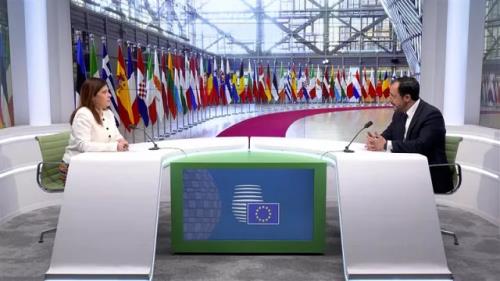
Just hours after the informal five -member for the Cyprus issue, the President of the Republic of Cyprus, Nikos Christodoulides, makes a first assessment of what happened in Geneva. Speaking to Euronews and Maria Psaras, she also reveals what she discussed with the EU leadership.
How did the meetings with the presidents of European institutions go?
They were very good meetings, productive, following the meeting yesterday in Geneva. And to start with this, the European Union’s involvement, the European Union’s intervention, both the telephone communication of the President of the European Council, but much more the joint letter of the Commission’s President and the President of the Council was a reference point just before the Conference on the role, the interest of the European Union and the interest of the European Union and the interest of the European Union in the European Union. Geneva. A conference that, in order to use the words of the Secretary -General, for the first time since 2017 we have positive developments.
And that is very important. You see the European Union determined to play an active role just in the pre -and after negotiations process.
I see the European Union and I am very pleased that the European Union sees two things on our own: our credibility, our political will, and at the same time the role that the Republic of Cyprus plays wider.
The Republic of Cyprus is not only the Cyprus problem, the Republic of Cyprus – and it was something I have just discussed with the President of the European Council – is a state that will continue to be a Member State and after the solution of the Cyprus problem and should be able to further enhance this role that, for example.
I repeat, the letter is a reference point on the Cyprus issue and the negotiations for the reopening of talks.
What was Turkey’s role in Pentameri now? Mr President?
It was the most decisive role of Turkey, you realize and everyone knows it, I don’t have to say that decisions will be made by Turkey in relation to the re -opening of talks and the resolution of the Cyprus problem. I am glad that yesterday, in addition to the letter from the European Union that I hold as very important, we had the decision to appoint a personal envoy of the Secretary -General.
From now on we have now agreed on the next meeting in July. But you know, they are very important and those that have been avoided. First, the Turkish Cypriot leader raised cooperation issues in a number of areas that touch state sovereignty: hydrocarbons, water and some other issues. And I am glad that our positioning that such cooperation cannot be done, it was understood by the Secretary General.
The Turkish Cypriot leader did not want to appoint a personal envoy of the Secretary -General. This has been avoided. There was intention to undergo public statements made by a specific document in relation to the solution of the Cyprus two states. The whole discussion, the evolution of the debate, the positions of the Secretary -General did not allow this.
So it’s not only the positives, they are also the ones that have been avoided in this great effort, where Turkey’s role is crucial.
And I also come to this intense interest we see from Turkey in terms of Europeans. Regarding the discussions we have here in Brussels, finally on defense issues, enhancing the architecture of the European Union, we are seeing an increased interest in progress, specific progress, in the Euro -Turkish and our message and the message of the European Union was clear: all this can be examined through specific developments.
You had a tie-a-tete with Turkey’s Foreign Minister, Mr. Fidan, who appeared a little different at this meeting. What exactly did you say?
It was a social meeting with Mr. Fidan, with whom I had the opportunity to discuss during the expanded debate in the presence of both the Secretary General, as well as Mr. Tatar and the representatives of Greece and Britain.
There we had a meaningful debate, because I expressed the readiness of the Republic of Cyprus, for example, for confidence -building measures for the Turkish Cypriots, as well as measures to build confidence between the Republic of Cyprus and Turkey.
And I also expressed my readiness to him, addressing him, to see positive developments in Euro -Turkish, if and when I repeat, there are specific developments in the Cyprus issue, as clearly recorded in the conclusions of April 2024.
Exactly. I want to get you on the subject of European defense. The topic at the summit will be competitiveness, of course, but the defense will dominate. What will be a successful meeting for you, the result that would satisfy you in relation to defense?
You said rightly that tomorrow the main issue is competitiveness. But we will also talk about the presentation by the Chairman of the White Bible Committee on Defense Issues. And defense and competitiveness are linked to each other.
How do they connect? With the great goal and strategic autonomy of the European Union. You cannot have strategic autonomy unless you have competitiveness, unless you are a strong European Union in competitiveness, if you do not have strong defense. And I am glad, despite the fact that it is the circumstances that have pushed us in that direction, the Republic of Cyprus, along with other Member States, have long been discussing the need to move forward.
And finally, the Commission has passed today, the White Bible will be presented by the Commission President and in June we will have a more detailed debate on defense issues. And it is a pleasure to see at a time when, you know, these decisions of the 26th and to be left out of Ukraine, it is not something we see as positive, it creates a precedent that is not positive, but on the issues of defense I am glad because I see all 27 Member States.
EU role in the Middle East and Ukraine
At the same time in the Middle East there are developments. The truce has virtually collapsed and I want to ask you about the role of the European Union at this given historical moment in this region, with Trump exactly the opposite and contrary to all this momentum.
Thanks for your question, because one of the issues we have now discussed with the President of the European Council. It is not only that the truce has collapsed in the Middle East, we also have developments in Syria. We saw unacceptable events last week that create, for example, a new wave of immigration. They create, if you will, problems and challenges in neighboring states. And we really see – or at least this is the appreciation in the region – that there is no interest in the United States, as before.
So we have an obligation as a European Union to fill this gap.
At the end of the day we are talking about the neighborhood of the European Union and this is one of the key priorities of the Cyprus Presidency that begins in January 2026. We discussed it today with the President of the European Council and I will also organize a special meeting in Cyprus as a Cyprus Presidency. And in this context, I also greeted the presence of the President of the European Council at the recent Arab League meeting. It was very important to be there as a European Union.
At the table of Ukraine negotiations, but we are not yet President and I wonder if the EU can increase its influence in relation to the permanent ceasefire for the Ukraine war.
Developments in Ukraine, on the border of Europe, directly affect the European Union and as a European Union yes, we must claim a role because no one will give us a role.
We will have a teleconference with the president of Ukraine. There seems to be some positive developments and the European Union is the only one if you want to be accepted to ensure any possible agreement. So we have a role to play. What we need to do is to claim a clearly bigger role.
Source: gr.euronews.com