

caramel_cy@yahoo.com / Tel: 99966518
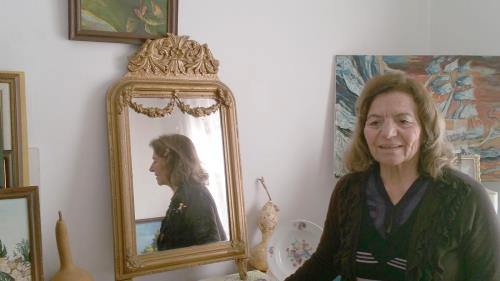
(Photo: Frah Kaya who found the mirror of Kakulus at home a few years later)
How did we write the stories of “missing” and “mass graves” all these years? We wrote these stories through the testimonies of the eyewitnesses, through those words who lost their loved ones, through stories as their spouses, daughters or sons told them. Or a close relative if they had no one to tell their stories. Some of those who were “ignored” had no close relative since they were not married or had no children. An example is John and Kakoulou who lived right next to the old grocery store in the northern part of Nicosia – Kakoulou was from Gialousa and was married to his uncle Takis Hatzidimitriou. At the end of December 1963, they were both killed and are still “missing”. I had a hard time finding who they were really, until a reader who read my article in the newspaper “Politis” wrote to me and brought me in touch with a relative of Kakulus in London. John and Kakoulou had not even been registered with the official “List of Missing” by Greek Cypriot officials, and I had to talk to the CMP, as well as find their relatives to give DNA samples, to set up an appointment with Xenophon Kalli (let’s be a dinner). Eventually they entered the DNA list given by their kind -hearted relatives. If their landfill is found, they will not stay in a box in the laboratory. One of my readers also told me that his father and his relative were saddened to leave them on the street killed, so they were secretly taken with their truck and when they night, they took John and Kakoulou to bury them in the cemetery in Tekke’s gardens. We have shown various places where some Greek Cypriots had been killed and buried about the same period as John and Kakoulou and in one place, they found the bones of four “missing” Greek Cypriots from 1963-64 and as far as I know only one of them has been identified and buried. I had also met his daughter and had written his story.
As for Kakoulou, one of my close girlfriends, Ferah Kaya lived with her family at the home of Kakoulous and found the mirror she belonged to. She also remembered her in this house when she was a student and passed by. He also painted me a picture of the bad guy. He wanted to return this mirror to the Kakoulus family in London, but she was told that he should keep him, as he had been holding him all these years. Ferah also painted a picture of Kakoulus’ house.
We remember them
The story of John and Kakoulous is very important to me, because it shows that if you don’t have your own children and your relatives have been living abroad for many decades, in the end no one will look for you. Real life stories are important because they reflect what really happened in a way that no one can deny. On January 23, 2013, I had written the story of John and Kakoulous in “Citizen”. Following the publication of my article on “Missing” Kakoulou and her husband, John, I get a phone call from a friend of the grandson of her sister Kakoulou. He says he remembers it very well and will inform the grandson living in London. A few days later I receive an e-mail from Takis Zachariou, grandson of Nestylus, sister of Kakoulous. It gives me details of the life of the bad guys. He writes to me.
The letter
‘Dear Lady Uludag,
I would like to thank you for this because although we know they were killed in 1963, we really didn’t have any other details about their death. I would like to give you some information about Kakoulou, but I have to introduce you first. I am Takis Zachariou from Gialousa, but since July 1963 I live in London. I am the grandson of Styliani (Nestilu) Panagis, which you mention in your article. In other words, Kakoulou is my grandmother’s sister. Kakoulous’s mother was Katerina, who had come to Cyprus from Turkey, I think from Adana. This should have been around 1860. She got married twice and had two children from her first husband, Panagis Panagis, and one of her children was Kakoulou. Kakoulou was about ten years older than my grandmother so I estimate that she was born between 1870-1880. The other child was a boy and his relatives lived in Rizokarpaso in later years when I met them.
Katerina got married again and had two daughters, one of which was my grandmother Styliani (Nestilou) who was born in the late 1880s. The other daughter was Athinou. They lived in the Turkish sector of Nicosia until my grandmother became 12 years old and moved to Gialoussa. Neither my grandmother nor Athena’s sister spoke Greek until then. My grandmother had told me that Kakoulu had been abducted when she was about 12 years old and was sold to a harem in an Arab country. He managed to escape and came back to Cyprus when he was about 15 years old. It is likely that he opened a prostitution as he was not likely to start a quiet family life by then. At least these were the rumors and whispers I heard then, but of course these are issues that the old Cypriot families did not speak openly, as I am sure you realize. Later there was the hotel you mentioned in your article. For this reason, Kakoulou, besides Greek and Turkish, also spoke Arabic. She was the first woman in Cyprus to have her own car. I remember seeing a photo my grandmother had with Kakoulou and Uncle John standing next to a beautiful old car. I calculate that this photo was taken around 1920. She was an impressively beautiful woman. This photo, like others, were lost when my grandmother and her family left Gialousa in 1977.
My memories of it have been since the mid -1950s. He was very old then ancient for a child like me. He was coming to Gialousa many times for vacation. She really liked going to the sea where she was asking my grandmother and my aunts to bury her in warm sand to her neck, which she relieved of the arthritic pain she suffered.
Her money gave power and although she was very generous on the one hand, on the other she was very authoritarian and very demanding of her relatives. She had sent a message to my grandmother to go to Nicosia to take care of her. My grandmother took me with her in this magical world of Nicosia. I remember that I woke up every morning with Hoxha’s call from the nearby mosque. The whole thing, now looking back, looks like a dream of a past era that has left and will not return again.
On one of these visits, Kakoulou was stroke and would die. I remember the doctor and the priest going to her bedroom (the room with the balcony in your painting) and I was not allowed there. And of course later Hoxas visited her after Aunt Kakoulou believed in having an insurance policy. I remember crying in many cases by saying that she would gladly give all her wealth so she could have her youth back for a day. I certainly regret that I wasn’t big enough to be able to talk to her and listen to the whole story of her life. Thank you once again for your article. I hope to be in Cyprus this September this year and we would like to get you one day to eat with my wife. By the way, Giannakis Papadopoulos is my Kaladafos, his mother is my Nuna. He may remember me, but we haven’t met since 1960. If you see him please send him my wishes.
With my best wishes,
Takis Zachariou »
Let us continue to try to find the places of burial and those who do not have their own children, to look for them.