
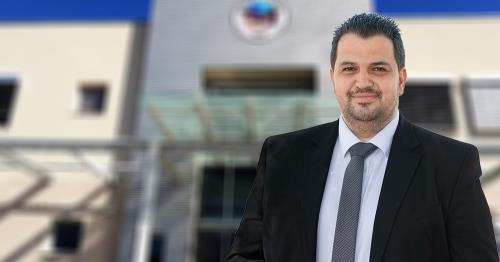

“It is a big change for all municipalities, which will reach around 80-100m euros with a pre-coster,” said Mayor Kourion
The route required to be implemented in order to implement delayed – the law sets on July 1, 2024 – in Cyprus, compulsory recycling with the program “I Pay As I Fall”, describes “Mayor Kourion”, Pantelis Georgiou. He speaks from the point of view of the excellent expert on the subject, as his municipality has been implementing a successful program – without financial damage – recycling for 20% of the population in the Epsoni apartment by recruiting modern digital technologies in accordance with the standards of European cities. After all, it is no coincidence that his choice by the Municipal Union for his participation in the group consulting at this stage with the Minister of Agriculture is not accidental.
About a month ago, at the conference organized by the Department of the Environment for “I Pay As I Fly”, you identified the Cyprus implementation of the system in early 2026. Inflicting what are the obstacles that make even municipalities hesitant, such as Kourion, which has been implemented for four years. Mandatory recycling?
There are three categories of problems. The first concerns the legislation, which must be made so that the system can operate, but also the local authority to have all the tools to impose any measures. The second concerns the economic aspect. You realize that we are talking about a change in the existing skyscrase system, which will reach around 80-100 million euros with a pre-cosmos for all municipalities.
Where will this amount be spent?
In the market for new rifles for organic waste, bins for organic and recycling, bags, citizens’ information campaigns and pop inspectors. In essence, there is a need for greater state funding compared to today. As for the third problem, it is purely technical and mainly concerns the possibility of delivering materials and equipment, such as bins and bags by private companies. But even more difficult is the delivery of vehicles for organic. Unfortunately, due to the size of Cyprus, there is a great deal of failure to provide immediate materials and equipment immediately, making it difficult for the first stages to apply PDO to its entirety.
That is?
We have decided that in 2026 we will first start with recycling, then we will go to the big producers for organic and then to the organic houses.
One reasonable question is why these obstacles were not overcome in the past so that municipalities could implement PDO on July 1, 2024, as required by law.
First of all, I find that the time was asked to apply this change to be implemented. As you mentioned, it was requested to be implemented on July 1, 2024, where you realize that at the same time the biggest change after GSEY at the state level, which was the reform of local government, with all the problems our society is living with this change today. In addition, there was a great stagnation, I would say from the previous government. The PDO bill has been passed for several years. A very serious preparation at state level should be made over the last three or four years. But it didn’t. As always, we run after the events and when the knot reaches the comb. And when it’s time to work for this system, because funding from EU cohesion funds was in danger, all the problems of the Union of Municipalities were warned for at least 3-4 years.
You are involved in the team of the Municipalities Union consulting with the Minister of Agriculture. How much was it won to date in the three aspects of problems you mentioned?
Changes in the legislative framework that must be made have made almost entirely. It has also been made clear at the ministry level that the process of sorting at the source of organic source cannot start, unfortunately because of the private sector of the private sector to be able to supply local authorities with the necessary equipment. Thus, we are at a time when we are waiting for the ministry to answer what units will receive organic, even for large producers, so that we can start working on action plans and be able to request state funding by period.
At this stage could you determine the amount of state sponsorship that would leave the municipalities satisfied?
I would not like to be placed, because there is a great exercise now in collaboration with the Department of the Environment and the Municipal Union for all the equipment required. A list of all kinds of equipment has already been prepared and has been costly. I wouldn’t like to say anything now, because it would be immature and we would be out of the process.
As for the technical part and the infrastructure, is the problem with the malfunction of machinery in OEDA Kosi and Pentakomos?
It is certainly one of the issues that are suspended in being able to immediately, even those municipalities who can and have machines, start collecting organic. There was a meeting recently in Pentakomo, in the presence of the Department of Water Development and the Waste Management Advisory Committee, in order to find a medium -term solution, so that it can satisfy at least the big producers. We are in the process of consultations. The state has realized, I think, that it must proceed as soon as possible for the part of the large units, but also under the relevant legislation. You realize that when we say “as soon as possible”, time will not be less than two-half years.
We did not mention the most important for the citizen, which is the cost for him. With the application of pop to pay less than today or more? I remind you that last January, it was reacted to the announcement that municipal sustainability studies showed a standing charge of € 150 to 250 euros per household annually, that is, higher than today.
First of all we should all realize that the way is changed. There will be a fixed fee, plus a changing amount, which will have to do with the prepaid bag or the prepaid bucket, depending on what each municipality will choose. Therefore, this changing amount, which the citizen will be required to pay, will be directly linked to his environmental consciousness. If it does not have an environmental consciousness, yes, it is a given that it will pay much more than it pays today. If it has followed and followed the instructions of the municipality concerned and the system adopted, then the amount will be in a very reasonable framework and lower than it pays today. Indicatively, in the case of the Municipality of Kourion, with the system we are promoting, the citizen, if and when he does everything he needs, he can pay from 140 euros to 420 euros annually -if he does nothing. It is therefore very important for the citizen to understand that if we quickly develop our environmental consciousness, as citizens and as a state, then he will pay much less than he pays today.
At the same time, however, the reduction of costs for the citizen is also linked to good practices on the part of the municipalities. Do you agree?
Exactly that. Let’s say that in the case of the former Municipality of Ipson, because we were accurately giving a fee to recycling, what the citizen paid was close to 135 euros. Let us mention that those who have joined the program continue and go on sorting at the source of organic source, as we give them composters, with their fees remaining at the levels they have paid to date.
Do you think that Cyprus will be able to escape the EU’s “bell”, a success of 2026, for 70% recycling?
You realize that we are talking about a very difficult equation. We have not learned to be particularly receptive to changes as a society. I hope we will avoid much of the fine, but I do not think we will avoid it in its entirety.
The bumps as a means of producing wealth
As for organic waste, which organism will certify the quality of the compost produced and who will pay the bride in the event of failure, as there has been a problem in this issue in the past, resulting in the channel of toxic waste into crops?
It is one of the issues that have been raised in the discussion with the Department of Environment. The compost produced is realized that it will be something that will be controlled by the Department of the Environment. Just to say that not all compost units may be for the processing of organic. It can be one unit for energy production. It may be something different from what we are used to to date, so we have put the request to the ministry to enable municipalities to consider all the solutions and all the data. For example, we know that this time by the Municipality of Nicosia has been assigned a study to see how some biogas production units could develop. So we see the skyscrapers as a medium, which could produce wealth for municipalities. What we want is to give us the opportunity to look at it and of course that, although we do and do what we have in mind, the citizen will have the benefit.