
“I want to share the things that hurt me when I was a kid. At the time of the inter -communal conflict of 1963 two of my brothers had gone to Nicosia to live with my uncle and learn sewing
Sevgul Uludag
caramel_cy@yahoo.com
Tel: 99966518
Today I want to share with you the memories of a woman from the abandoned village of Vretzia. The village of Vretia is “famous” because of the late Turkish Cypriot leader Ozker Ozgur. Zalihe Yababa, born in 1953 in Bretia, wrote about the village, in the online newspaper “Gazedda” belonging to our friend Nuri Silay. In short, he wrote the following: “The village of Vretia was on the slopes of Troodos, so it was between mountains with many uphill. To get to the fields, we had to cross many rugged trails. Because it was close to Troodos, every winter it was snowing in our village. Its population was about 500 people. “
‘Our home’
“Our house was built on a plot of two garden stairs. In the courtyard we had an oven where we baked bread and next to the coop and a walnut. Underneath it was the stone boats where we washed our clothes. Between our house and the road, there was a groove. And the fountain of the neighborhood was just opposite the house, so we heard the running water, birds and noise from the leaves of the trees. “
A coexistence in nature
“Because we were constantly in nature and working, we were very healthy, we rarely got sick. If something happened to us, we went to our famous doctor, Ihsan Ali. This kind -hearted doctor most of the time instead of money asked for prayer from his patients. When I was a young child, we were collecting fruit from our garden and going to the surrounding villages to sell them with donkey. One of these villages was Aigiannis (Agios Ioannis) and we had to cross the river to reach and we were in danger several times. “

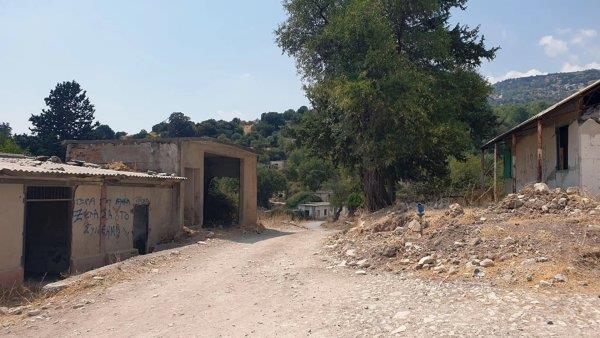
View from Brets. Photo by Gazedda newspaper
Goat with… earring
“My grandfather had a lot of fields in Bretia and I was going to help the harvest era and finish the wheat first. As a grandfather reward, he gave me a goat. We had other goats and gave them names. Some were called “girl with henna”, some “the black girl”. I loved the goat that my grandfather gave me and I took care of it. I had called her “the girl with the earrings” because her ears looked like they had earrings. Despite the difficulties, in those years they were very beautiful. Because we lived in nature, we worked in the fields and spent time with the animals, we didn’t even understand that time was going. “
‘Millarkas area’
“In Bretia, there was a separate habitat in a tall place called Millarka. This was a neighborhood on a slope. There were five families living there, all relatives. Among them were my father’s aunt Elmaziye Ozgur and her husband Enver. Mrs. Elmaziye was Ozker Ozgur’s mother. The late Ozgur was born in this maha. They had a clay house with a room and in the spring the birds built their nests on the roofs. There was a fountain built in 1950 during the British colonialism. Next to it there was an olive tree so large that it covered the fountain. In this area there were various flowers such as roses, orchids and narcissists. The water coming out of the ground was fired at a height of 3-4 meters. There were water stores, grooves to carry water, many gardens with fruits and vegetables. These gardens were surrounded by stone walls, poplars and cypresses. This place was called “Subashi” (“Water Head”). As one went to this area through dirt roads, he could often see rabbits, partridges, deer and foxes. Because there was no electricity, we used lanterns to see. Sometimes we listened to a sound and scared, but then we saw a deer passing and loosened and continued our work. “

Zalihe Yababa from the Ribs. View from Brets. Photo by Gazedda newspaper.
‘The Berovasa Tree’
In the mountains of Troodos, which were very close to Bretia, there were many pines. There was a pine that needed 15 people to hug it, it was so huge. This tree was called “Berovasa Pine”. The government put this tree under its control and was under the protection of the Forestry Day and Night. “Subashi” and “Pine Berovasa” were two very important and beautiful parts of our village Vretzia to visit them. “
‘Life at school’
“As for our lives at school, we went both in the morning and in the afternoon. Every morning we were offered breakfast at school, which consisted of a glass of milk and margarine bread. Generally at school there were very smart students, we all liked to read. When I went to school, I was collecting “maps” from cypresses to use them in the mathematics lesson for calculations. Some friends brought beans for the calculations. We had a huge rock in front of our house before entering our backyard. We went up on this rock with all the children in the neighborhood and slid down. Sometimes, I wrote the multiplication table on this rock with a pointed stone and we all read it loudly and studied mathematics in this way. “
‘Things that hurt me’
“I want to share the things that hurt me when I was a kid. At the time of the 1963 interdisciplinary conflicts, two of my brothers had gone to Nicosia to live with my uncle and learn sewing. One day my mother had gone to Nicosia to see them and because of the 1963 conflicts, the streets were closed and could not return. In those days I, my four brothers and my father were in the village. Our younger brother was 3 years old, he was very ill and died that night. I was 10 years old. My father had asthma and had a crisis of asthma. I and my brothers were very scared and spent the night in the yard. In the morning we went to a relative and told him about the death of our brother. He sent us to the mountains to cut some meters of mersine to take them to the cemetery and bury our brother. Until we bury my brother was 10 in the morning and then we went to school. Our teacher did not know what had happened and without asking he began to punish us and hit our palms with the ruler. When this was the case I looked at the eyes of my brother standing by me and saw his sadness. I still remember the sadness in his eyes. “
” Marrying ‘the trees’
“The trees that did not bear fruit were ‘marrying’ with fruit trees. Aunt Hatice, who was married to my great uncle, was picking up the children and asked us to make music by hitting canned. He had a ‘wedding’ for the trees and tied ribbons to the trees to ‘marry’. He offered us some sweets that he made believing that this would help the tree bear fruit. There was no electricity in our village, so we woke up with the sunrise and went to bed when the sun was going. The weddings in our village were done with solidarity. When they called people to marriage, they were given a candle, the purpose was to light the candle to see where they were going to go to the wedding, since there was no electricity and the roads were dark. All the people of the village brought food to help the host and everyone ate happy. As I think about all this, I am very happy to be born and raised in the Borses. “