
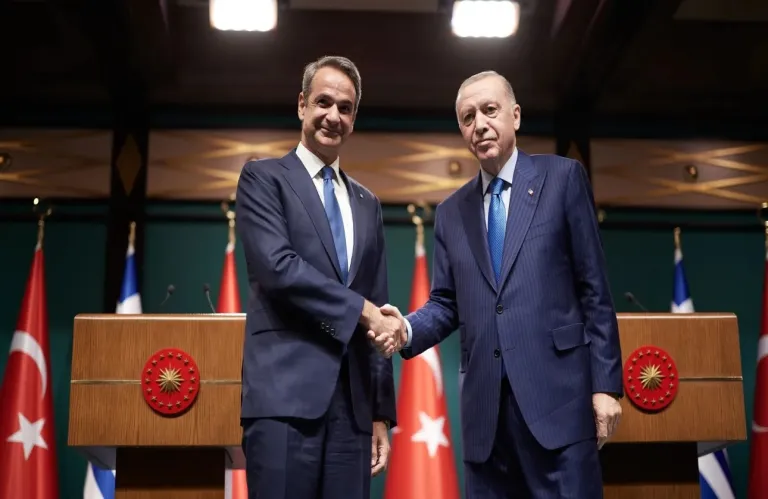
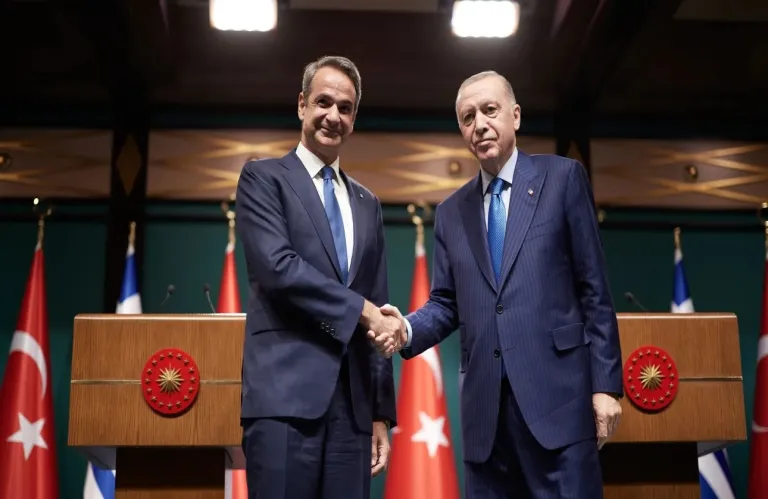
With limited expectations, but increased geopolitical weight, the meeting between Greek Prime Minister Kyriakos Mitsotakis and Turkish President Recep Tayyip Erdogan will take place on February 11 in Ankara.
Despite the continuation of “calm waters”, substantive differences remain unresolved.
Professor of International Politics and Advisor to the Prime Minister on Foreign Policy, Sotiris Serbos, speaking to CNN Greece, sets the scene from the start, pointing out that the critical question is not the dialogue itself, but the expectations that accompany it.
As Mr. Serbos notes, for Turkey, all issues remain open, from the political negotiation in the Aegean to the revisionism that is a pillar of its strategy.
“You see that we are slowly and steadily moving into a low-risk phase of controlled escalation, but we knew beforehand that this case of tactical folding with a seasonal sign on the part of Turkey, would one day end,” he notes.
The problem, according to him, is that often in Athens we focus on the “tree” of bilateral Greek-Turkish relations and miss the “forest”, i.e. the big geopolitical picture, to which Turkey attaches much greater importance.
He emphasizes that “we have now entered a geopolitical adventure that involves risk, a test of endurance without the once-given safety net. In such a condition, where the logics of power and self-preservation dominate, Greece is not only facing new challenges; it has entered a phase of historical “rupture”.
In this context, it would be naive to assume that the Turkish president will remain inactive. On the contrary, it is estimated that he will attempt to capitalize on the transactional nature of personal diplomacy with President Trump, taking advantage of the new international climate.
At the same time, with the bilateral level, he emphasizes that “at the same time we should return to conditions of active negotiation, primarily with the Americans. Utilizing factors of soft power that we have not yet activated (eg religious diplomacy). Of course, negotiation always involves risk. However, if we remain inactive and cautious, refusing the negotiation, there is the greatest risk that a fait accompli will be imposed on us and with the argument that if we do not accept it, in a different development things will go worse”.
The Ankara meeting, in this light, is neither a solution nor a guarantee. It is, however, a link in a chain of developments that go far beyond the bilateral level.
The key political stake is whether and to what extent calm waters can be maintained in the future, given that no one knows how Turkey’s moods will shape up.
In this context, he emphasizes that “Greece still considers that it needs additional time. All of this started with the initiative of Ankara and Athens also responded. We probably want to use this time for an attempt to rationalize Ankara.” The normalization process was initiated by Ankara, at a time when Turkey needed an economic breather, especially after the earthquakes, but also a rapprochement with the West. It was, therefore, to be expected to “slow down”, he adds.
The problem, according to Mr. Serbo, was that excessive and incorrect expectations were cultivated in the public debate, even about an appeal to The Hague, without ever having any real indications in this direction. This in turn caused suspicion and wariness among sections of the public. “It is better to be pessimistic and right than optimistic and wrong. Best of all to be realistic with knowledge and robustness,” he adds.
The change in the international system
Today, however, the big picture is radically different. As he points out, a structural regime change (regime change) is taking place in the international system, with changes inside America, in the West as a whole and in international balances.
In this new environment, the way is opening for secondary powers – such as Turkey – to claim an upgraded role. Ukraine’s precedent confirms to Ankara that revisionism, when accompanied by power, tends to be de facto legitimized, he says.
If American settlement efforts fail, a window for coercive diplomacy cannot be ruled out, a scenario that, he observes, is not sufficiently discussed in Greece.
“Surely, we should be much more systematically concerned with the personal diplomacy and transaction between the two leaders, Trump and Erdogan. Greece also maintains a counterweight role for the West, against revisionism and Turkey. There is the example of Greenland, which basically the US administration says “I sell security, you have to pay me”. So, being in a treaty where everything becomes questionable to negotiable constitutes a negative precedent for Greek interests due to revisionist Turkey. It’s as far as we can go on a matter of national security.”
Mr. Serbos cites the case of Japan as an example, pointing out that although it acts as a counterweight to China for the US, it has come under intense pressure on the issue of tariffs. As he notes, Tokyo was even pressured to reject the prospect of forming a common trade front with the European Union in order to negotiate on a more equal footing. This example, as he emphasizes, raises a crucial question for Greece as well: is there a possibility that we can act as a strategic counterweight, but at the same time accept pressure for concessions or “compromises”? And, in such a case, with what papers and by what means will we respond to the United States?
He reminds that Greece remains a small country in terms of population, without the luxury of internal divisions around the major issue of national security. At the same time, he underlines that in relation to 2019, a crucial fact has changed that Ankara systematically invests in the strategy of coercion, what is internationally described as bullying. In this field, as he emphasizes, the Greek position must be absolutely clear. The country now has the hard power to reject such practices and make it clear that any revisionist arbitrariness, outside of the context of “calm waters”, will not open the way for trade but will have costs and consequences.
Messages, he notes, need to be crystal clear, as ambiguity acts as an invitation to do. The two leaders must be able to speak openly, something that, as he observes, the Turkish president also appreciates. The real question, however, is whether certain developments in foreign policy can be diplomatically prevented at a later stage. That is why it becomes necessary for Greece to enter into difficult and demanding discussions with the United States, in order to clarify what opening up to Turkey entails for Greek interests, both for the security architecture, as well as for the Eastern Mediterranean and Greek-Turkish relations. Maintaining open channels with Ankara is legitimate, he concludes, however experience shows that the bilateral framework has de facto specific limits and specifications.
Casus belli and “Blue Homeland”
Mr. Serbos points out that the Greek-Turkish debate is often in danger of becoming trapped in a vicious circle, as Turkey consistently pursues a political negotiation on the Aegean, a position that the Turkish president himself has publicly stated since his previous visits to Athens, even in times less favorable for Ankara on a geopolitical level.
The issue of casus belli, which the Prime Minister is expected to raise with the President of Turkey during their meeting, as he has stated is, according to Mr. Serbo, a useful tool for internationalizing the Turkish threat, especially towards the Europeans.
“Because, you know, it’s not high in the hierarchy of the European factor as an issue. It never was and maybe it is one of the reasons why the Greek-Turkish issues were not resolved. So, we are rightly putting Turkey in a more difficult position,” he adds.
However, the reality should not be ignored that, after the Ukrainian “and the abrupt pulling of the carpet by the Americans on the Europeans”, several European countries, he says, have moved towards opening up to Turkey, both in the defense industry and in bilateral relations.
This shift is a clear wake-up call for Greek foreign policy. If Greece does not claim co-ownership in the shaping of Euro-Turkish relations, it risks finding itself in an unfavorable negotiating position.
As he argues, “if we don’t claim co-ownership through active negotiation we will find ourselves in an unfavorable negotiating position later on. What kind of initiatives should we take in order to co-shape a special EU-Turkey relationship that will include certain conditionalities and safeguards.”
Despite attempts to “rationalize” the Turkish attitude, he points out that Ankara has not only not abandoned its bigotry, but appears today with increased self-confidence and a sense of power.
In this context, he emphasizes that dialogue is necessary, but it is not enough by itself. “It will be a mistake to lock ourselves in a bilateral level”, he emphasizes. Greece must act simultaneously on multiple diplomatic, geopolitical and strategic levels with clear messages and without ambiguities.
Mr. Serbos argues that the effort to rationalize Turkey “must go hand in hand with a demanding negotiation with the West as a whole and especially with the United States and Europe.”
Source: cnn.gr