German architect Nikolai von der Nonne (1836-1906) played a
great role in the development of the architecture of Baku in the
late 19th – early 20th century, forever entering its history.
Nikolai von der Nonne was born in St. Petersburg province,
became an officer-military engineer, in 1856 was sent to the
Caucasus, where he was honored with a number of awards. For his
success in 1881 Colonel Nikolai von der Nonne was transferred from
Tbilisi to Baku and appointed provincial engineer of Baku province.
During the oil boom that took place in Baku in the second half of
the 19th century, the city needed fundamental changes. The huge
influx of population and together with it great construction
activity, creation of industrial zones, neighborhoods, and streets
actually led to harsh conditions, deterioration of ecology and life
of people. There was a lot of work to do…
He became a city engineer at the Baku City Duma in 1883. In
1884, he was elected chairman of the United Sanitary Commission,
which was established at the Technical Society, having presented
the report “Assenization of Baku city through sewerage”, raising
for the first time the issue of the creation of sewerage in the
city.
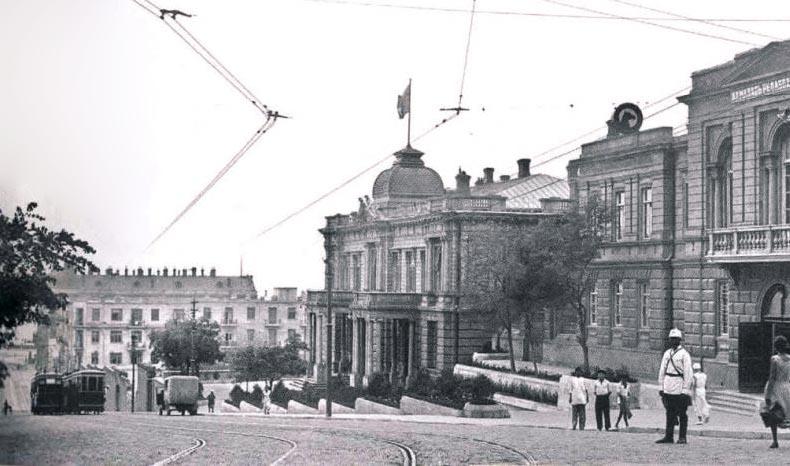
He managed the construction of three buildings at Mikhailovskaya
hospital, erected buildings for the women’s gymnasium and
disinfection chamber, and under his supervision and guidance, 67
thousand square meters of streets were paved. In 1895, due to
illness, he left the civil service and became a free architect.
Nevertheless, the city clearly needed him! In 1897, the Baku City
Council assigned him the responsibility of drawing up the first
general plan of the capital. Nikolai von der Nonne already knew
Baku well and loved it from the bottom of his heart, he was able to
declare himself as a high professional, passionately worried about
the work that was entrusted to him.
In May 1897, the newspaper “Caspian” started publishing
announcements to Baku homeowners: “Colonel von der Nonne, who has
taken upon himself the compilation of the city plan, begins work on
the leveling of the area, the marks of which will be made on metal
repiers, nailed to the walls of houses. Therefore, the Baku City
Administration asks homeowners not to hinder the manufacturers of
works to nail the repiers and not to tear them from their
houses”.
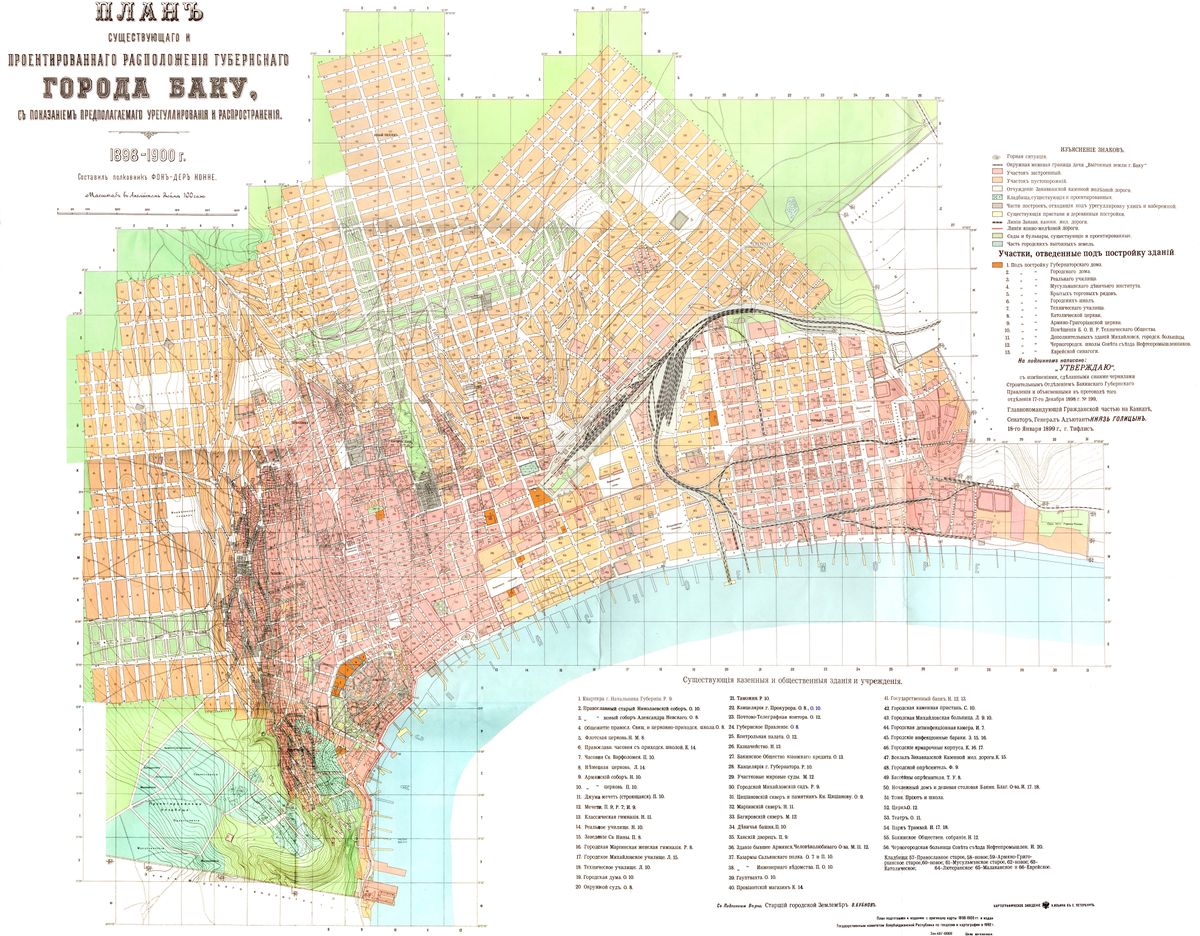
In 1898, he drew up “The plan of existing and projected location
of the provincial city of Baku with the indication of the proposed
settlement and distribution. 1898-1900”, which was simultaneously a
project document characterizing rapid growth.
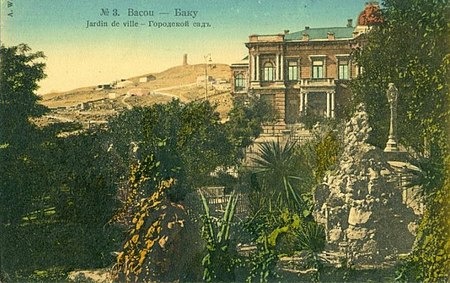
According to Shamil Fatullayev in his book “Urban Planning of
Baku in the late XIX – early XX centuries,”: “By the time the
general plan of Baku was developed in 1898, the neighborhoods
located north of the Fortress were realized in the form of a clear
rectangular grid. Von der Nonne was closely bound by a contract by
which the interests of private owners had to be taken into account.
He had to reckon with the existing buildings when designing the
project, although in individual cases, it might have been more
appropriate to demolish all dilapidated structures to ensure at
least the minimum required street width. Nevertheless, he did a
great deal… All his design work was aimed at settling the
existing parts of the city and, most importantly, at expanding and
planning new areas for the growing urban population, which was
intensively engaged in civil engineering. According to von der
Nonne’s plan, the projected area doubled the city’s planned area…
Von der Nonne considered it necessary to link the existing
development with the new emerging parts of the city on the basis of
the minimum urban planning requirements of the time…”.
On November 4, 1898, Nikolai von der Nonne officially assumed
the position of the mayor of Baku, which he occupied until the end
of 1902. The city was built under the guidance of the experienced
engineer and architect. His plan was valuable also because it
showed the city authorities the fact that when building new
residential areas, when selecting the territory and its layout
should have taken into account the hygienic features of the area,
that it is impossible to build anything and anywhere without taking
this factor into account.
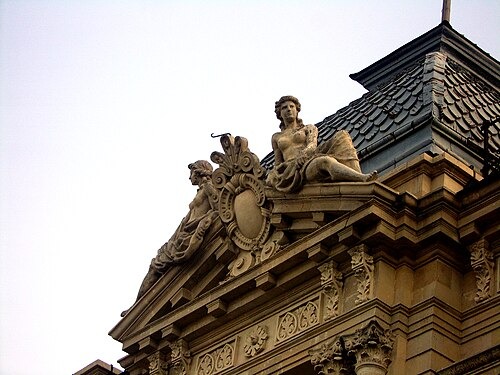
In addition to working on the first general plan in the history
of Baku, Nikolai von der Nonne is also known for numerous
architectural projects. In total, about fifty residential and
public buildings were erected according to his designs. These
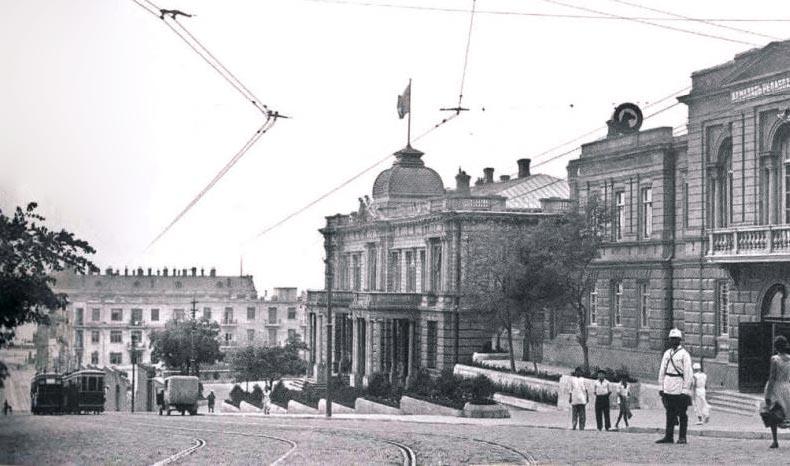
include the Deburov Palace (now the National Museum of Arts of
Azerbaijan), the building of Terentyev’s distillery on
Vorontsovskaya Street, the building of the Mutual Credit Society on
Petrovskaya Square, almost all the old quarters on Gubernaya Street
(later Nizami Street), the Bulk Wharf, completed the building of
the Mariinsky Gymnasium for Women, etc.. It combined modern
European design with oriental elements, and at that time, it was
very well received by the people of the city. Thus, Western
architecture also became native to the Eastern city. The Deburovsky
Palace was built with funding from the Rothschilds, who were
running a successful oil business at the time.
He was also the director of the Baku branch of the Baku
Provincial Prison Board and, in 1901, an honorary justice of the
peace for the city of Baku.
Interestingly, already in our time, one curious fact has become
known, which has shown the true uniqueness of the plan of the great
architect – if you superimpose it on a modern map made with the
help of satellite imagery, then everything will match up to the
smallest detail! How it was possible to achieve such accuracy at
that time, without modern technology, is simply incomprehensible!
By the way, after many years, in 2023, the Baku master plan,
prepared by order of the State Committee for Urban Planning and
Architecture of Azerbaijan, was created by the winner of an
international tender, the German company AS+P Albert Speer +
Partner Gmbh.
The plan covers the entire area of the capital – 212,300
hectares – and sets out the main directions for Baku’s development
through 2040. It presents a vision of the city as a well-organized,
multi-centered urban space, ready for dynamic and sustainable
growth. The plan places particular emphasis on efficient land use,
the preservation of cultural and historical heritage, strategic
zoning, and improvements in construction, transport, social
infrastructure, public services, and environmental initiatives. It
also reflects new economic approaches in line with the shift toward
a post-industrial society.
https://www.instagram.com/germanyinazerbaijan/p/C5gEwaBNYYe/?img_index=1