
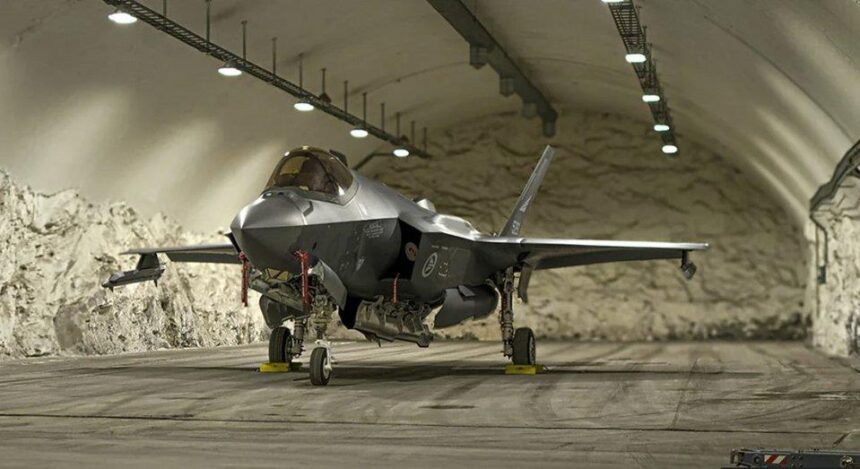
At the height of the Second World and the Cold War, the sparsely populated, mountainous country had about 3,000 underground facilities.
Norway’s proximity to the USSR led it to the construction of many military shelters before the Cold War.
Hundreds of thousands of tourists visit northern Norway each year. But there is a secret world they never see. Because hidden in mountain caves and military shelters there are fighter aircraft and nuclear submarines.
Norway is a country with many shelters. At the height of the Second World and the Cold War, the sparsely populated, mountainous country had about 3,000 underground facilities where its armed forces and allies could hide and make the life of any invader. They date from the time when the Scandinavian country was part of Hitler’s “Atlantic Wall” during World War II.
Now, with the Russian-Ukrainian war raging, Norway reactivates two of the most emblematic underground structures of the Cold War: the Bardufoss airline sheds and the naval base in Olavsvern.
But the Soviet Union – the reason why they were made from the beginning – no longer exists. Does it really make sense for Norway to invest money in such expensive constructions?
Why do these shelters need today?
In the advertising shots for reopening the sheds in Bardufoss, the Lockheed Martin fighter – the F -35 Lightning II – sits threateningly as a predator under the lights of the shed’s arched roof. The air station opened in 1938 was once used by German fighters who protected the giant Tirpitz battle while it was anchored in a nearby fjord.
After the war, the Royal Norwegian Air Force then used the mountainous sheds to protect its fighter planes from a possible Soviet attack.
These sheds included everything that the planes and their pilots needed, such as fuel storage, weapons storage, space for maintenance of aircraft systems and crew spaces. Then, about 40 years ago they were closed and mined.
Now, Bardufoss seems to be needed again.
The military base, which has undergone structural upgrades and upgrading of its equipment, aims to help the Norway’s “durability and survival” in the event of a Russian attack.
The Russian invasion of Ukraine has shown to the world how vulnerable the expensive military aircraft such as these F-35s worth 80 to 100m euros can be when on the ground, especially in attacks by unmanned “kamikaze” aircraft that can cost just 300 euros.
Instead of tires on the wings or manufactured with wire mesh, as the Russians did in Ukraine, the threat of drones can be limited by dispersing targets in many different locations. Or, even better, by keeping the aircraft in a safe protected shelter.
The naval base
It is enough for the map to explain why the OLAVSVERN naval base was built. It is located near the point where the Norwegian Sea meets the Barents Sea, in these 650 kilometers between the coastline of Norway, Bear Island and Savvard that are sometimes called “the bear gap” because it was, and is still a “suffocation” point for “asphyxia” the Atlantic Ocean.

Inside the shelters of the Bardufoss shelter there are many wikipedia fighter planes.
The construction of the naval base took place mostly gradually from the 1950s onwards, in response to the accumulation of the Northern fleet of the Soviets. The base itself with the underground administration center, the warehouses, the deep water pier, the dock and its exit tunnel, was such a huge venture for Norway that NATO had to fund a large part of it.
In the meantime, until the base was completed, the Soviet Union had collapsed completely. But despite the gradual … Cold War, the NATO boats were still using it as an intermediate station for missions to the frozen Arctic Ocean.
In 2009, the Norwegian parliament voted marginally to close the highly secret Olavsvern base despite the growing threat from Russia and in 2013 it was sold to private investors well below market value, around 7.5m euros.
Her tunnels were full of caravans and vintage cars. The new owner allowed two Russian research vessels and Russian fishing boats to use the once strictly guarded facility.
In 2020, Wilnor Governmental Services, with close ties with the Norwegian army, bought the company. Since then it has begun to repair and upgrade the location and the military presence at the base has increased, while the US Navy is interested in installing its nuclear submarines there.
Norway’s concerns about Security did not start in 2022 – when Russia invaded Ukraine – or 2014, when it invaded Crimea, but even earlier. “Around 2006-2008 we saw that there were many investments in the northern fleet of Russia,” says Andreas Østhagen, a senior researcher at the Fridtjof Nansen Institute, a Norwegian institution. And he continues: “At the same time, we had the repetition of Russian military exercises in the Arctic for the first time since the Cold War but also Russia’s growing interest in exploiting the Arctic resources.”
“Putin’s Russia is not the Soviet Union,” Østhagen adds. “But in terms of Norwegian security, the questions remain the same. How do you prevent Russia and, if you end up in war, how do you fight Russia? “

The Naval Base of Olafvern / Wikipedia.
In “Game” Sweden, Russia, China, Britain
The Norwegians are not the only ones to re -activate the bases of the Cold War. The Russians have also reactivated about 50 bases of the Cold War of various kinds throughout the Arctic in recent years. The Swedish Navy returned to its underground naval base on the island of Muskö, about 40 kilometers from Stockholm.
Other countries have gone more than mere reactivation of warehouses built decades ago and constructing new underground structures. China has built a huge new underground submarine base on the island of Hainan in the disputed southern Chinese sea. It also builds a huge new underground administration center near Beijing.
“The psychology of the nuclear shelters is really very strong today,” says the independent Cold War researcher and a military blogger known as Sir Humphrey, the name in the blog of the writer Thin PinstriPed Line, which studies the Cold War. “I think they are deeply rooted in our psyche and our perception of the Cold War.”

At the climax of the Cold War, the sparsely populated, mountain country had about 3,000 underground installations / wikipedia
“Placing vessels and submarines (and airplanes) in tunnels can still be a great way to protect them from a vertical air bomb attack,” says Paul Ozorak, author of the book “Underground Structures of the Cold War”.
But countries such as the United Kingdom may be “reluctant” to follow Norway’s example in the reactivation of underground bases or the construction of new ones due to the huge costs, Ozorak says.
Many of the underground structures of the Cold War in the United Kingdom and other NATO countries have been sold to become museums or even nightclubs. Some have been destroyed. At least one has been sealed. Many more will have been flooded and will be of course useless.
“The big challenge for the reopening of those left over will be the cost,” Ozorak says. “In many cases, these shelters were stripped of all their equipment. The repositioning of this equipment and the reassignment of the communication cables would be very expensive. “
There is also the problem that if they have been disabled like Olavsvern, then their safety may have been at risk by foreign intelligence services, even if they had no visits from Russian research vessels.

The RAF Air Command in Buckinghamshire / Wikipedia
“There are also limited business benefits from a location that everyone knows that it has been targeted for 60 years, and where satellite images can now detect ventilation wells and entry points,” says Sir Humphrey.
However, in the United Kingdom, the RAF Air Command refuge built during the Cold War at Buckinghamshire is still used, as well as the shelters that make up Northwood Headquarters, a military headquarters in northwestern London, which was rebuilt in 2006-2011.
Mod Corsham is now a secret location for military communications built on the huge Corsham tunnel network, which was the location of the UK’s “Nuclear War Headquarters”.
The British Council of Ministers, for reasons of national security, began to upgrade and withdraw documents on the design of a nuclear war that had been made public after the end of the Cold War.
Source: iefimerida.gr