
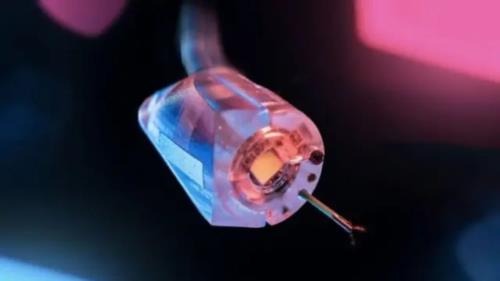

According to researchers, this robot could revolutionize the diagnosis and treatment of various forms of cancer.
Researchers in Britain have developed a tiny magnetic robot that could revolutionize the early diagnosis of cancer. The robot developed by the Linds University Group of Engineers in Britain creates three -dimensional ultrasound scanners from the interior of the body.
According to researchers, this robot could revolutionize the diagnosis and treatment of various forms of cancer, allowing “virtual biopsies”- non-invasive scans that provide immediate diagnostic data. These data help doctors detect, stagnate and possibly treat alterations in a single process, eliminating the need for conventional biopsies.
The group used a geometric shape that allows the robot to roll accurately into the human body, making precise navigation and indoor tissue visualization. They then arranged it with a small high -frequency device to obtain detailed 3D inner tissue images.
“This research has allowed us to reconstruct a three -dimensional ultrasound image taken from a capsule deep in the gut – something that has never happened before,” said Pietro Valdastri, a professor and head of the Robotics and Autonomous Systems and Director of Storm Lab.
The researchers also said that the imaging device – a 28 MHz micro -micro -micro -creation – creates a high -resolution three -dimensional reconstruction of the scanned area. From this virtual reconstruction, clinicians can create incisions similar to those made in a conventional biopsy.
“By combining our advanced robotics with medical depicting ultrasound, we are proceeding with this innovation a step further from conventional colonoscopy, allowing doctors to diagnose and cure in a single process – eliminating waiting between diagnosis and intervention,” said Nikita.
“This not only makes the process more comfortable for patients, but also reduces waiting times, minimizes the repetitive procedures and relieves the waiting concern of possible cancer effects,” he added.
The next phase of the study includes clinical trials in humans, which are expected to begin in 2026.
The study was published in the journal Science Robotics.
SOURCE: ertnews.gr