
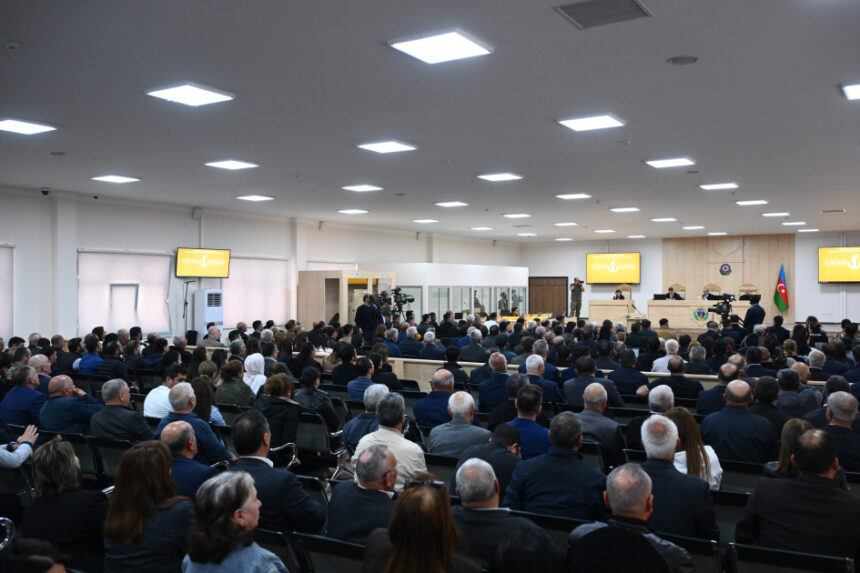
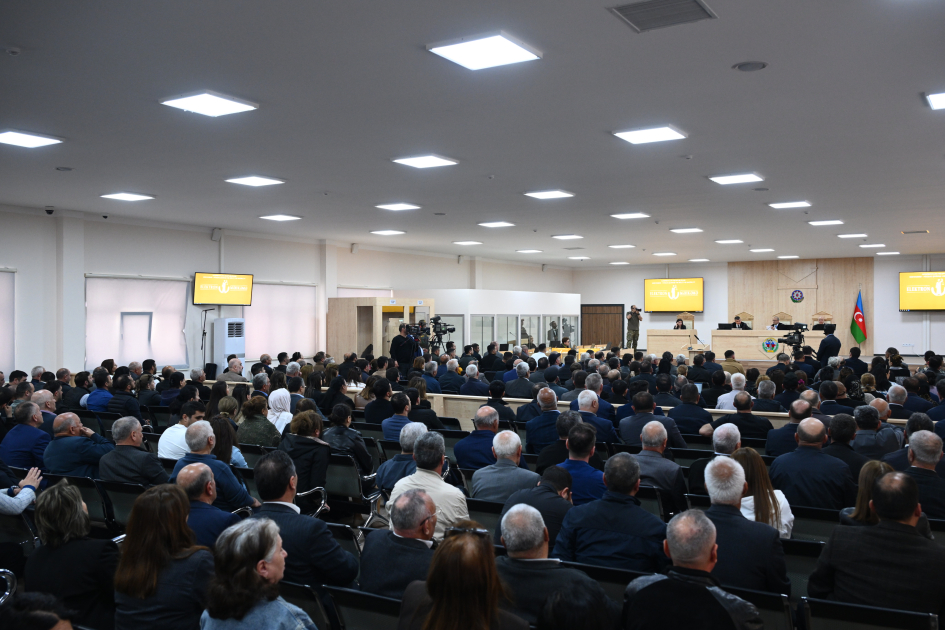
Baku, Azerbaijan, April 8. Court hearings on
the criminal case against Ruben Vardanyan, an Armenian citizen
charged with torture, mercenary activity, violation of the laws and
customs of warfare, terrorism, financing terrorism and other
articles of the Criminal Code of the Republic of Azerbaijan, were
continued on April 8, Trend reports.
The open hearings were held at the Baku Military Court and
presided over by Judge Zeynal Agayev and a panel of judges
consisting of Anar Rzayev and Jamal Ramazanov (reserve judge Gunel
Samadova). The accused was provided with an interpreter in the
language of his choice, i.e. Russian, as well as lawyers for his
defense.
The hearings continued with the questioning of victims.
Before the questioning, Zeynal Agayev explained to the victims
their rights and obligations stipulated by the legislation.
Then the accused Ruben Vardanyan and his defense attorney Avraam
Berman appealed to the court saying that they wanted to familiarize
themselves with minutes of the hearings again.
Presiding judge Zeynal Agayev said that conditions would be
created for them to familiarize themselves with the minutes
again.
At the meeting, Ruben Vardanyan, who was accused of joining a
criminal organization that committed numerous criminal acts during
the aggressive war waged by the Armenian state in December 2020,
was interrogated after he joined it in December 2020, with the
direct leadership and participation of the Armenian state,
officials of its state institutions, military forces and illegal
armed formations, with the help of verbal and written instructions,
orders and instructions, material, technical and personnel support,
and under his central management and strict control, in violation
of domestic and international law, in the territory of
Azerbaijan.
During the hearings, the court questioned the victims of the
criminal acts committed by the accused Ruben Vardanyan, who is
charged with joining a criminal organization in December 2020,
which was created under the leadership and direct participation of
Armenian state bodies, officials, military forces and illegal armed
formations, in accordance with their verbal and written
instructions, orders and guidelines, as well as material, technical
and personnel support, central management and strict control, and
also of committing numerous criminal acts during the war of
aggression waged by the Armenian state against Azerbaijan in
violation of domestic and international law.
Victim Vahid Aliyev stated that he was not personally acquainted
with the accused, but that he knew about Ruben Vardanyan from
social networks and the media. He said that he had been wounded as
a result of the fire opened during a military provocation of the
Armenian army, noting that several of his acquaintances had been
martyred or received various wounds.
Victim Anar Jalalov stated in his testimony that he had been
wounded as a result of an explosion of an artillery shell fired
during a military provocation of the Armenian armed forces. He said
that he had been the chief of staff of a military unit at the time
of the incident and added, “Artillery fire was opened from the
opposite side. At that time, some of my servicemen were wounded and
some rose to martyrdom.”
The victim also stated that the ceasefire in the direction of
Khojavend had often been violated, adding that the opposing side
was using all types of small arms.
Answering questions from public prosecutor Fuad Musayev, victim
Emin Shahbazov said in his statement that he had been injured in
Aghdam.
The serviceman said he had suffered a head injury, had been
taken to hospital where he could not speak but had to communicate
with the doctors in writing.
He described the incident in which he was wounded as follows,
“The enemy had two posts there. When they tried to commit a
military provocation, we prevented it. Then their artillery attack
began. As a result, I was wounded and was treated in various
hospitals. My treatment is still ongoing.”
When answering questions from public prosecutor Vusal
Abdullayev, victim Hilal Hasanov said that he had been wounded
while preventing the enemy’s military provocation in the direction
of Aghdara. He said, “The enemy committed a military provocation by
first opening artillery fire, then trying to attack us with its
personnel, but this provocation was prevented. We had people
martyred and wounded.”
In his statement, victim Zamig Hasratov said that he had been
wounded as a result of mortar fire while preventing an enemy
provocation.
In response to questions from public prosecutor Tarana
Mammadova, victim Elnur Hasanov said that he had been wounded on a
multiple occasions as a result of the fire opened by the Armenian
side. He said that he received three bullet wounds, that 70 of the
shrapnel had been removed and more than 30 were still in his body.
He said, “I am currently in service. I am continuing my
service.”
In his statement, victim Fariz Manafov also said that he knew
the accused from social networks. Fariz Manafov noted that the
opposing side had opened fire using large-caliber weapons and
artillery during the incident in which he was wounded. He said, “I
served as a commander of a motorized rifle platoon in the direction
of the Chartaz village of Khojavand district. The enemy’s
provocations were frequent. They used large-caliber weapons and
artillery.”
He said that 14 of his fellow soldiers had been wounded, two 2
soldiers and one warrant officer had martyred.
Victim Agshin Balakishiyev, who was the chief of the medical
service in an unspecified military unit of the Ministry of Defense,
said in his statement, “As a result of the enemy provocation, I was
wounded by artillery fire from the enemy in the rear.”
He said that the mobile medical station where he was working was
5-10 km behind the frontline, and that despite the presence of a
sign indicating that it was a medical station (a red crescent), it
was fired upon. “All doctors and paramedics have a red ribbon on
their sleeves. Along with our medical station, our ambulances,
paramedics and doctors were subjected to artillery strikes as a
result of enemy provocation. In other words, the requirements of
the international convention were flagrantly violated.”
Victim Habil Guliyev said in his statement that he had also been
wounded. “The enemy was constantly firing on us,” he added.
Victim Farhad Taghiyev stated that the ambulance vehicle in
which he was traveling to evacuate wounded military personnel in
Aghdam was hit. He said: “Three sides of the vehicle are marked
with a red crescent. So it is clear that this is a vehicle that
evacuates the wounded. Our vehicle was hit by a missile. As a
result, four of my fellow servicemen and I were wounded in the
vehicle.”
Another victim, Farid Zeynalov, who was in the same ambulance
with Farhad Taghiyev, confirmed his statement. He said that the
vehicle had been hit by a guided missile.
Victim Hijran Sultanov said that he was wounded while trying to
prevent an enemy provocation in Aghdam. He said, “I was a unit
commander. They wanted to hit the medical vehicle while we were
evacuating our comrades – the wounded and martyrs. They failed to
hit the medical vehicle. They did not take aim correctly and the
shooter made a mistake. In any case, I don’t think they would have
fired the anti-tank rocket “Fagot” because of two people. The main
shell landed 10-15 meters away from us. We were lucky that the
place was empty ground. None of the shrapnel hit us.”
Victim Ruslan Heydarov said that he had been injured in his
right shoulder as a result of sniper fire in Khojavand.
Other victims questioned included Nabi Babayev, Vugar Mammadov,
Emil Nabiyev, Mahir Zeynalov, Subhan Alirzayev, Afran Kamilov,
Tabriz Ahmadov, Javidan Talibli, Niyamaddin Asgarov, Hasan Gurbanov
and others. They said their testimonies that the opposing side had
opened fire at their positions from various weapons and that they
themselves had received wounds of varying degree of severity.
Conclusions of the forensic medical examination conducted on the
victims were also announced during the hearings.
The next hearing is scheduled for April 15.
Ruben Vardanyan is charged with crimes under Articles 100.1,
100.2 (planning, preparing, initiating and waging a war of
aggression), 107 (deportation and forced displacement of the
population), 109 (persecution), 110 (forcible disappearance of
persons), 112 (deprivation of liberty contrary to international
law), 113 (torture), 114.1 (mercenary activity), 115.2 (violation
of the laws and customs of warfare), 116.0.1, 116.0.2, 116.0.10,
116.0.11, 116.0.16, 116.0.18 (violation of international
humanitarian law during armed conflict), 120.2.1, 120.2.3, 120.2.4,
120.2.7, 120.2.11, 120.2.12 (intentional murder), 29,120.2.1,
29,120.2.3, 29,120.2.4, 29,120.2.7, 29,120.2.11, 29,120.2.12
(attempted intentional murder), 192.3.1 (illegal entrepreneurship),
214.2.1, 214.2.3, 214.2.4 (terrorism), 214-1 (financing of
terrorism), 218.1, 218.2 (creation of a criminal group), 228.3
(illegal acquisition, transfer, sale, storage, transportation and
possession of firearms, their components, ammunition, explosives
and devices), 270-1.2, 270-1.4 (acts threatening aviation safety),
278.1 (forcible seizure or retention of power, forcible change of
the constitutional structure of the state), 279.1, 279.2, 279.3
(creation of armed formations or groups not provided for by law)
and 318.2 (illegal crossing of the state border of the Republic of
Azerbaijan).