
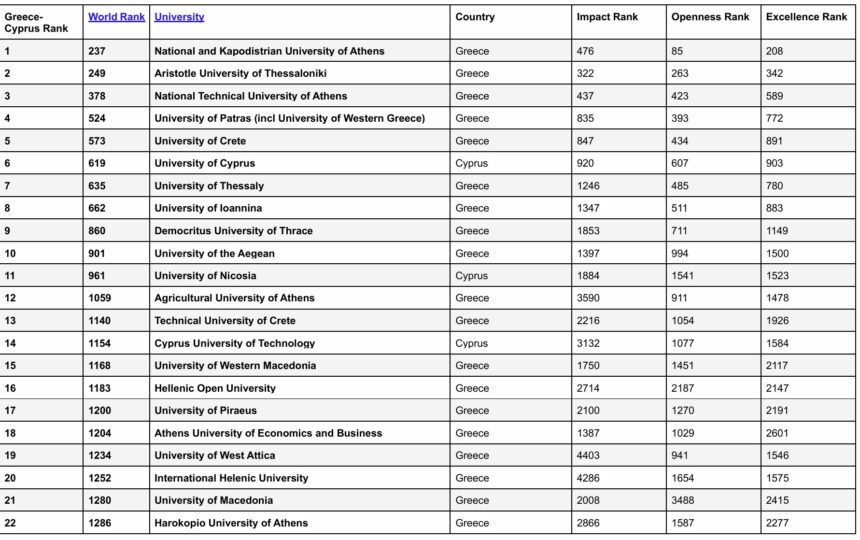
The World Universities Ranking of the Webometrics Ranking Web of Universities was published. According to the publication of the ranking, the National and Kapodistrian University of Athens (NCSR) is at 237th in the world among 32,000 universities and in the 1st place in Greece and Cyprus between the 105 Greek and Cypriot universities and higher education providers.
Based on the results of the rankings, after the National and Kapodistrian University of Athens, the Aristotle University of Thessaloniki is followed by the National Technical University of Athens at 378, while the first five are closed at the University of Patras at 524 and the 524th place of Kyriaki. Table 1).
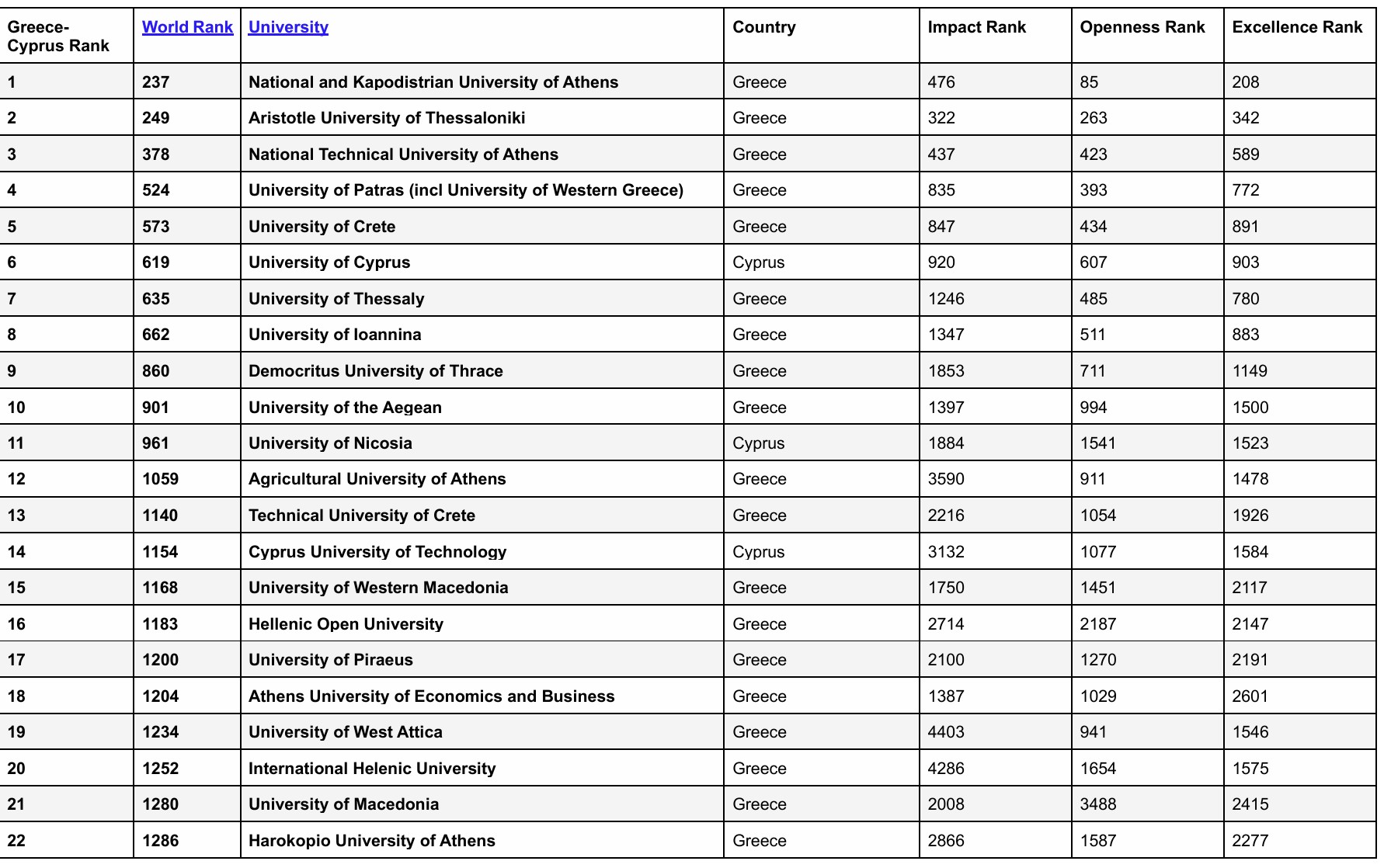
Table 1: The first 22 Greek and Cypriot Universities and Higher Education Service Institutions in accordance with the webometrics table for 2025 (B semester)
This ranking, which closes 22 years in the world rankings of universities, is drawn up by Cybermetrics (CCHS), a Spanish National Research Council (CSIC) unit, which is Spanish’s main research institution. It gives information on more than 32,000 universities, from 200 countries, according to their online presence and the appeal of their research work. Universities are classified by criteria that mainly relate to their presence and popularity on the world fabric, the impact of their research work as reflected in the total number of hetero -references of the articles and publications of their teachers and researchers and their publications in 10% of the world.
It is considered one of the most valid ranking tables in the world because it is based on directly verifiable data on the Internet, and not on indicators that are largely based on interviews, questionnaires and “opinion surveys” which are in some cases being biased or subjectivity. The basic principle of this ranking is that in today’s era the majority of the most important activities of an academic institution must be reflected in the world fabric. The ranking is published for the 23rd year since 2004, and is renewed twice a year each January and July.
The classification of each university is based on the following three criteria:
1. Visibility 50%: Content quality is evaluated by its popularity, that is, by the number of external networks (subtractions) connected to the institution’s websites (normalized and then the maximum value is selected). The popularity of the content is considered to recognize the value of the institution, its academic performance, the value and utility of the published information or service provided by the Foundation.
2. Transparency or openness) 10%. The Foundation’s participation in the open scientific standards of the world fabric is evaluated through the multitude of documents listed on Google Scholar and the number of heterogeneys in them. In practice, the study of heterogeneys is considered to be the most valid criterion for the evaluation of the scientific – research work of a university. The number of heterogeneys and consequently the score of each university is calculated by the sum of the hetero -references of the first 310 profiles and researchers at the University minus the hetero -reports of the first twenty profiles.
3. Excellence or scholar 40%. Percentage of the Foundation’s publications in 10% of the most reported publications in each field of science. This index comes from Scopus and Scimago and includes five-year elements 2019-2023 in 27 different scientific fields.