
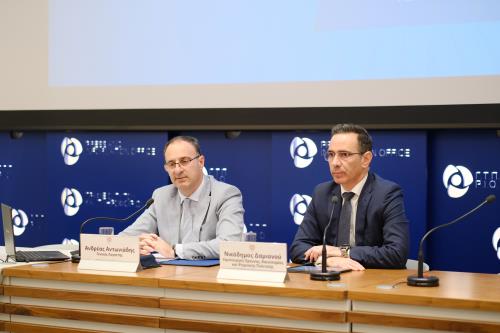

At a press conference on electronic pricing in transactions with the State, it was noted that such actions and actions aim to promote the broader use of the electronic pricing method.
Electronic pricing in transactions with the government is promoted by the Government, with the Deputy Minister of Research, Innovation and Digital Politics Nicodemus Damianou and the General Accountant of the Republic Andreas Antoniadis presenting the actions and actions today in this direction.
At a press conference on electronic pricing in transactions with the State, given by the two officials, they noted that actions and actions aim to promote the broader use of the electronic invoice method, which is expected to lead to faster and more efficient management of business.
As noted, through the automatic, electronic invoice processing, which is done through the authorized PAN-European Public Procurement On-Line (PEPPOL) access point, their timely execution and repayment are achieved, and, on the other hand, significant resource savings, while efficiently enhanced and intervened. It is noted that the issue and distribution of invoices in PDF format is not considered electronic pricing.
As mentioned, through this government’s action, the aim is to promote electronic pricing in the market and in the business world. Electronic pricing is considered one of the actions that are fundamental to the digital economy.
The first action presented is the prioritization of the management of electronic invoices by government accounts. More specifically, a procedure has been specified by which the valid electronic invoices received will be prioritized against those who are naturally submitted, and will be directly handled. The online route, among other things, is expected to lead to timely repayment of electronic invoices within 20 days after receipt or acceptance date, while preventing the loss of documents and eliminating shipping costs.
Another action concerns the inclusion of electronic pricing compulsory pricing in competition documents. As mentioned, the General Accounting Office of the Republic will issue an announcement for the encouragement of the contractors of the existing framework agreements for computerized equipment and technology services as they use electronic pricing. At the same time, the new Framework Agreements concerning computer equipment and technology services as well as in the new open competitions related to the development of computerized systems managed by the Department of IT services will include provision for compulsory use of electronic pricing. Gradually, the scope of this welfare will extend to other categories and areas of public procurement.
Another action concerns the implementation of a gradual obligation of electronic pricing to existing contracts through decrees for public and wider public sector.
As mentioned, in this regard, the Ministry of Finance has put in place a amending bill in public consultation with the aim of amending the law on the issuance of electronic invoices under public procurement, in order to enable the implementation of a gradual compulsory electronic invoicing of businesses to the public and public sector. In practice, the relevant decrees will set the financial limits of the value of existing contracts above which the issuance of electronic invoices by successful tenderers becomes mandatory.
Another action concerns cooperation with private bodies to facilitate the movement of electronic invoices. This action will attempt partnerships with private entities, with the aim of further facilitating businesses in the use of electronic pricing in their transactions with the State, through the utilization of available domestic market tools and existing infrastructure of the state.
In his posting at the Conference, the General Accountant of the Republic Andreas Antoniadis emphasized the importance of promoting the use of electronic pricing to reduce bureaucracy and better management of public resources. “In addition,” he stressed, “accelerating public payments is an important incentive for businesses and especially small and medium -sized, which are also the backbone of the Cypriot economy.”
Undersecretary of State for Research, Innovation and Digital Politics, Nicodemus Damianou, said that “today we are taking another step towards modernizing the state. Convincing to President Christodoulides’ vision of an efficient, digital state, we implement a comprehensive planning, parallel axes, and in collaboration with all government bodies, with the aim of reducing bureaucracy, enhancing transparency and speed. The ultimate goal is to facilitate the daily activity of citizens and businesses, but also to strengthen our country’s position as an attractive investment and business center, “he said.
He added that electronic pricing is another step towards boosting the country’s business environment, “and today we are essentially calling on businesses to use this tool not only in their transactions with the public but also at the wider business level.”
Source: KYPE