
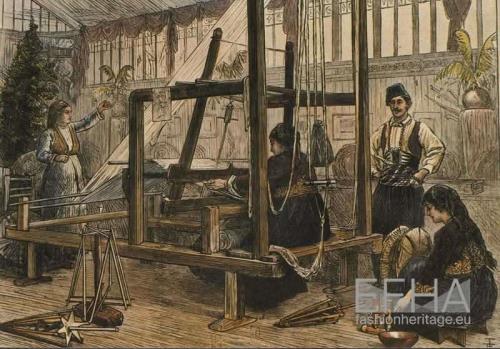

(Central Photo caption: Cypriot women weave in the loom; light from the internet.)
Sevgul Uludag
http://caramel_cy@yahoo.com
Tel: 99966518
When my grandmother Ziba from the Knodara remained orphaned, her sister “adopted” her, aunt Afet. Aunt Afet was married to someone we think was called Mustafa and at that time adopted my grandmother (his wife’s little sister) on the condition that he would give her a third of his property. Later he died and Aunt Afet married Kazim Chavush of Avdimou – a police officer serving in the Knodara. But the village of Knodara did not like Kazim Chavush at all because there was no water in this small village of Mesoria. She persuaded Divine Afet to sell all her ex -husband’s property and move to Nicosia. And they did. They sold everything and went to the famous Ermou Street, buying a house and a shop there. As aunt Afet had no children, she took care of my grandmother’s grandmother Ziba – she helped some of them educated – like my mother, helped them get married, giving almost each of them a house on Ermou Street. My mother loved her aunt Afet and took care of her in the last years of her life when they lived together. Since both Divine Afet and Kazim Chavush died long before I was born, I never met them, but their photos hang on the wall of our house and what my mother told me, they were a large part of our family history. My mother was extremely grateful to them as they had taken her to live with them so that she could continue her secondary education and become a teacher. In those years of poverty, they respected the wishes of my mother Turkan and helped her achieve her goal of further training.
Grandpa Mehmedali and Grandma Ziba.
O TAKAUTAKALAS
My grandfather Mehmedali Soyer was a stubborn man from the knodaras who sold what my grandmother Ziba had in the village and moved to Taktakala in Nicosia. They bought a house by the mosque in Taktakala and lived there in 1918.
My grandmother Ziba brought her loom from the Knodaras when she moved from the village to Nicosia and set him up to the house they bought to Taktakala. In what my mother wrote to me, she said that she didn’t like her father at all working and only liked to hunt and collect and knit baskets for cheese and making spoons of sandalwood and olive branches. She was opposed to the education of his daughter and constantly quarreling my mother and told her not to go to school but to stay home and help her mother wrap the pouches for her loom or take care of her brothers. But my mother was also a very decisive person trying to do what she wanted to do. To be able to go to elementary school, he had to work very early. He carried water in the houses from the “fountain of the bishop”, even though he was a young child.
Her older sister put jasmine on palm branches and went to sell them so she could get some money to buy a pencil or a notebook needed at elementary school. She had no shoes and her municipality gave shoes intended for poor people to wear them at school. As soon as the first rains fell, the shoe bottom was melting, as the person who made and distributed the shoes for the municipality was cheating and put a cardboard painted in black underneath them, so they melted with the first rains.
Grandmother Ziba, Kazim Chavush and Divine Afet.
Divine Peace
To survive as a family coming from a small village, with many children and a lazy wife, my grandmother was knitting baskets and continued to weave fabrics without lifting her head for many hours. In her memoirs about Taktakala, my mother writes the following about my grandmother’s textile Ziba:
“Divine Irene was our neighbor in Taktakala. Everyone was calling her “Peace Aba”. It was tall, a little hood. He was talking very well Turkish. He was coming and saying to us, “What are you doing Ziba, you weave again on the loom? You never rest? ” And my mother Ziba used to say, “What can we do Mrs Peace? I have kids, they want everything. And I want to sit down and rest, but I have to let 20 alaza fabric every day. Giannakos wants these fabrics very quickly. I let go and take some grosss for the needs of my children. “
Divine Irene had no children. He brought an apple or some oranges when he came to visit us. We had nothing to offer her. In our house they never made coffee. Divine Irene was sitting a little, talking a little and then left. It looked like the famous Turkish singer Safiye Ayla. He was old, but full of joy. Everyone loved her to our Mahala. “
Only bread and olives
My mother wrote in her memoirs as follows about their lives in Taktakala: “Meat, milk, eggs, butter, yogurt, cheese, halloumi we never had in our home. In the morning we ate bread and olives. We didn’t even make tea, no coffee. Meat, chicken or fish were never bought for the home. When we came from school at noon, we again ate olives and bread. Sometimes my mother bought an oak fresh beans and put them in the middle of the disc. We were all sitting and eating. My father bought two oaks of bread and left it home in the morning and went to the Salih uncle’s shop. At noon, he was taking a little bread, a little halva or a little bit of herring fish and ate, with fruit depending on the season. He ordered his coffee, lit his cigarette and did not think of his children’s hunger. “
The story of the Dolmades
“I was about 4-5 years old and one day I went to the house of my mother’s sister, Nazif, who was right from our house in Taktakala. They cooked dolmades and the smell was incredible. In our house these were never cooked. Our meals consisted of potato potatoes, french fries, pilaf pilaf in plain water, zucchini and soup. One at a time my mother bought pine trees and made us “cherceloths”. He made some cookies from the dough he made and roasted them in water and then threw the carob. It became a very nice sweet. We ate it with joy. Because my aunt Nazif knew about our poverty, she put 5-6 coupes on a small dish and a little bread. My father was very strict we had to be at home before the sun set. Until the coupes are cooked, it darkened. I wanted to leave, but my aunt said, “Sit down and eat your coupes, I will say it to your father so he doesn’t get angry.” I got the first coupe to eat and the door knocked. He was my father. “Is he here?” he said. My aunt said, “I put on her some couples to eat, let her eat and come home.”
“I told her to be home before the sun sets,” he said. My father didn’t hear her. He took me out of my hair and started pulling me to the door. Whatever my aunt said, he didn’t hear. He started beating me. Every time he hit me, I fell on the stones. The road would be asphalted and stones were spread on the ground. My hands and feet bleeding from falls on these stones and my eyebrow was injured. I was at home with blood everywhere. My mother took me and washed my face, changed my clothes. She was afraid to say something because she would start beating her too. We went to another room. I explained to her what happened. “Let his hands break,” he said. His hands did not break, but when he went to Avdimou, he fell from the second floor and was injured in the head. Whenever the word “coupe” is mentioned, I remember the smell of those coupes and the sign that was left on my eyebrow from that day. “
In the end, my mother was so beaten by him so much that at the age of 12 she finally left her home and went to live with Divine Afet and Kazim Chavush, without ever returning to her mother’s home again.