
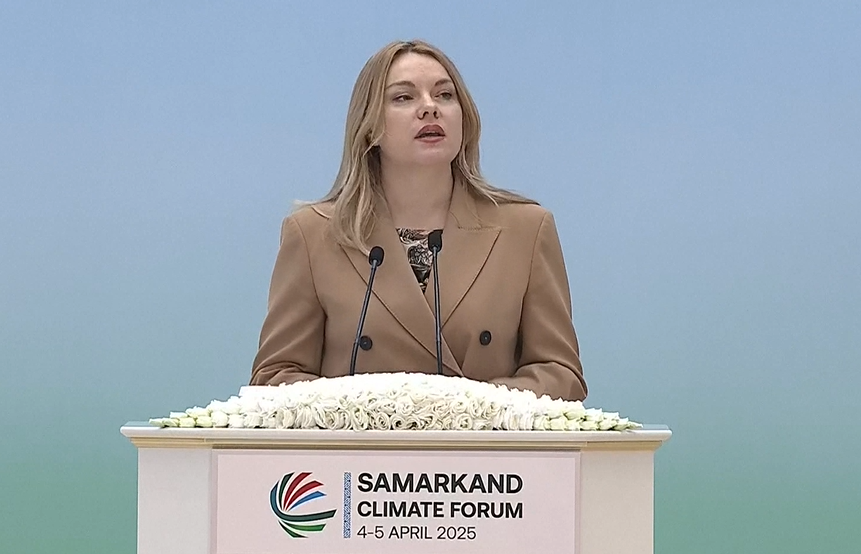

Baku, Azerbaijan, April 4. At the Samarkand
Investment Forum, Tatiana Molcean, Executive Secretary of the
United Nations Economic Commission for Europe (UNECE), emphasized
the urgency of action on climate change despite the region’s
political and economic challenges.
Speaking at the high-level gathering, Molcean outlined three key
elements for tackling climate change: political will, effective
partnerships, and scaled-up financing.
“Facing the hard realities of Central Asia—such as the disaster
of the Aral Sea and the vanishing glaciers—it is clear that
political will is present,” Molcean said. She noted the strong
commitment to climate action demonstrated by the leaders attending
the forum, convened by the President of Uzbekistan.
Molcean also highlighted the importance of Central Asia’s unique
partnership with the European Union, which she believes could be a
game changer for the region. “Your personal leadership, Madam and
Mr. President, is really crucial in this process,” she added,
addressing the leadership present at the forum.
The UNECE executive stressed the vital role of multilateral
development banks, particularly the European Bank for
Reconstruction and Development (EBRD) and the European Investment
Bank (EIB), in facilitating the green financing needed for the
region’s transition. “From the UN side, we are ready to contribute
to this collective effort,” she affirmed.
Turning to the region’s priorities, Molcean acknowledged the
importance of infrastructure development, economic growth, and job
creation. However, she emphasized that these goals must go hand in
hand with smart, economically viable climate action. “At UNECE, we
strongly believe that this is not only possible, but achievable,”
she stated.
One key area of focus is transport, a significant source of
greenhouse gas emissions. “In 2024, members of the UN, under the
UNECE convened platform, adopted the UN’s first decarbonization
strategy for inland transport,” Molcean announced. She also
highlighted the regional effort to digitize the Trans-Caspian
Corridor, positioning it as a green corridor to reduce emissions
and improve transit efficiency.
Molcean also shared promising developments in energy. A recent
UNECE report on energy systems for Central Asia found that energy
self-sufficiency could improve significantly through regional
interconnectedness, potentially saving up to 1.4 billion US dollars
annually by 2050. These savings would provide crucial support for
the region’s decarbonization efforts.
Water cooperation was another key issue addressed by Molcean.
“Transboundary cooperation is essential for effective climate
adaptation,” she stated, stressing the importance of water
management in optimizing energy use and making economies and cities
more resilient. She noted the UNECE Water Convention, which has
helped foster transboundary cooperation for over 15 years, as a key
tool in tackling these challenges.
Molcean concluded by underscoring the need for a
whole-of-society approach to climate change. “The voices of
citizens, civil society, and local communities are crucial,” she
said, pointing to the role of local governments and communities in
driving change. She also announced that Uzbekistan had recently
acceded to the Aarhus Convention, making it the fifth Central Asian
country to join this important environmental treaty.