

If the basic EU economies are hit by a reduced exports, financial instability can affect the European market as a whole, including Cyprus.
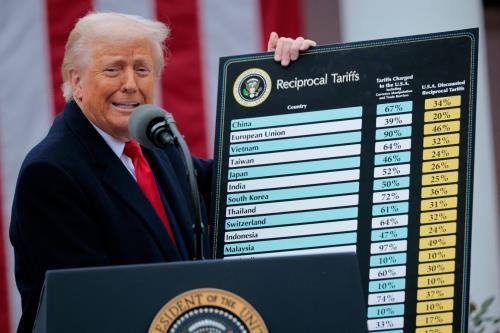
If the basic EU economies are hit by the duties announced by US President Donald Trump, due to reduced exports, financial instability may affect the European market as a whole, including Cyprus, the economist Tasos Yasmidis said in the CIP. Exogenous economy ”.
“Cyprus’s exports may be limited to the US, but alertness is needed to evaluate the external environment and ensure the import of new products, with our country being part of new agreements,” he said.
Mr Yasmidis, who expects rising prices and inflationary pressure in the US, said that “Europe, and especially its core, Germany and France, face serious financial problems with increases in production costs, export reduction and zero growth rate” and warned “
“As a member of the European Union, the Cypriot economy is closely linked to large European markets and is influenced by the decisions taken by the EU,” he noted.
He also said that negative developments in the course of the European economy would limit the disposable income of citizens who may limit travel and other habits.
Called by the CPC to comment on what the impact on the global economy may be by the imposition of customs duties by the US President, Mr Yasmidis said that “the duties announced by Mr Trump are greater extension and intensity than expected.” He added, however, that “the complete impact of Trump announcements is difficult to appreciate at this time if we have to expect to see the reactions of other countries.”
“Many leaders have referred to the need for dialogue, so there may be differences,” he said, adding that “duties are a hindrance to international trade and lead to ‘seagulling’.
He also said that the financial markets have reacted negatively, declining as investors estimate that the imposition of duties would significantly affect global trade and economic activity.
According to Mr Yasmidis, Mr Trump, with the imposition of duties, aims to force companies selling products to America to transfer their production units to the country, and not to lower jurisdictions.
In addition, he said that Mr Trump wants to boost US companies, production and employment, even providing tax reliefs, adding, however, that “especially for heavy industry products, taking into account the geographical interconnection of production, it is very difficult to replace US products”.
“So as an immediate development is expected to increase prices and inflationary pressure on America,” he said.
The economist also said that “we may be partially seeing 1930 scenarios where anti-teachings led to a restriction of US exports and a growth restriction.”
“We must not forget that the US has a negative trade balance with the EU on goods, but positive on services,” he added.
In this scenario, according to Mr. Yasmidis, the Fed should balance between inflationary pressures and the restriction of growth, affecting its monetary policy.
“However, Mr Trump is a fan of paying interest rates to reduce the cost of serving the country’s public debt, much of which is distracted by Chinese interests,” he added.
He also said that the disturbance of global trade flows due to duties could affect marine transport and demand for shipping services.
“The imposition of duties may be unprofitable to introduce some products, while on the other hand, we can see a rearrangement of international trade, with new transnational agreements and partnerships, as we have seen with the start of the war in Ukraine and Russia economically moving to the East,” he added.
Finally, Mr Yasmidis told the CPC that it should be clarified “if the comparative table on which the decisions on duties were based only relate to duties or VAT (different mechanism), if many times the US VAT president has been mentioned”.
Source: KYPE