
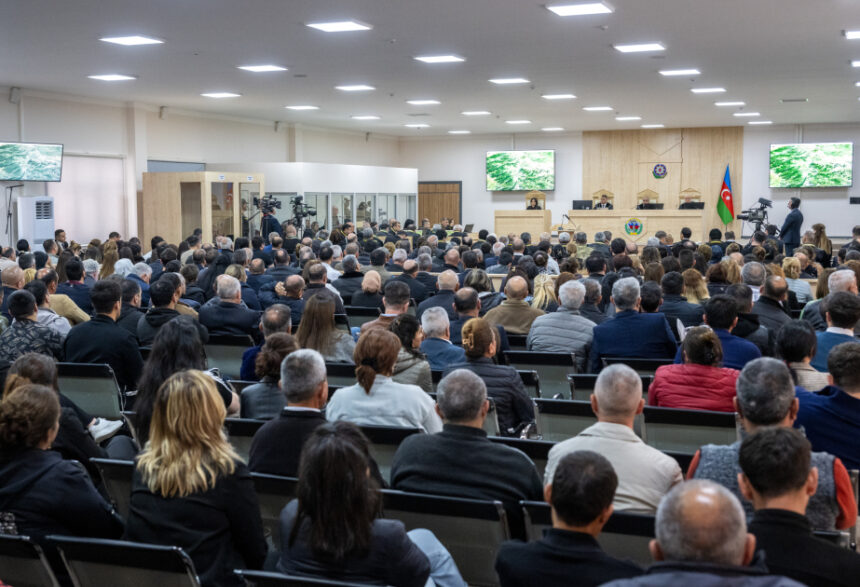
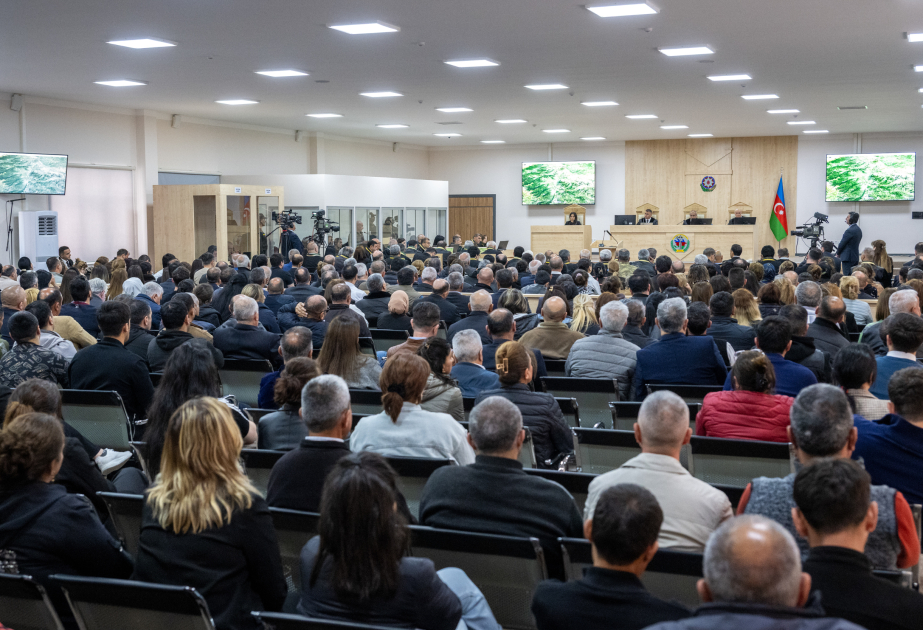
Baku, Azerbaijan, April 21. Court hearings on
the criminal case against citizens of the Republic of Armenia
Arayik Harutyunyan, Arkadi Ghukasyan, Bako Sahakyan, Davit
Ishkhanyan, Davit Babayan, Lyova Mnatsakanyan and others, who are
accused of committing crimes against peace and humanity, war
crimes, including the preparation and conduct of a war of
aggression, acts of genocide, violation of the laws and customs of
warfare, as well as terrorism, financing of terrorism, forcible
seizure of power, forcible retention of power and numerous other
crimes as a result of Armenia’s military aggression, continued on
April 21, Trend
reports.
The hearings held at the Baku Military Court were presided over
by Judge Zeynal Aghayev and a panel consisting of Jamal Ramazanov
and Anar Rzayev (reserve judge Gunel Samadova). Each of the accused
was provided with an interpreter into the language of their choice,
as well as defense attorneys.
Present at the hearings were the accused and their defense
attorneys, some of the victims, their legal successors and
representatives, as well as prosecutors in charge of public
prosecution.
Judge Zeynal Aghayev explained the rights and obligations
stipulated by the legislation to those of the victims who were
participating in the hearings for the first time.
During the hearings, the accused answered questions from
prosecutors in charge of public prosecution in relation to the
Khojaly genocide committed in the early hours of February 26, 1992
and deliberate extermination of innocent people for the sole reason
that they were Azerbaijanis.
In response to questions from Senior Assistant to the Prosecutor
General, Vusal Aliyev, the accused Arkady Ghukasyan said that he
had first learned about the events in Khojaly through “official
reports” in February 1992. He said, “We did not know the scale of
the tragedy at that time. We knew that hundreds of Azerbaijanis had
come to Khankendi from Khojaly. And they were later handed over to
the other side”. He emphasized that he condemned the killing of
civilians and noted: “This is unacceptable, one of the bloodiest
pages of the war.”
Arkady Ghukasyan said that during the Khojaly genocide, the
self-styled republic was led by Artur Mkrtchyan, while the military
was led by Arkady Ter-Tadevosyan. He was nicknamed “Commando” and
held various leadership positions in the Armenian armed forces. He
added that the head of the newly formed “self-defense forces” was
Serzh Sargsyan at the time. He further said, “I am against all
wars. But if this happens, the laws of war must be observed”.
While answering the questions of Head of the Department of
Public Prosecution of the Prosecutor General’s Office Nasir
Bayramov, the accused Bako Sahakyan claimed that he did not have
detailed information about the Khojaly events. Referring to the
video materials and documents shown in court, he said, “I did not
know all these details. But this does not change my position. I
condemn such events both then and now”.
The accused said that he had heard about the participation of
the 366th Motorized Rifle Regiment of the former Soviet Army in the
Khojaly genocide and that Seyran Ohanyan, who later became the
Armenian minister of defense, served in that regiment.
In response to questions from public prosecutor Vusal
Abdullayev, the accused David Ishkhaynan said that the images of
the Khojaly genocide were evidence of barbarism. He said that he
was a “member of parliament” of the so-called republic at the time
of the events.
In response to questions from public prosecutor Fuad Musayev,
the accused David Babayan said that he was not involved in the
Khojaly genocide and the occupation of Khojaly. He said that during
the Khojaly events, those who wanted to resolve the issue by force
achieved their goals. “Various groups participated in this
operation,” he said.
David Babayan also said that there was even a medal “For the
Liberation of Khojaly” “established” in the so-called republic. He
could not answer the question from a representative of the victims,
“If, as Armenia claims, there was a corridor for civilians to leave
during the Khojaly genocide, why were they not allowed to leave,
and as Arkady Guksayan said in court, hundreds of Azerbaijanis were
taken to Khankendi?” In response, he said, “How can one justify
what was done to children and civilians? This is barbarism”.
In response to questions from public prosecutor Tarana
Mammadova, the accused Arayik Harutyunyan said that he considered
the Khojaly events the greatest tragedy of the First Karabakh War.
He claimed that there were no discussions about the Khojaly
operation in the so-called republic. He said, “For example, several
books have been written about the Shusha operation. Therefore, we
know who participated in it and how it happened. There were no
discussions about the Khojaly operation. The key military leader at
the time was Arkady Ter-Tadevosyan. The military operations in
Khojaly were probably conducted on his instructions and
consent.”
Arayik Harutyunyan said that in any case, it was an unforgivable
tragedy.
Then the court examined a report of the “Memorial” Human Rights
Center on the mass violations of human rights committed during the
occupation of the Khojaly settlement on February 25-26, 1992.
The organization’s report states that during the operation that
resulted in the occupation of Khojaly by Armenian troops, mass
killings of the population and violations of human rights on ethnic
grounds were widespread.
“After the occupation of Khojaly by Armenian troops, the
civilian population remaining there was deported. These actions
were carried out in an organized manner,” the document states.
According to the document, the majority of the deported
population was kept in Khankendi, which is a clear indication that
the so-called republic’s “authorities” had an order to this
effect.
The mass killing of civilians cannot be justified under any
circumstances.
The “Memorial” Human Rights Center confirms that Armenia’s
actions against the civilian population in Karabakh during the
attack on Khojaly represent a flagrant violation of Geneva
Conventions, as well as relevant articles of the Universal
Declaration of Human Rights.
The next hearing is scheduled for April 24.
We recall that a total of 15 Armenian nationals are being
charged with numerous crimes involving direct leadership and
participation of the Armenian state, its state bodies, military
forces and illegal armed formations, verbal and written
instructions, orders and assignments, provision of material and
technical support, central governance, as well as the exercise of
rigorous control, with the aim of committing military aggression
and acts of terror against the Republic of Azerbaijan in the
territory of Azerbaijan in violation of domestic and international
law, and involving Robert Sedraki Kocharyan, Serzh Azati Sargsyan,
Vazgen Mikaeli Manukyan, Vazgen Zaveni Sargsyan, Samvel Andraniki
Babayan, Vitali Mikaeli Balasanyan, Zori Hayki Balayan, Seyran
Mushegi Ohanyan, Arshavir Surenovich Garamyan, Monte Charles
Melkonyan and others, including criminal acts committed during the
course of the war of aggression waged by the aforementioned
criminal group.
The said persons, i.e. Arayik Vladimiri Harutyunyan, Arkadi
Arshaviri Ghukasyan, Bako Sahaki Sahakyan, Davit Rubeni Ishkhanyan,
David Azatini Manukyan, Davit Klimi Babayan, Levon Henrikovich
Mnatsakanyan, Vasili Ivani Beglaryan, Erik Roberti Ghazaryan, Davit
Nelsoni Allahverdiyan, Gurgen Homeri Stepanyan, Levon Romiki
Balayan, Madat Arakelovich Babayan, Garik Grigori Martirosyan,
Melikset Vladimiri Pashayan, are being charged under Articles 100
(planning, preparing, initiating and waging a war of aggression),
102 (attacking persons or organizations enjoying international
protection), 103 (genocide), 105 (extermination of the population),
106 (enslaving), 107 (deportation or forced displacement of the
population), 109 (persecution), 110 (enforced disappearance of
people), 112 (deprivation of liberty contrary to international
law), 113 (torture), 114 (mercenary service), 115 (violation of the
laws and customs of warfare), 116 (violation of international
humanitarian law during armed conflict), 118 (military robbery),
120 (intentional murder), 192 (illegal entrepreneurship), 214
(terrorism), 214-1 (financing terrorism), 218 (creation of a
criminal association (organization)), 228 (illegal acquisition,
transfer, sale, storage, transportation and possession of weapons,
their components, ammunition, explosives and devices), 270-1 (acts
threatening aviation security), 277 (assassination of a state
official or public figure), 278 (forcible seizure and retention of
power, forcible change of the constitutional structure of the
state), 279 (creation of armed formations and groups not provided
for by law) and other articles of the Criminal Code of the Republic
of Azerbaijan.