
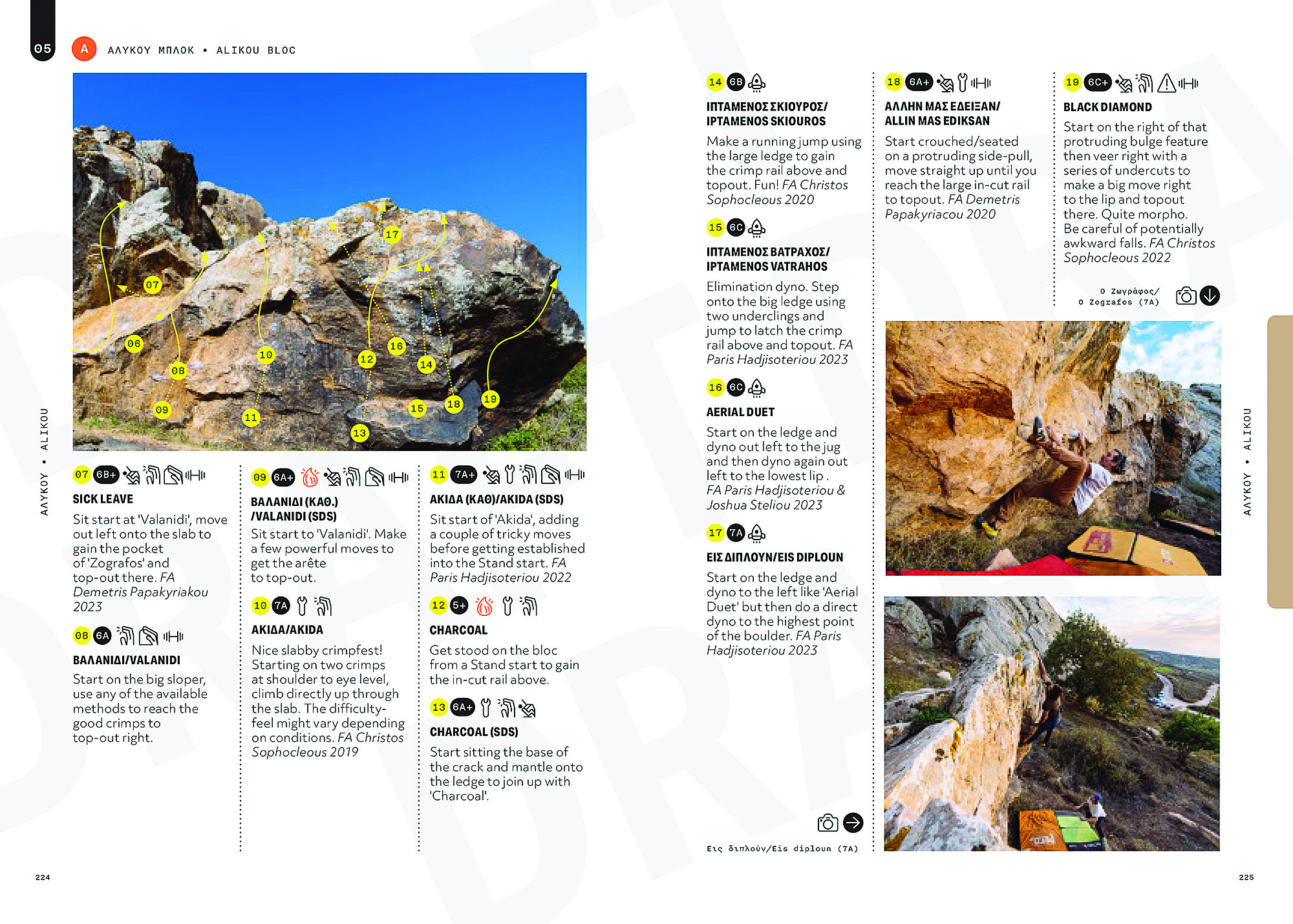
Mapping rock routes: The first bouldering guide in Cyprus
With almost 700 recorded bouldering routes, Cyprus is starting to shape its own identity on the global climbing map. Behind this development is an ambitious and long-term project: the creation of the first comprehensive bouldering guide for the island.
What is bouldering?
Bouldering is a form of climbing that is practiced either on natural rocks of small height, usually 3 to 5 meters, or on artificial climbing walls of the same size. Unlike rope climbing, the emphasis here is on the maximum difficulty one can perform in a short time rather than endurance.
The nature of bouldering is reminiscent of sprint running: these are short, demanding routes that test the climber’s strength and technique. In contrast, other forms of climbing, such as sport or traditional climbing, which are done at higher altitudes, require mainly endurance, such as longer distances in running. Many climbers dabble in more than one genre, however many choose to focus on bouldering because of the simplicity and direct access it offers.
Equipment is limited and relatively simple. No ropes or other safety equipment found in other forms of climbing are used. Special climbing shoes, safety mattresses to absorb falls and magnesium for better grip are essential.
The guide project started in 2019, with the aim of collecting, organizing and systematically capturing the routes, areas and necessary information for the climber. As its creator, Dimitris Papakyriakou, explains, the guide is not just a record, but an exploration tool.
“The aim is to enable anyone to move independently on the rock and experience bouldering in Cyprus with safety and completeness”.
The personal path
Dimitris is a programmer and from a young age he was involved in sports. His first contact with climbing was in England, through an organized university excursion. What won him over from the start was not just the activity itself, but also the contact with nature, as well as the strong sense of community that comes with it.
He then began to train systematically in indoor climbing spaces, while a trip to Spain, in an area with canyons ideal for climbing, proved decisive. There, as he says, he “fell in love” with the experience: the daily contact with nature, the challenge of the route, the strengthening process and the variety the sport offers. At the same time, he was fascinated by the fact that climbing takes you to new places.
He started with rope climbing, but gradually turned more towards bouldering. At one point in his life in England he lived for a while in a van, working remotely and climbing in nature every day.
The geology of the routes
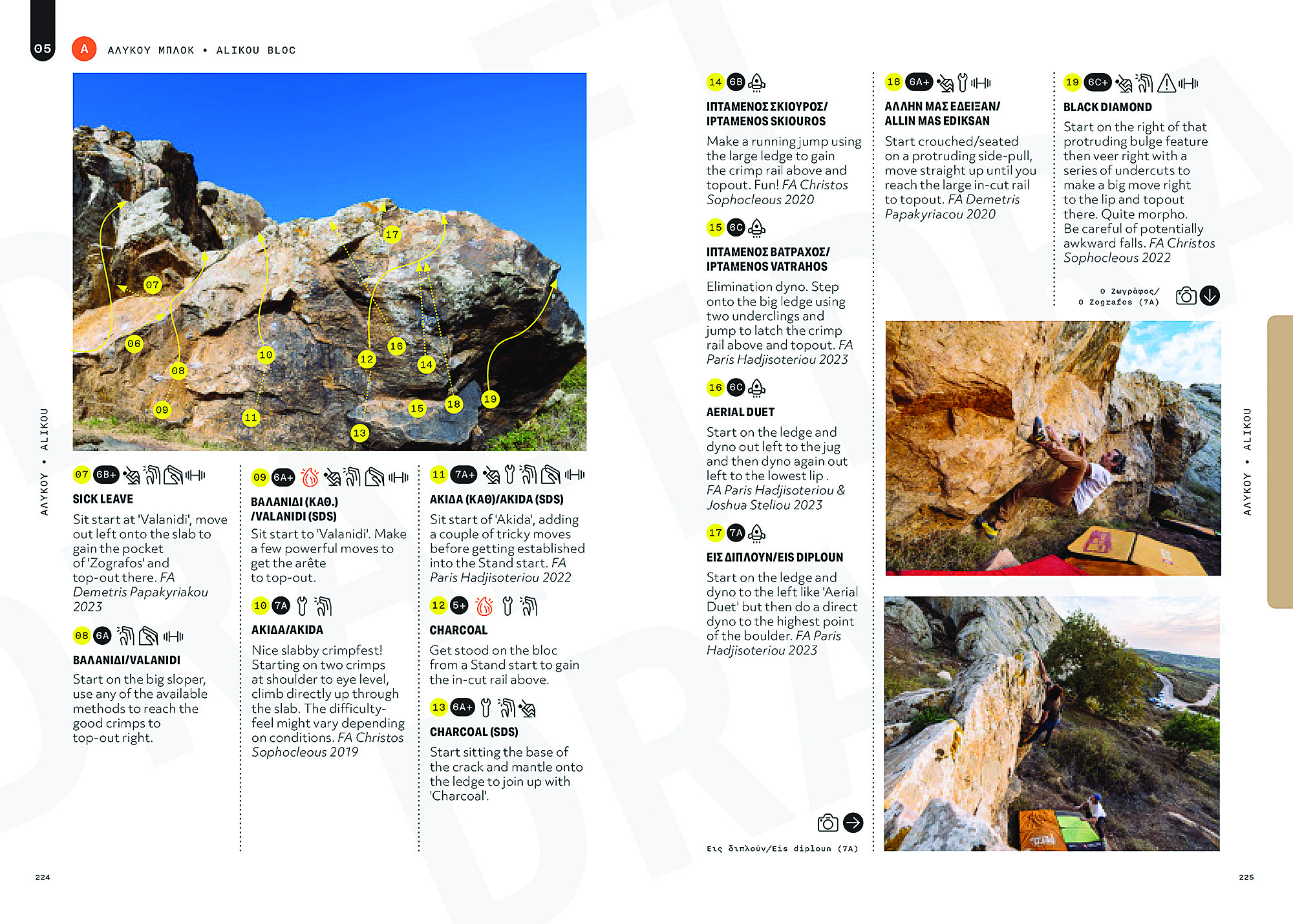
In Cyprus, the main areas for bouldering are in Pafos province, mainly around Inia, Druseia and Akamas. There is the largest concentration of suitable rocks. The main rocks are limestone and sandstone. Limestone is characterized by sharper and sharper handles, while sandstone has more rounded surfaces and high friction. Especially the compressed sandstone rocks in the Akama area are considered ideal for the dynamic nature of the sport.
To date, approximately 700 bouldering routes have been recorded on the island, with the prospect of exceeding 2,000 in the future. Of these, around 200 are suitable for beginners and another 300 for intermediate climbers, showing that there are plenty of options for those looking to get started.
As he points out, one of the advantages of Cyprus is that it offers easy access to such experiences, due to the short distances and favorable weather conditions. The best seasons for bouldering in Cyprus are autumn, winter and spring. Spring is considered the most pleasant season, while the months from January to March offer the best conditions for high performance due to low temperature and better friction. In summer, the activity is mainly limited to early morning or late afternoon, while more attention is needed due to heat and the possible presence of snakes.
A route that stood out, or “boulder problem”, is Pachamama in Druseia, a relatively high line/route with special meaning for him, in terms of the experience he had to climb it. As he describes, he first descended from the summit with a rope to clear it of moss and other obstacles. He then began to approach her from the ground, climbing up without a rope. The moment he managed to complete the route was accompanied by a strong mix of emotions and a sense of disbelief that he had made it. Each route is treated like a puzzle that the climber is asked to solve, finding the right way to move.
The easiest routes are usually in accessible spots near roads. However, there are more secluded options, in rivers or deep in the forest, where the quality can vary. The process of finding and developing a route requires patience: tracing, refining and lots of testing, with failure being an integral part of the experience.
International interest and community
The mild climate of Cyprus allows climbing on natural rock even in winter, when in many European countries this is not possible. This attracts climbers from abroad, especially from northern European countries, who visit the island for bouldering.
The bouldering community in Cyprus is growing steadily. In addition to the gyms in Nicosia, Limassol and Paphos, there are informal groups on Social Media that organize excursions and activities for the development of new routes. In terms of events, an annual spring bouldering festival has been held in recent years with competitions and seminars, while the Cyprus Rock Climbing Festival in October also includes related activities. At the same time, competitions are also organized indoors, with the participation of bodies such as the Cyprus Climbing Federation.
The interest in bouldering shows a significant increase in recent years. From a few climbers who were active in the past, today there are dozens who climb the rock on a regular basis, while participation in festivals and events exceeds 100 people. At the same time, interest from foreign visitors is increasing, many of whom return after their first experience.
Despite the development, there is still a demand for better organization of the sport. There is community mobility and initiatives to develop new routes and continue activities, but if examples are taken from countries with a strong climbing tradition such as England, the United States and France, it appears that the effective organization of the sport is linked to the existence of a strong and functioning central body. Such an organization could contribute substantially to the systematic development and protection of climbing in Cyprus.
Paper or digital guide?
Dimitris would like the guide to be available in digital format as well. At the moment, the routes are uploaded to an international climbing and bouldering platform, while in the future another platform hosting digital guides is being considered. Even creating a custom app is not out of the question, as there are several ways to implement this.
However, the choice of print was made consciously. As he points out, there is a clear preference in the climbing community for printed guides, as they offer a different experience: they allow you to see the photos on a larger scale and flip through them, which is not easily replaced by a mobile screen.
The guide is expected to be released around the end of April and will be available from the boulderingcyprus.com website as well as some gyms, climbing shops and bookshops.