
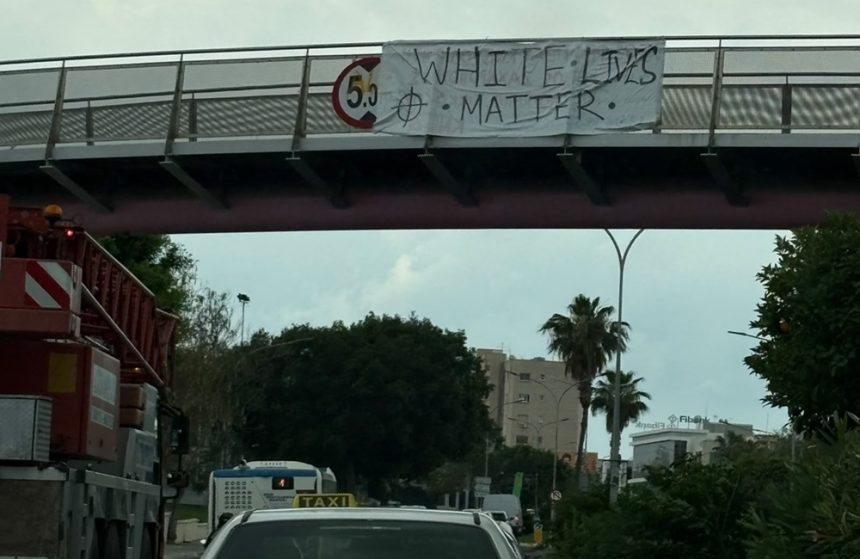
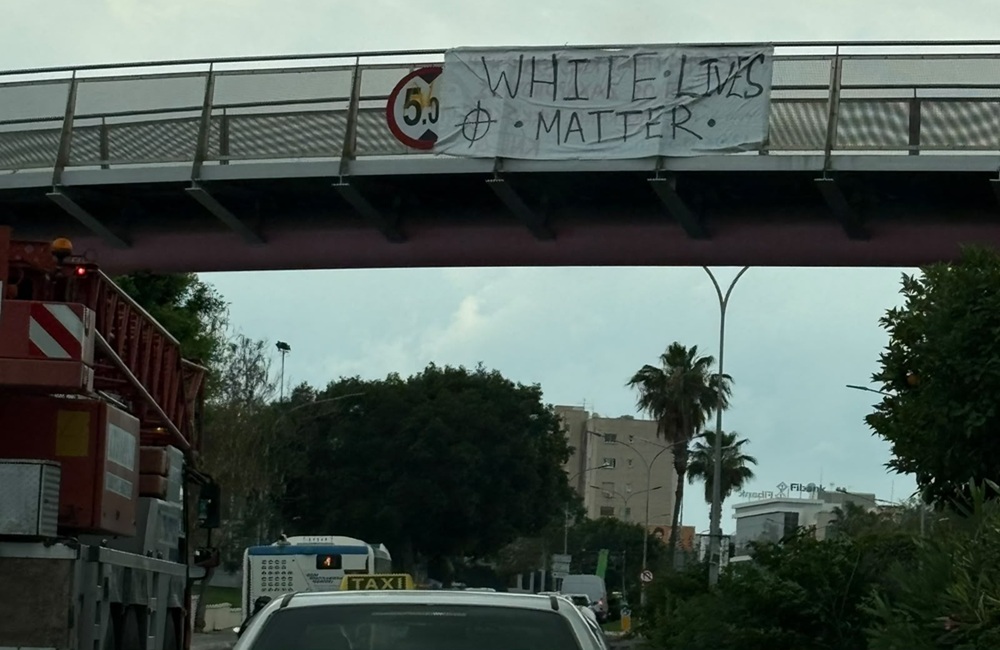
A few weeks ago, on a bridge in Nicosia, a banner appeared with the slogan “White Lives Matter” and next to it a cross in a circle. This symbol, known as the Celtic Cross or Sun Cross, is one of the most widespread symbols of modern neo-Nazism worldwide, precisely because it retains enough ambiguity to avoid direct legal charges. It is, however, recognizable enough within the Movements to function as a badge of identity. The slogan next to it belongs to a widespread far-right tactic of inverting the discourse of anti-racist movements, in order to construct a narrative of victimization of the dominant group. The question is how these symbols got here and what conditions normalize them.
Dr. Giorgos Venizelos, assistant professor at the Department of Communication and Marketing of the Cyprus University of Technology, speaking to “P” makes an observation: “The Far Right in Cyprus did not emerge as a reaction to a vacuum left by the Center Right. It was asserted before that, shaping the very terms within which the Center Right is now forced to operate. How this happened has to do with a combination of local convention and international infrastructure.”
The local condition includes what Mr. Venizelos describes as “pervasive racism,” a pre-existing social reality where suspicion of the Other, whether immigrant or foreigner, has been tolerated and largely pervasive. Racism thus created a breeding ground. In this way and with the effect of globalization and the internet, racism acquired a language, symbols and a network.
Easy radicalization
The international infrastructure is the key to understanding the transport mechanism. The ideology of the Great Replacement, the theory that white Europeans are systematically replaced through immigration with the tolerance or even encouragement of political elites, reaches Cyprus through algorithms, as explained by Dr. Venizelos. It reaches through closed groups on platforms where radicalization does not require physical contact with an organization or a leading figure. A person in Nicosia or Limassol can be ideologically integrated into a global White Supremacy Movement without ever meeting any of their ambassadors.
This condition is fueled by an ideological mechanism that the Far Right has developed with great communicative complexity and that the research of the last decades has begun to systematically deconstruct. At its core is what sociologist Michael Kimmel, at Angry White Men (2013), called “aggrieved entitlement”, the collapse of the sense of entitlement with the sense of injustice. It is a specific psychosocial condition in which individuals, mainly young men, perceive that advantages to which they considered themselves entitled have been taken away from them, and attribute this loss not to structural economic changes but to specific groups, such as immigrants, minorities, feminists and the economic “elite”. The result is an anger that constantly seeks scapegoating victims.
The displacement
Dr. Venizelos identifies as a structural characteristic of the contemporary Far Right the transfer of the rhetoric of the victim from the historically oppressed groups to the dominant group itself. Political scientist Cas Mudde, one of the world’s most recognized scholars of the Far Right, has described this strategy as defining the “fourth wave” of the post-war Far Right. Since the 1970s, as documented in research published in Political Communication (2024), these rhetorical points, namely that whites are persecuted by affirmative action policies, that they are not allowed to express pride in their identity, that something has been taken away from them, have diffused from the far-right fringes into mainstream political discourse. This communication structure also has a systemic dimension that dr. Venizelos points out with concern, since the very communication tactics of the Far Right lead to normalization and ultimately to violence.
The role of the Left
Herein lies one of the most complex problems. The Left has not developed the ability to produce an effective counterargument. This is a deeper weakness in the field that the Far Right has conquered, identity, community, sense of belonging. And the answer to this cannot be only legislative or institutional. It must be cultural, social, educational, and requires, as he puts it, the normalization of a specific, i.e. open, society as a counterweight. The Left has not found an equivalent vehicle for the digital age. Social media algorithms favor emotionally charged, polarizing content. The Far Right naturally works in this environment. Anger, resentment and a sense of danger spread rapidly.
Musk’s Twitter
The antithesis of tolerance, complexity and solidarity does not spread at the same speed. An example is that of Twitter, the platform bought by Elon Musk in October 2022 and renamed “X”. Musk’s first decisions were to scrap disinformation policies around the pandemic, buy verification for a fee instead of a rating, and, most notably, a blanket amnesty that reinstated thousands of accounts banned for rule violations, including nationalists, neo-Nazis and conspiracy theorists. According to independent researchers who monitored the restorations, among the accounts restored were leading figures of American white nationalism and participants in the Unite the Right rally in Charlottesville, one of the most violent far-right gatherings in the US in decades.
The spread of racism
Research by the University of California, Berkeley, published in the scientific journal PLOS One in February 2025, examined 4.7 million English-language posts from the beginning of 2022 to June 2023. The weekly rate of hate speech increased by about 50% compared to the months before the takeover, with increases in racist, homophobic and transphobic content, and the number of “likes” on hateful posts increased by 70%, suggesting that such content was widely circulated.
Other research by the Harvard Kennedy School found that engagement with accounts active in far-right networks increased disproportionately to the overall increase in platform usage, indicating algorithmic amplification of far-right content. “X” subsequently blocked academic researchers’ access to its API, making it impossible to pursue corresponding independent research.
The consequences
The consequences for youth are particularly worrying. International opinion polls show that a significant majority of young people are exposed to hateful content on social networks, and data suggests that this exposure has measurable effects on relationships and the socialization process. What has structurally changed is the normalization of exposure to racist symbols and hate speech. As it circulates in the same environment as news, entertainment and social communication, it ceases to be treated as something unusual and begins to appear on banners and slogans in the most “remote” parts of the world, with Cyprus not being an exception but a place that confirms the rule.