
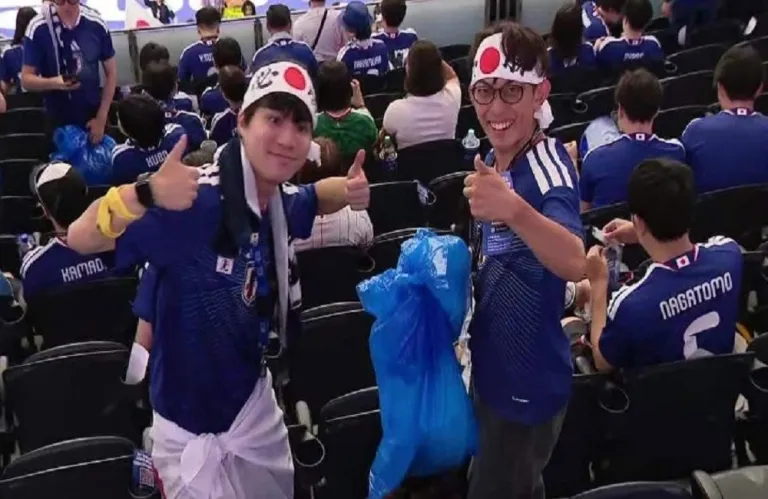
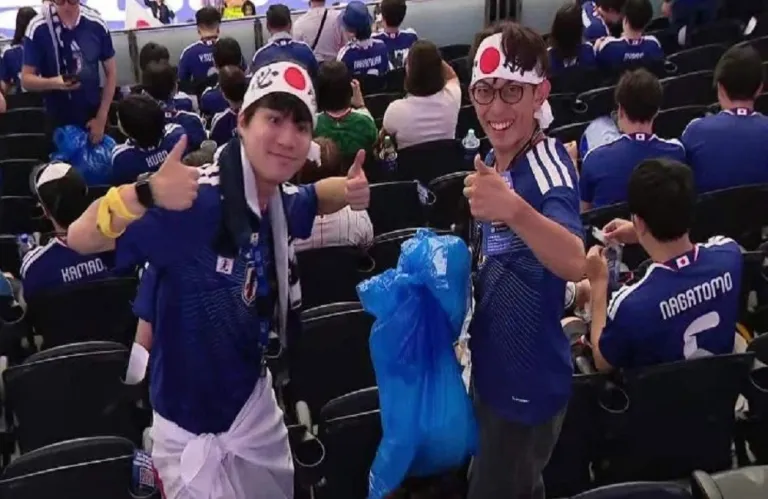
True to tradition, Japanese fans left the stands in Dallas spotless yesterday (14/6) after their national team’s World Cup opener against the Netherlands, explaining that cleaning was part of Japanese “culture”.
Dressed in Blue Samurai jerseys, the Japanese fans were left after the 2-2 draw to meticulously pick up all the rubbish from the stands and pile it into blue plastic rubbish bags.
“They taught us that when we use a space, we have to leave it cleaner than we found it,” explained Eita Tanaka, a beer and some glasses in hand, wearing his team’s blue jersey.
“For example, at school, we clean our classrooms by ourselves without having to be told by our teacher,” added 20-year-old Tanaka. The cleanliness of the Japanese fans, whose team is participating in the eighth World Cup, has become their trademark internationally.
“It’s our culture. Everywhere we go, we have to clean up. It’s our spiritual practice, our attitude,” says Futo Hagiwara, proud of this collective behavior.
And this is becoming more and more popular. New York Giants quarterback Jameis Winston was seen engaging with Japanese fans after Sunday’s game, wearing a blue Japan jersey with his name on the back.
Sociologist and philosopher, Masachi Osawa, believes that a combination of a sense of social responsibility and “peer pressure” underlies fan behavior.
“Japanese people tend to be less interested in large-scale justice and issues such as global inequality, conflict or the climate crisis. But they are extremely sensitive to small-scale moral considerations,” he explains, adding: “When interacting with people in the same space or with whom they have direct personal contact, they feel a strong desire not to cause them any trouble or make them feel uncomfortable.”
Housework is part of Japanese education from a very young age, and children can be seen scrubbing school floors and tables every day. Public dustbins are rare in the country, so people have to take their rubbish home. Disposing of household waste in public places in Japan is, in fact, quite a challenge.
Scott North, Emeritus Professor of Sociology at Osaka University, suggests that these fan groups are organized with leaders and followers.
“As long as everyone gets together, they are expected to act as a group,” explains the American scientist, who has lived in Japan for about forty years, explaining: “And when the leaders pull out the bags and say, ‘Let’s go,’ no one is going to say no.” In Japan, once someone starts picking up trash, those around them feel they simply have no choice but to follow suit. In this case, the main motivation is not so much the desire to keep the stadium clean or to avoid creating work for those who have to clean it up afterwards. It’s more a desire not to be seen as a nuisance within one’s group.”
APE – BEE