
The lifeguard Chrysis Nikolaou expressed his strong concern about the ongoing understaffing of the lifeguard services and the effects this has on the safety of bathers, speaking on the radio of Politis 107.6 and 97.6 and on the show “Deuteri Matia”.
As he mentioned, most lifeguard coverage in Cyprus is based on hourly staff with fixed-term contracts. “80% of lifeguard coverage is done on four, six and eight month contracts,” he noted, explaining that this regime does not allow workers to plan their future and is one of the main reasons many leave the profession.
Unguarded beaches due to the strike
Referring to the strike mobilization of hourly workers, Mr. Nikolaou admitted that many beaches remained without lifeguard coverage.
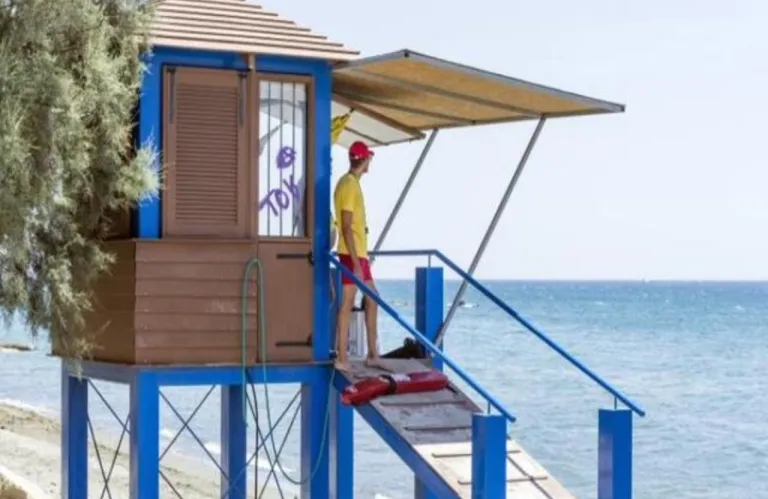
“Most were unguarded,” he said, adding that the empty towers recorded on various beaches were a result of the participation of lifeguards in the strike.
Serious problem in Larnaca
According to him, the situation differs from province to province, however in Larnaca the problem is particularly acute.
As he explained, in the period 2018-2021 the needs were almost completely covered, but in recent years a significant reduction in staff has been observed. On the contrary, in the province of Famagusta the staffing is at better levels.
Limited hours due to lack of staff
Mr. Nikolaou mentioned that during June the lifeguards work from 9:30 in the morning until 5:00 in the afternoon, pointing out that this schedule does not meet the real needs of the beaches.
As he said, due to understaffing, an effective shift system cannot be implemented, with the result that coverage ends at times when there is still a large number of bathers on the beaches.
For the summer months, he added, the most likely solution is overtime work, stressing, however, that this is a temporary measure that does not solve the problem at its root.
Infrastructure improvements, but slow pace
Despite his criticism of staffing issues, the lifeguard acknowledged that steps have been taken in recent years to improve working conditions.
As he mentioned, new lifeguard towers have been built throughout Cyprus, while the available equipment has also been strengthened. However, he underlined that there are still significant needs and that the equipment and means of rescue must be continuously upgraded.
Dangers of monostaffing
He made special reference to the phenomenon of single manning of lifeguard towers, which he described as dangerous.
As he explained, in the event of a rescue incident, the presence of at least three people is required, both for the safety of the bather and for the protection of the lifeguard himself.
According to him, this practice is applied in some cases in order to maintain the conditions for awarding beaches with the Blue Flag, but without ensuring sufficient operational coverage.
“The world wants stability”
Having completed eight years in the profession, Mr. Nikolaou estimated that lifeguarding is no longer an attractive career choice for many young people. He leaves the profession in eight days and remembers his participation in the salvage operation of a fishing boat.
“People want professional and financial stability,” he said, noting that contracts of a few months offer no prospect of long-term employment.
In closing, he called on both the State and citizens to pay more attention to the issue of beach safety, pointing out that recent tragic drowning incidents remind us of the importance of adequate lifeguard coverage during the summer season.
Listen to the entire intervention of Chrysis Nikolaou in “Second Eye”: