
On the road to Ankara’s airport, municipal workers work tirelessly under the sun planting flowers and covering with giant signs any sight that might cause embarrassment, such as dilapidated houses or slum neighborhoods.
These beautification works are being done so that the Turkish capital will make a good impression on the heads of state and the delegations of 32 countries – among them the American President Donald Trump – who are waiting in Ankara from Tuesday for the NATO summit, the opposition and the residents of the city complain.
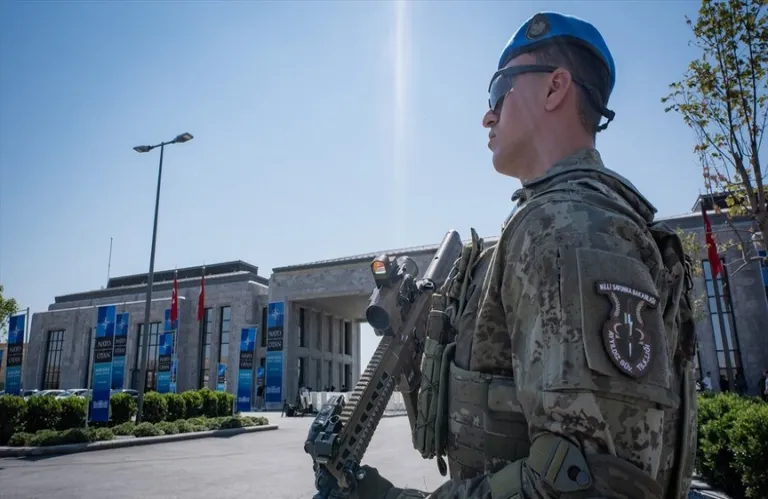
Due to the strict security measures that will be in place, many major roads will remain closed during the two days of the session, forcing Ankara residents to limit their movements and some traders to temporarily close their shops.
Furthermore, from June 28 until the end of the session, on July 8, any gathering or demonstration in the Turkish capital is prohibited.
“Ankara has essentially turned into an open prison (…). The entire capital has been paralyzed in order to facilitate the passage of some official motorcades,” protested the co-chairman of the opposition pro-Kurdish People’s Equality and Democracy (DEM) party Tuncer Bakirhan.
“They’re even saying they’re going to close parks so a president can jog there! Residents are treated as unwelcome in their own city,” he added, referring to rumors – which have since been denied – of some Ankara parks being closed in order for French President Emmanuel Macron to take his morning jog.
Closed shops
According to the Turkish press, the preparations for the NATO summit, including the renovation of a military airport and the construction of new roads, cost more than 11 billion Turkish liras (over 205 million euros).
The authorities present these projects as investments aimed at modernizing the capital’s infrastructure.
“It is our money that is being wasted. They don’t spend it on us or the poor neighborhoods behind these signs, but on the presidents of other countries,” protested Umit Erkan, manager of a grocery store whose entrance is blocked by signs advertising the summit and Ankara’s tourist attractions.
“We, the traders, are in a very difficult situation. Customers can no longer come. We are forced to close for a week,” he added. “I have seven employees, insurance and rent to pay, but no compensation for lost income.”
Delights in taxis
The Turkish Taxi Drivers Federation, on the other hand, seized the opportunity: it required drivers to wear gray pants and a white shirt and designed a campaign to charm visitors.
“We will offer our customers water, Turkish delight and cologne to show Turkish hospitality,” announced Federation President Mehmet Giginer.
In addition, for the first time, mounted police officers will patrol in Ankara, while potholes on the streets were closed, the sidewalks were painted and manhole covers were adjusted to the same height as the asphalt.
All these preparations have provided plenty of material for social media users: “Now if you make an effort for your guests, they’ll say you’re hosting NATO,” wrote one. Another suggested beauty salons offer “NATO treatments” to their clients.
“All these efforts are good, but I would like them to be for us and not for NATO,” commented Cem Ezbek, manager of a pastry shop located near a boulevard that will be closed during the summit. “Road closures are known in advance, but alternative routes are not clear. Our customers, employees and suppliers will find it difficult to come here. Small businesses will suffer a lot,” he said worriedly.
Many residents preferred to leave the Turkish capital: trains and buses departing from Ankara are full as the summit approaches.
“I don’t plan to stay in the city. Many places will be closed, transportation will be difficult,” said Demir Balemir.
“All this nonsense is not for us,” complained Sima, a student, echoing a joke circulating on social media: “If Macron could use public transport, maybe we’d finally have air conditioning on the buses!”
Source: RES-MPE